
Russia's Communists in rare Moscow anti-government demonstration, chant Navalny's "crooks and thieves" slogan


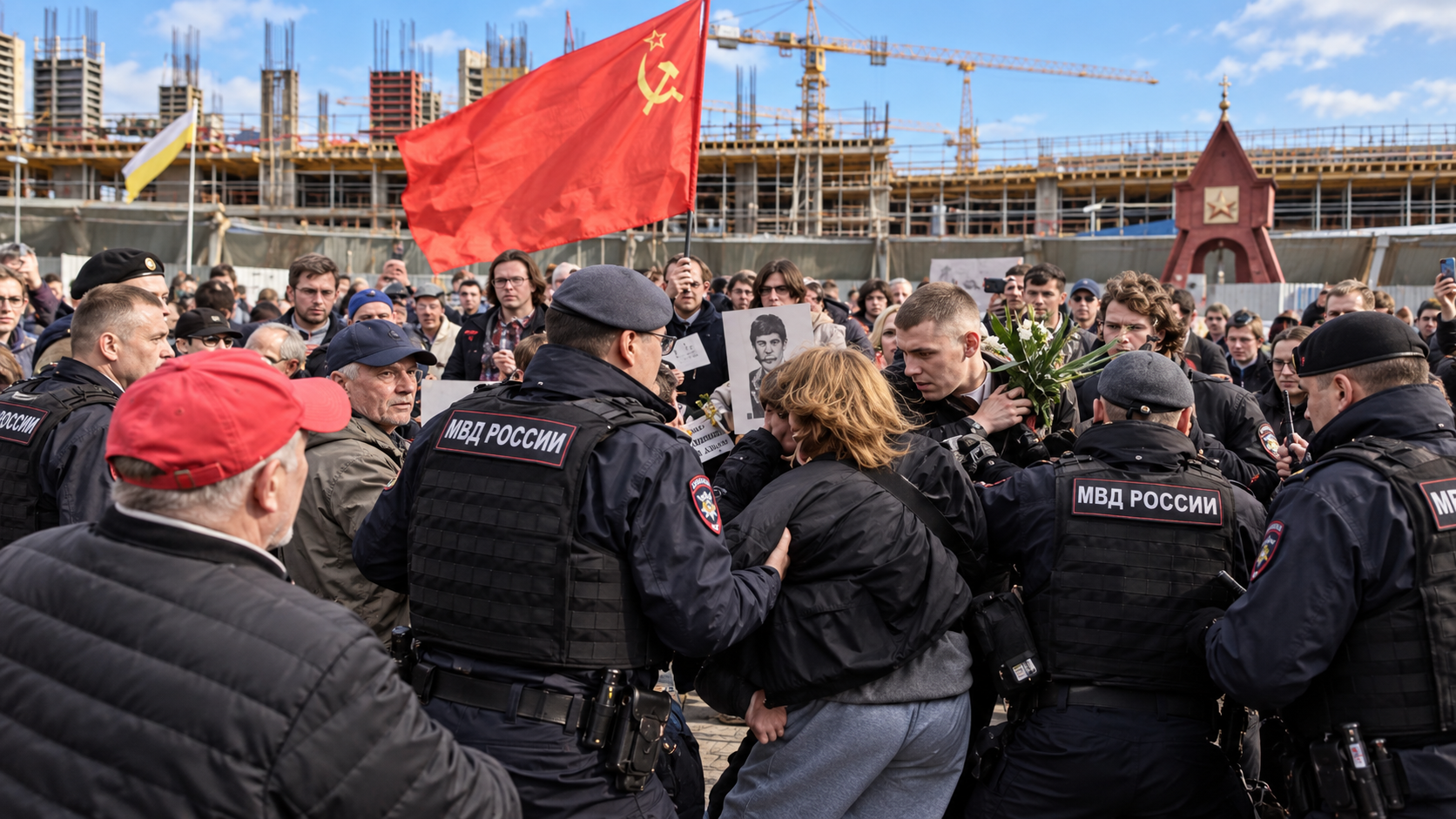
Moscow police detained about 60 people at an authorised Communist Party (KPRF) rally on October 4 where they chanted "Down with the Tsar!" and "Down with the party of crooks and thieves", a slogan coined by the late opposition leader Alexei Navalny in protest of latest blatant fixed Duma elections last month against the ruling United Russia party.
Around 2,000 people gathered at a monument near Krestyanskaya Zastava metro station to mark the anniversary of the October 1993 storming of the parliament building. Demonstrators also chanted "We want fair elections!", "Freedom for political prisoners!", "No to political repression" and "Down with Roskomnadzor", the internet regulator, according to rights group OVD-Info.
Riot police moved in as the rally was ending and the slogans turned on United Russia. Independent election monitor OVD-Info, declared a “foreign agent”, said 26 of those detained were Communist Party members, 30 belonged to the liberal Yabloko party that was banned from the poll, the only party to run on an anti-war platform, and the rest were other activists. Witnesses saw a man being kicked on the ground and a woman dragged by her hair, Belsat reported. The detainees were taken to the Krasnopresnensky police station.
The protest comes following the elections where the ruling United Russia party won twenty points more in the race than even the state-controlled pollsters were predicting in one of the most egrevious “victories” of the last three rounds of Duma elections.
The protest was made doublely poignant as it commemorated the October 1993 showdown at the Duma building when then president Boris Yeltsin clashed with communist-led deputies lead by Alexander Rustskoi and Ruslan Khasbulatov, who occupied the parliamentary building on the banks of the Moskva until Yeltsin broke the siege by putting tanks on the street. The clash came to a head at a gunfight at the Ostankino TV station where several hundred people were killed, according to various reports. Following several days of martial law in Moscow, Yeltsin illegally changed the rules giving the president considerably more power in what has been described as a constitutional coup and denuding the KPRF in the process. The result Duma elections only underscores the changes that have undermined Russia’s parliamentary system ever since and laid the ground work for the system of absolute power that Russian President Vladimir Putin now wields.
Since then the KPRF has become part of the so-called systemic opposition in Russia’s authoritarian-lite system, where the Kremlin tolerates a nominal opposition in the Duma, but they typically vote with the Kremlin on all important issues and United Russia’s share of the vote is typically capped at around 65% of the total.
In all three of the last elections the KPRF won almost double its final official result in the low teens, but its leader Gennady Zyuganov, has refused to call the people to the streets in what would like lead to major civil unrest if he did so. This weekend’s demonstration in this light is highly unusual insomuch it suggests the rank and file have taken matters into their own hands and the Kremlin’s control over Russia’s “managed democracy” is starting to crack.
The real opposition
While most of the attention in the international press has focused on the likes of Navalny and his colleagues, most of which are now in exile after a historic prisoner swap completed last August, the KPRF are now arguably the true opposition in Russia and the only party positioned to take votes from United Russia in large numbers. Had the real result been posted then United Russia would not have won a clear majority in any of the last elections, according to statistical studies of the voting numbers, taking around 35% instead of the official 57% the Central Election Committee (CEC) awarded it.
In the 2021 Duma elections, early counts based on paper ballots put the KPRF at about 25% of the vote, helped by Navalny’s smart-voting campaign, and its candidates took most of Moscow’s single-mandate seats. The results were overturned by electronic votes counted the next day. The party ended with just under 20% officially, while a statistical study suggested half the votes cast for United Russia were probably fake.
Zyuganov complained loudly following the latest poll but accepted the reduced result. The KPRF held a rally of about 1,000 people on Pushkin Square and police raided its offices as its lawyers prepared to challenge the e-voting, but the leadership never called supporters out in force and settled back into its role as the Kremlin's tolerated pet that allows voters to pretend they have a semblance of a choice in the poll.
The same thing happened again last month. United Russia took a constitutional majority of 355 of the 450 seats in the September 18-20 vote, which the Parliamentary Assembly of the Council of Europe said was neither free nor fair, while the KPRF was held to about 13.8%. Zyuganov went as far as saying on television that the result had been fixed, but again did not call people onto the streets. The Kremlin briefly flirted with the idea of allowing Yabloko to run on an anti-war ticket as part of the system to prevent social tensions building up too high, but when that strategy backfired as it became clear it would turn the election into a referendum on the war in Ukraine, the Supreme Court banned the party at the last minute in August.
Rare and quickly contained
Open protest in Russia is rare. Those that have happened on Putin’s watch usually fizzled out fast as the general population have not been radicalised to the point where they are willing to suffer beatings by police battons.
The last big round of protests followed Navalny's arrest on his return from Germany in January 2021 and saw large numbers take to the streets and for the military to change sides and “protect the people” on January 8 across the country in the biggest demonstrations since 2011. The police detained a record 5,135 people at the second round. But as IntelliNews reported at the time, those protests were driven more by anger at the arbitrary arrest of an opposition leader than by support for Navalny himself, who polls showed left most Russians indifferent. They petered out within weeks and never seriously threatened Putin.
The one protest that really matters and was at scale happened following the Duma elections of 2011. Again the Kremlin injected some 13 percentage points to make sure United Russia won just a simple majority, but was a step too far for most Moscovites, by far the most liberal and western-leaning of Russia’s population. Those Duma results were widely challenged as fraudulent and about 100,000 people took to the streets around Bolotnaya Square. It was the largest protests of Putin’s time in power and came close to sparking a colour revolution. It was brutally suppressed by OMON riot police, and many were arrested and given long jailed sentsances after they briefly turned violent. But the protest wave did not bring a change of government. Putin has been careful not to make that mistake again. The expansion of the electronic system this year to cover a third of Russia’s most populous regions means the Kremlin now dominates the system; electronic ballots cannot be recounted.
After Navalny’s arrest Putin has dropped any pretence of the repression-lite regime he operated until then and gone for the full McCoy, according to political commentator Mark Galeotti, the CEO of Mayak Intelligence.
Back to 1993
The rally marked the 1993 standoff in which Communist and nationalist deputies led by Duma speaker Ruslan Khasbulatov and Vice-President Alexander Rutskoi resisted President Boris Yeltsin’s decree dissolving parliament.
This was a seminal moment in modern Russia’s history, a break between the proto-democracy that Yeltsin represented in the first decade of independence, but also the end of representative politics, ironically also brought about by Yeltsin as he struggled to keep a hold on power and present Russia descending into complete chaos in the midst of its economic collapse.
After weeks of tension as the crowds built up around the White House, things came to a head when Rutskoi called on the demonstrators to take the Ostankino television centre and announced the government had fallen and a provisional committee was talking over. Men flooded out of the basement of the White House carrying Kalashnikovs and loaded up in KAMAZ trucks to drive around the Ring Road to the national TV station. The government’s Alfa force troops got there minutes before them and a fierce firefight broke out as the sun set.
By the morning of the next day, it was all over. Dozens were killed at Ostankino and hundreds move died after General Alexander Lebedev position his tanks on the bridge facing the White House and shelled the parliament building on October 4. Authorities reported 123 deaths; later official figures cited by Belsat were 147-156, while other sources put the toll at at least 700-800 or more.
Yeltsin pushed through a new constitution that ended the deadlock with the Communist-dominated parliament that had dogged his first years in office. It gave the presidency sweeping powers that laid the ground work for the absolute hold on power that Putin enjoys today. None of this history will be lost on the Kremlin so a rally of communist die-hards specifically citing the events of that October should be very unsettling for the powers that be and it is little wonder the authorities moved fast to nip it in the bud.
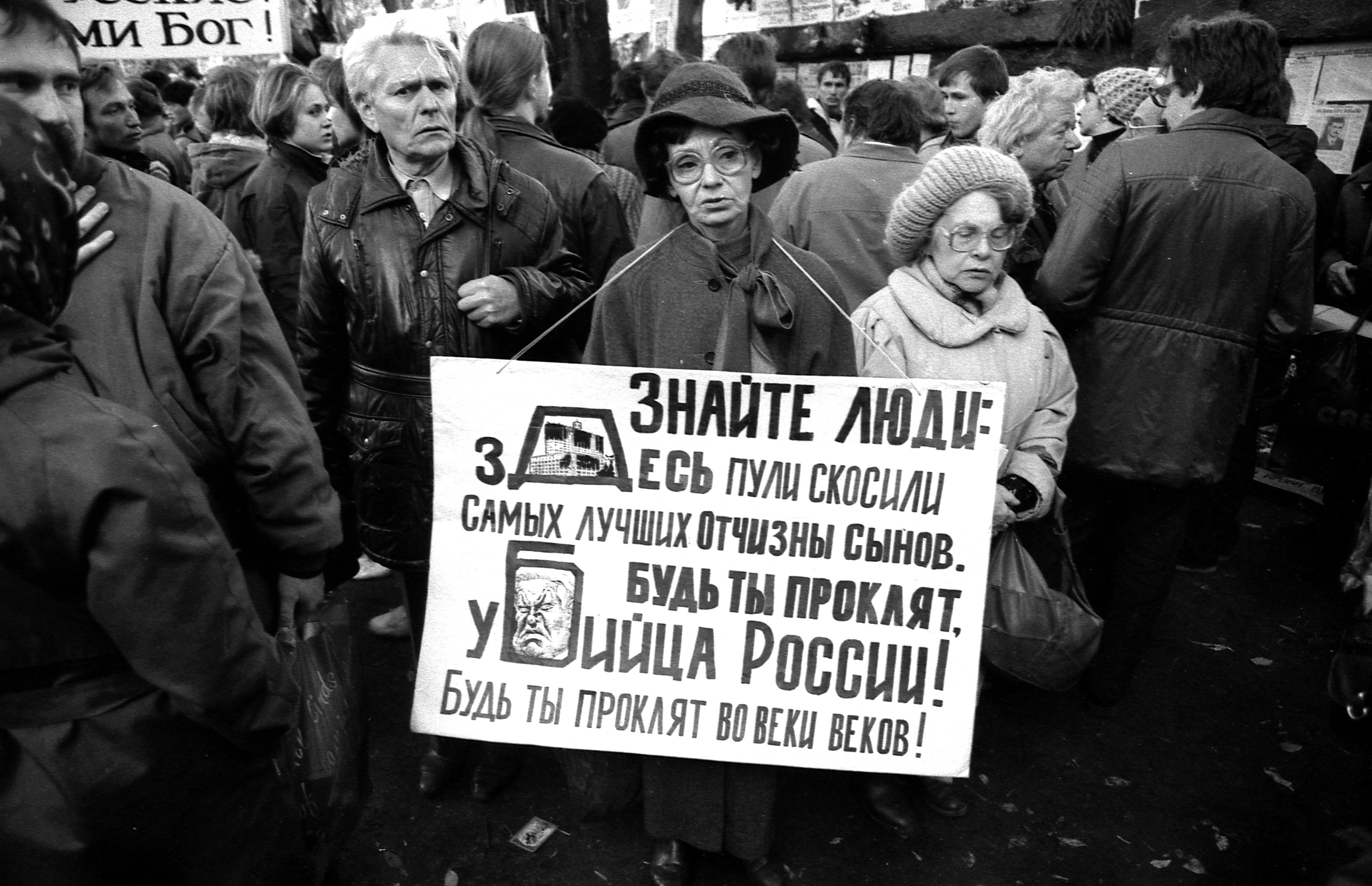
Thousands of regular people came out to support the Communist deputies when they barricaged themselves into the White House in October 1993. The standoff was broken when Yeltsin put tanks on the street that shelled the building. Hundreds of people died in what has been dubbed a constitutional coup / photo: Ben Aris
A spark still missing
On the surface Russia looks calm. Recent polls still put Putin’s popularity at 74% of those polled and despite a general unhappiness with the war and its economic impact on SMEs where the situation has deteriorated rapidly, there is little public dissent.
But the rally is symptomatic of building pressure. The economy slowdown has been dramatic in the last year, the war is in moving into its fifth year, and Russians are paying for it in rising prices and repeated Ukrainian drone and refinery strikes. But the size of the crowd and the speed with which riot police moved in show that repression works and that Putin remains in full control – for now.
Situations like this can still turn quickly. Putin appears to be counting on a massive bombing campaign this winter to force an end to the war on his terms. If that fails, and Russians face the prospect of fighting on into 2027, the spring could bring another moment of heightened tension, and with it the spark that this protest lacked.
Unlock premium news, Start your free trial today.


