
Russia's economic ties with Serbia hinge on gas and oil


Russia is a minor trading partner for Serbia, but its gas supplies and ownership stakes in key energy assets give Moscow influence that Belgrade would find costly to unwind.
The Student List, which won about 53% of the vote in the October 25 parliamentary election and ended Aleksandar Vucic's 14 years in power, takes over as two Russian energy arrangements run out. The US Treasury licences that let Serbia's only oil refiner, Russian-controlled NIS, keep working and negotiate its own sale expire on October 30, and Gazprom's gas supply arrangement runs to December 31.
Russia's place in Serbian trade has shrunk to a sliver. Its share of Serbia's goods imports fell from 11.4% in 2014 to 4.3% in 2023, and it has dropped out of Serbia's top five export markets. What it still holds is energy: Russian gas covers almost all of Serbia's consumption, Russian state companies own the country's only refinery, a majority of its main gas storage site and part of the pipeline that brings the gas in, and a Russian oil major runs a chain of its petrol stations. Unwinding that would cost Belgrade money, because Serbia buys its gas at little more than a third of the price paid on the European market.
The Student List has ruled out joining EU sanctions on Russia, Reuters reported on October 26. It has set out no policy on NIS or on the gas contract, and the NIS question will be settled in Washington as much as in Belgrade.
Gas at a third of the price
Serbia consumed 2.65bn cubic metres (bcm) of gas in 2024, almost all of it from Russia, Interfax reported. Since 2021 the gas has arrived through TurkStream under the Black Sea and on through Turkey and Bulgaria. The Serbian leg, which also carries Russian gas to Hungary, is run by Gastrans, a joint venture between a Gazprom subsidiary and state-owned Srbijagas.
Serbia's last three-year contract, signed in 2022, provided for up to 2.2bcm a year at about $275 per 1,000 cubic metres. Since it expired in 2025 Belgrade has lived on short extensions, the latest agreed at the end of September for three months on unchanged terms of around 6mn cubic metres a day. The price is still set by an oil-indexed formula rather than by European hub prices, which shields Serbian buyers when hub prices spike.
Vucic named the spread in the prices on September 26, the day before he resigned as president to run for prime minister: about €318 per 1,000 cubic metres for Serbia against €868 on the European market. Energy Minister Dubravka Djedovic Handanovic said European prices were above €800. On Vucic's figures, 6mn cubic metres a day at that discount is worth about €3.3mn a day to Serbia, or roughly €300mn over the three months of the current extension.
Moscow frames the deal in political terms. "Serbia has always been regarded as one of our country's key partners," Russian Deputy Prime Minister Alexander Novak said in January after meeting Aleksandar Vulin, chairman of Srbijagas' supervisory board, according to a Russian government statement. On February 3 Nenad Popovic, the Serbian minister who co-chairs the bilateral intergovernmental commission, said after talks in Moscow that Serbia would receive Russian gas throughout 2026 at the best price in Europe and on the best terms, Prime reported.
Gazprom also owns 51% of the Banatski Dvor underground storage facility, with Srbijagas holding the rest. Serbia went into this winter with 704mn cubic metres stored at home and in Hungary, a four-year high, according to the energy minister. It has started buying Azerbaijani gas through the interconnector with Bulgaria, and the EU has invited Serbia to join its joint gas purchasing, but Srbijagas CEO Dusan Bajatovic said in December that Russian gas would stay Serbia's cheapest option until EU restrictions take effect in 2028.
The refinery under sanctions
At NIS, Gazprom Neft holds 44.85% and Gazprom a further 11.3% through JSC Intelligence, giving Russian companies 56.15%, while the Serbian state owns 29.87%, according to NIS. Its Pancevo refinery, with capacity of about 4.8mn tonnes a year, is the country's only one.
Washington named NIS in its January 2025 sanctions on Russia's energy sector and postponed the measures several times before they took effect in October 2025. Croatia's JANAF pipeline then stopped crude deliveries and NIS began shutting Pancevo on December 2. Output of oil products fell 94.3% in December and Serbian industrial production dropped 9.1% y/y in January. Fears over NIS sent Serbians queuing for euros, and the central bank sold foreign currency from its reserves and scrapped exchange-office commissions to calm the market.
A special US licence let crude flow again, and it has been renewed for a month or two at a time since. Hungary's MOL agreed the main terms of a purchase of the Russian stake with Gazprom Neft in January, leaving room for an Emirati company to take a minority holding, and signed a shareholders' agreement with the Serbian government in June, but no final deal has been signed. Two Republican congressmen, Joe Wilson and Keith Self, asked Treasury Secretary Scott Bessent in September to stop renewing the waivers, arguing they let the Russian owners play for time.
NIS applied for a new operating licence on October 24. Energy expert Zeljko Markovic told state broadcaster RTS on October 26 that he expected the Office of Foreign Assets Control to grant it, and that crude and fuel stocks would last two to three months if it did not.
NIS also matters to the budget. It paid RSD101.4bn (€862mn) in taxes and other public charges in the first half of 2026 and made a net profit of RSD9.8bn (€83mn). The tax bill equals about 4.5% of the RSD2,274bn (€19.3bn) Serbia's consolidated general government collected in revenue over the same six months, according to finance ministry data. Belgrade economic journal MAT lists the NIS sanctions among the main factors holding back industrial output.
Petrol stations and railways
The other Russian assets are smaller. Lukoil, sanctioned by the US alongside Rosneft in October 2025, must sell its foreign business, which includes a petrol station network in Serbia; its Serbian unit put four stations up for sale in August. The wider sale stalled when US private equity firm Carlyle walked away from Lukoil's roughly $22bn international portfolio this month, and Washington has extended the licence for its foreign filling stations to April 24, 2027.
Russian Railways' contracting arm RZD International has worked on Serbian lines over the past decade, financed by an $800mn Russian state loan signed in 2013 to modernise the Corridor 10 route and the Belgrade-Bar line to Montenegro's coast.
Free trade, little trade
Serbia signed a free trade agreement with Russia in 2000. It was folded into a deal with the whole Eurasian Economic Union (EAEU), whose members are Russia, Belarus, Kazakhstan, Armenia and Kyrgyzstan, signed on October 25, 2019 and in force since July 10, 2021. Serbia would have to give it up on joining the EU, which sets trade policy for all its members.
The agreement has not stopped the slide in Russia's share of Serbian trade. Serbia exported $852mn of goods to Russia in 2025, led by machinery, knitted clothing, fruit, drinks and medicines, and imported $1.42bn, of which $892mn was mineral fuels and $213mn fertilisers, according to UN Comtrade data. Against Serbia's total exports of €33.1bn and imports of €41.9bn last year, that puts Russia at just over 2% of exports and about 3% of imports. EU countries accounted for 58.3% of Serbia's trade in 2025, and the EU provides close to 70% of its foreign direct investment.
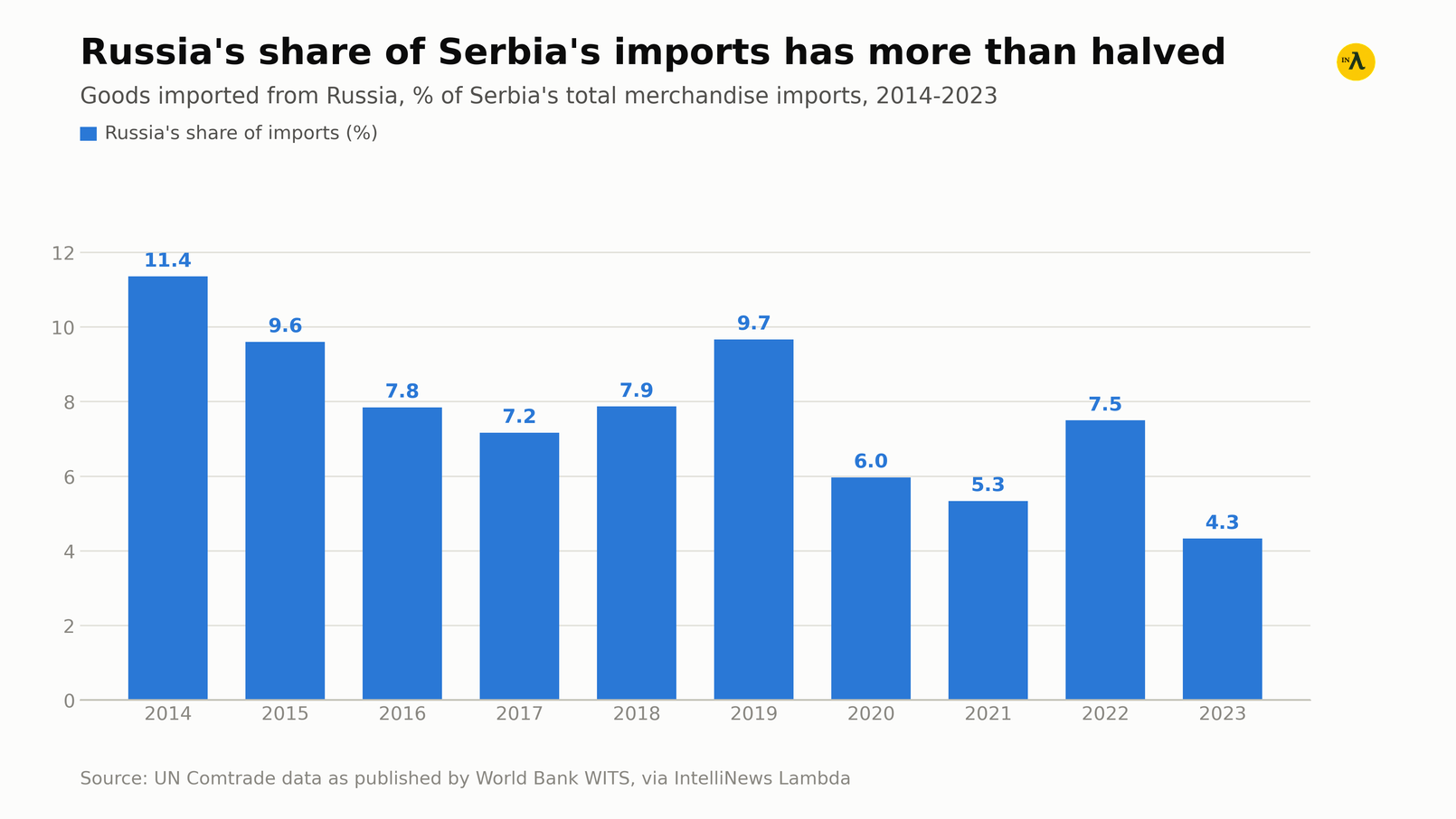
Russia's share of Serbia's goods imports, 2014-2023. Source: UN Comtrade data as published by World Bank WITS, via IntelliNews Lambda.
The import share jumped in 2022, when gas and oil prices soared after Russia's full-scale invasion of Ukraine, and fell back to a new low the following year. Exports have slipped too: Russia took 6.9% of Serbian exports in 2014 and just over 2% last year.
Russia keeps economic clout in Serbia mainly as an energy supplier and the owner of crucial energy infrastructure, while its wider role has been far outstripped by the EU's, Dutch think tank Clingendael found in 2023. "Since 2022, Moscow's role and influence have significantly diminished in the Western Balkans and, to a lesser extent, in Serbia," Nikola Xaviereff of the German Council on Foreign Relations wrote in a policy brief in September. Serbia is the only Western Balkan country that has not joined EU sanctions on Russia.
The first tests for the new government are the NIS licence that runs out on October 30 and the gas contract that expires on December 31.
Unlock premium news, Start your free trial today.


