
Russia deploys Poseidon nuclear torpedoes and Satan II ICBMs


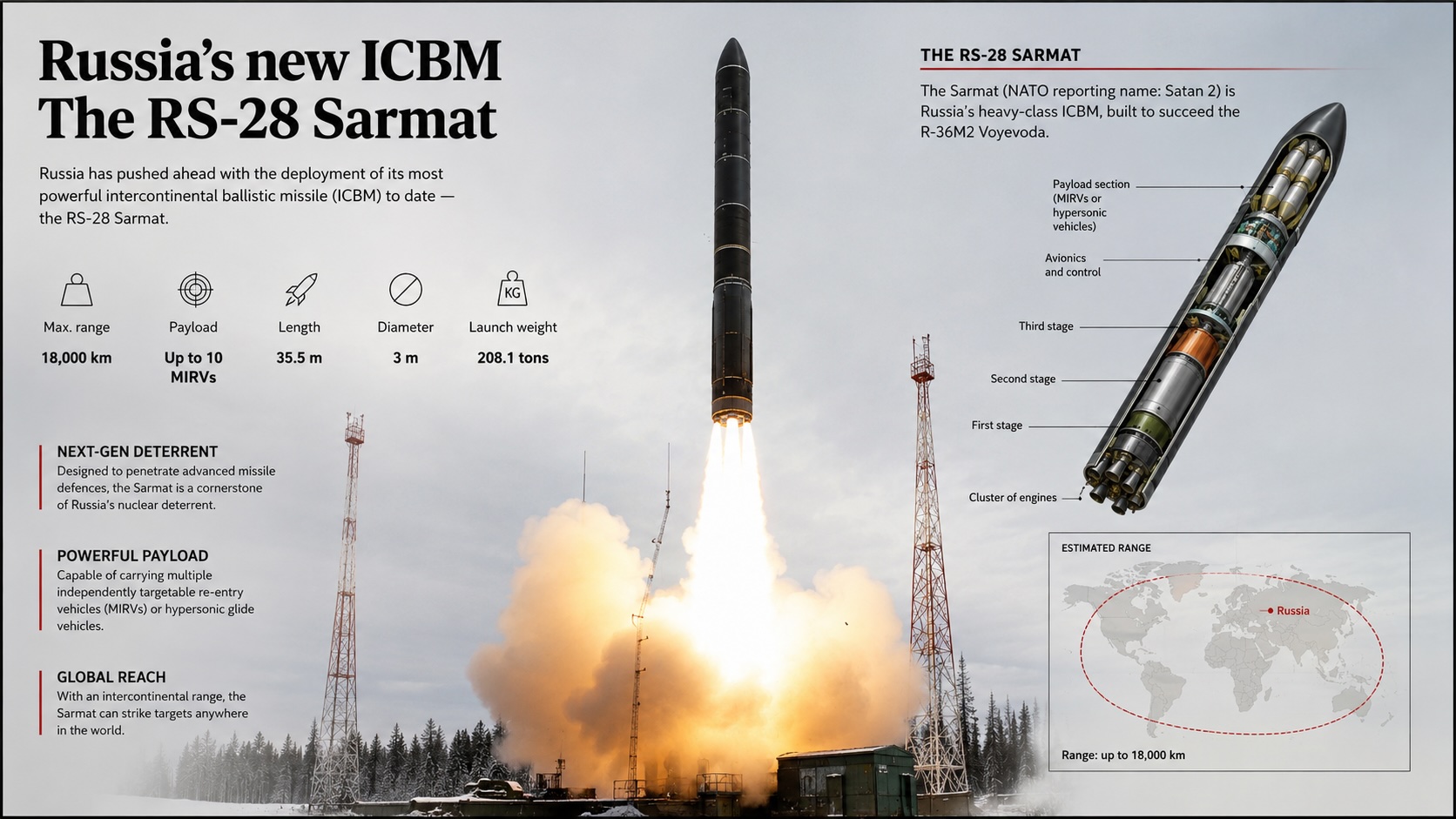
Russia has pushed ahead with the deployment of its most powerful intercontinental ballistic missile (ICBM) to date — the RS-28 Sarmat, a weapon Moscow claims will form the backbone of its nuclear deterrent for decades to come.
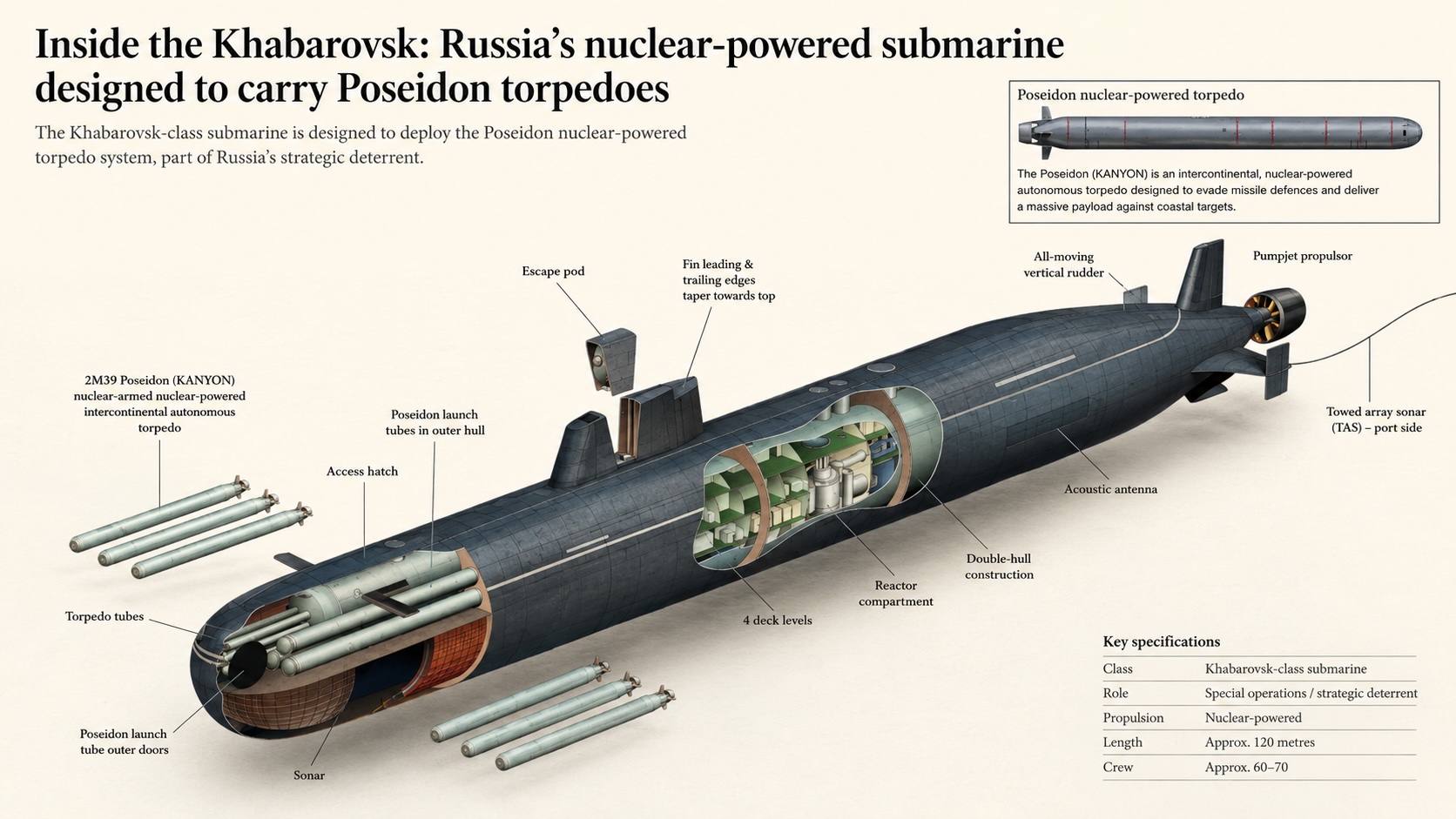
Russia has also just launched the RFS Khabarovsk, a nuclear-powered special-purpose submarine designed to carry the Poseidon nuclear-powered torpedo system, the most recent innovative weapon the Kremlin has put into operation intended to bypass western missile defences.
The submarine, developed under a highly secretive naval programme, is designed specifically to deploy the Poseidon, also known as Status-6, an autonomous nuclear-powered underwater drone capable of carrying either conventional or nuclear payloads. Russian President Vladimir Putin confirmed a successful test of the system in October 2025, calling it “a huge success” and saying “there is nothing like this”.
The two new weapons are part of Russia’s broader “superweapons” programme of next-generation strategic systems being introduced since 2018, when he unveiled Russia’s new class of hypersonic missiles, including the Avangard hypersonic glide vehicle that can evade US air defences entirely.
While Russian officials have presented Sarmat as a game-changing weapon, Western analysts remain cautious. Questions persist over production rates, operational deployment, and the reliability of repeated test launches.
Even so, the missile’s sheer scale and design philosophy underline a clear message: Russia is doubling down on heavy, high-yield strategic systems at a time when arms control frameworks are eroding. The same is true of the Poseidon torpedo, which is in a class of its own and faces no effective defence mechanism.
The Sarmat arrives on the scene just as the last remaining major nuclear treaty, New START, is about to expiry which could kick off a new arms race between Russia and the US.
Sarmat missile upgrade
Unveiled by President Vladimir Putin as part of a suite of “invincible” strategic systems, Sarmat is designed to replace the ageing Soviet-era R-36M Voyevoda missiles, known in Nato terminology as “Satan”. Its successor has quickly acquired the nickname “Satan II”, reflecting both its scale and destructive potential.
Putin described the missile as “a truly unique weapon that will strengthen the combat potential of our armed forces”, adding that it is capable of overcoming “all modern means of anti-missile defence”.
Sarmat is one of the largest ICBMs ever built. Weighing more than 200 tonnes and measuring roughly 35 metres in length, it is designed to carry a significantly heavier payload than most Western equivalents.
Each missile can reportedly carry up to 10–15 nuclear warheads, or a smaller number of advanced hypersonic glide vehicles. These warheads can be directed at separate targets, dramatically increasing the missile’s destructive reach.
The missile has an estimated range of up to 18,000 km — effectively a global reach – and the payload is made up of multiple independently targetable re-entry vehicles (MIRVs). It is also capable of carrying hypersonic glide vehicles such as the Avangard, which are also able to penetrate US air defences via unconventional trajectories.
The inclusion of the Avangard hypersonic glide vehicle is particularly significant. Travelling at speeds exceeding Mach 20 and capable of manoeuvring during flight, Avangard is intended to render traditional missile defence systems largely ineffective.
Sarmat is central to Russia’s strategy of maintaining nuclear parity with the United States and Nato, particularly as missile defence technologies continue to evolve.
One of its key features is its ability to take non-traditional flight paths, including trajectories over the South Pole, complicating early warning systems designed primarily to detect threats over the Arctic.
Sarmat comes into service in the wake of the Oreshnik ICBM that was debuted two years ago and with a range of over 5,000km can hit any capital in Europe.
What is the Poseidon torpedo system?
Russian state media and western defence analysts describe Poseidon as an intercontinental underwater weapon with a reported range of up to 6,200 miles. The system is believed capable of carrying a warhead with a yield of up to two megatons and operating at depths and speeds intended to make interception difficult.
According to the US Naval Institute, Russia plans to deploy as many as 30 Poseidon torpedo systems across four submarines, split between the Northern and Pacific fleets. The weapons are intended to provide Moscow with a survivable second-strike capability in the event of a nuclear conflict.
Khabarovsk is powered by a single OK-650V nuclear reactor and is believed to carry up to six Poseidon torpedoes in specialised side-mounted launch compartments. Analysts say the submarine is designed to operate from heavily defended “bastion” areas close to Russian waters, while the autonomous torpedoes travel independently towards their targets.
Russian military doctrine increasingly positions Poseidon as a response to US missile defence systems, precision-strike weapons and low-yield nuclear capabilities that Moscow argues threaten strategic stability. Some analysts believe the system could also be linked to Russia’s “Perimeter” retaliatory command structure, known informally as the “dead hand” system, designed to ensure a nuclear response even if Russian leadership and communications are destroyed.
The weapon’s emergence has renewed debate in Washington over anti-submarine warfare capabilities. The US Navy retired the Subroc anti-submarine missile system in 1992, while its proposed successor, Sea Lance, was cancelled after the end of the Cold War. No equivalent long-range underwater interception system is currently operational.
Unlock premium news, Start your free trial today.


