
Post-Orban Hungary turns inward: warmer on the EU, cooler on Ukraine, no break with Russia


Hungary’s new Prime Minister Peter Magyar has inherited a country that remains broadly supportive of closer ties with the European Union but is increasingly cautious about breaking with Russia or deepening support for Ukraine, according to new polling that highlights both continuity and change after the end of Viktor Orban’s 16-year rule.
Research by the European Council on Foreign Relations published by Transitions Online suggests Magyar’s election victory marked a decisive rejection of Orban’s domestic governance rather than a wholesale endorsement of a new foreign policy direction.
Under Orban, Hungary frequently clashed with Brussels over rule-of-law concerns, migration and sanctions policy, while maintaining comparatively close ties with Moscow and Beijing. European leaders have hoped Magyar’s government would reverse that approach and align Budapest more closely with mainstream EU positions on Ukraine and Russia.
The polling indicates that Hungarians do want a reset in relations with Brussels, and they continue to support Ukraine, but they don’t want to break ties with Russian entirely. The easiest way to understand these apparent contradictions is the issues are being framed in terms of what is good for Hungary, rather than from what is good for Europe and policy goals turn inward.
Nearly 80% of respondents expect Hungary’s ties with the EU to improve under Magyar, while large majorities support continued EU membership and favour a more European-oriented foreign policy over Orban’s strategy of balancing between the West, Russia and China.
The prospect of unfreezing billions of euros in suspended EU recovery funds is also widely viewed as one of the new government’s most important early objectives.
Yet the survey suggests Magyar’s mandate for geopolitical change is limited compared with the strong public demand for domestic reform.
“Hungarians largely voted for Tisza because they wanted a ‘change’, rather than voting for the party itself,” the ECFR report said. Only 15% of Tisza supporters cited the party’s programme or Magyar’s personal leadership as the main reason for backing him.
Instead, voters were primarily motivated by dissatisfaction with corruption, economic management and the state of public services under Orban’s Fidesz government.
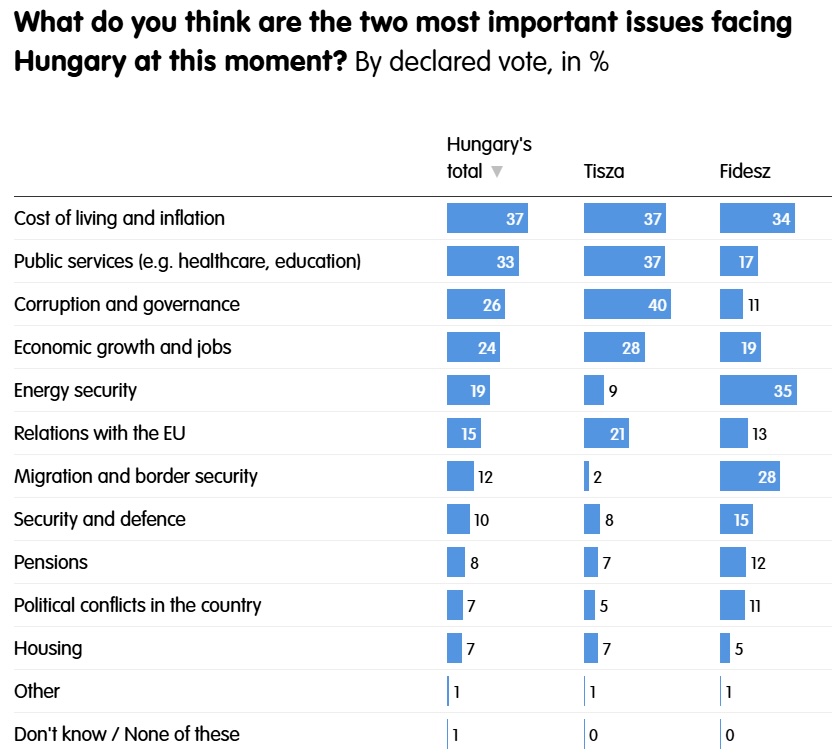
Domestic concerns now dominate Hungary’s political agenda. Respondents ranked the cost of living, healthcare, governance, economic growth and jobs as the country’s main priorities, while relations with the EU were considered significantly less urgent.
The findings suggest a shift away from the Orban era’s emphasis on sovereignty disputes with Brussels and foreign policy positioning toward more immediate economic and institutional concerns at home.
At the same time, the polling revealed that Hungarian public opinion remains far more cautious than many European governments on Ukraine.
Although voters generally support improving relations with Kyiv and backing EU financial support for Ukraine, majorities oppose direct military assistance and remain sceptical about Ukraine eventually joining the EU.
A majority also oppose opening Ukraine’s accession negotiations, despite growing pressure from Brussels for candidate countries to advance Kyiv’s membership process.
The issue could become politically difficult for Magyar, whose own supporters are more favourable toward Ukraine than the wider electorate. During the election campaign, he pledged to hold a binding referendum on Ukraine’s possible EU membership.
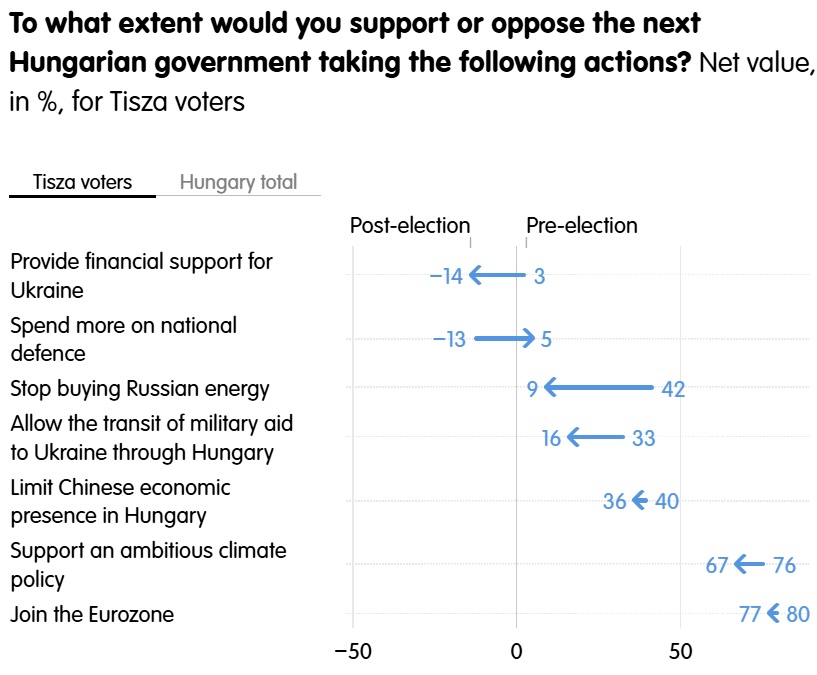
The survey also pointed to continuity with the Orban era on Russian energy. Despite expectations that a new government might move more aggressively to reduce dependence on Moscow, a majority of Hungarians now oppose ending imports of Russian fuel.
That marks a shift even among Tisza voters. Before the election, two-thirds supported halting Russian energy purchases. Post-election polling showed support falling to less than half.
The findings suggest that while voters support Hungary’s political reintegration with Europe after years of confrontation under Orban, they are less willing to accept the economic costs associated with a sharper break from Russia.
The ECFR said Magyar’s challenge would be balancing European expectations with domestic political realities.
“Budapest’s broader political reset will not seem legitimate to voters if Magyar does not first deliver on the narrower agenda of systemic change,” the report said.
The authors warned that failure to improve living standards and governance could create an opening for Orban’s Fidesz party to regain support despite its electoral defeat.
Unlock premium news, Start your free trial today.


