
Round-number anomalies nearly double in Russia's Duma vote


The number of Russian polling stations reporting suspiciously round turnout and vote-share figures almost doubled in this month's State Duma election compared with 2021, Meduza found in a precinct-level analysis published on September 24.
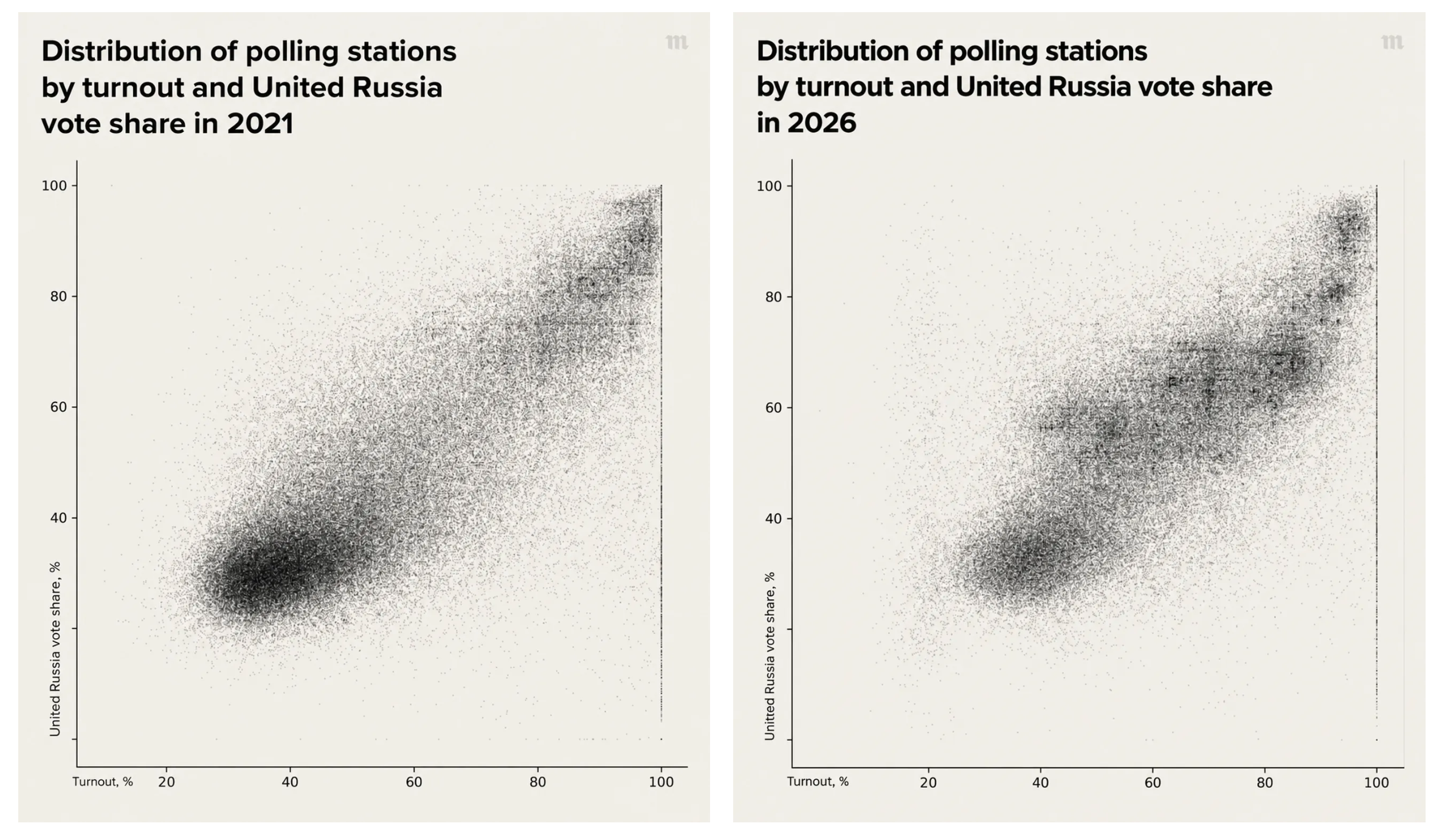
Each dot is a polling station, placed by turnout (across) and United Russia's vote share (up). In 2021 most precincts sat in a dense core at 35-40% turnout and about 30% for the ruling party; in 2026 the high-turnout, high-share "comet tail" has thickened into a body of its own. Source: Meduza
Using a method developed by Dmitry Kobak, Sergey Shpilkin and Maxim Pshenichnikov and published in the statistics journal Significance, the independent outlet counted almost 2,250 precincts with anomalously round turnout and vote-share figures, up from 1,300 at the last parliamentary election in 2021. Meduza says spikes at round numbers of this size cannot result from an honest count; statistical methods set a limit above which they indicate interference with the count. The tally uses preliminary returns from 82,124 precinct commissions, about 85% of the total; returns from the remaining precincts were unavailable or had only recently become available.
The analysis adds forensic weight to the gap between the official result and independent estimates of what Russians actually voted for. United Russia was awarded 57.9% of the party-list vote and a constitutional majority, while three separate estimates put its real support near 35%. Meduza calls it the least fair Duma election of Vladimir Putin's time in power.
Plotting every precinct by turnout and United Russia's share shows how the shape of the count has changed. In 2021 most precincts clustered in a core with turnout of 35-40% and about 30% for the ruling party, with a "comet tail" of precincts stretching up and to the right, where higher turnout came with a higher share for United Russia. This time the tail grew so dense that it formed a "body" of several clusters. The honest-looking core survived, unlike in the 2024 presidential election, but became smaller and thinner.
The core itself has barely moved. If its precincts are taken as unfalsified, United Russia's support rose by about five percentage points over five years, from roughly 30% to roughly 35%, a reading Meduza calls reasonable overall but hedged with qualifications, since even before fraud became widespread Russian results showed a slight correlation between turnout and the leading party's share.
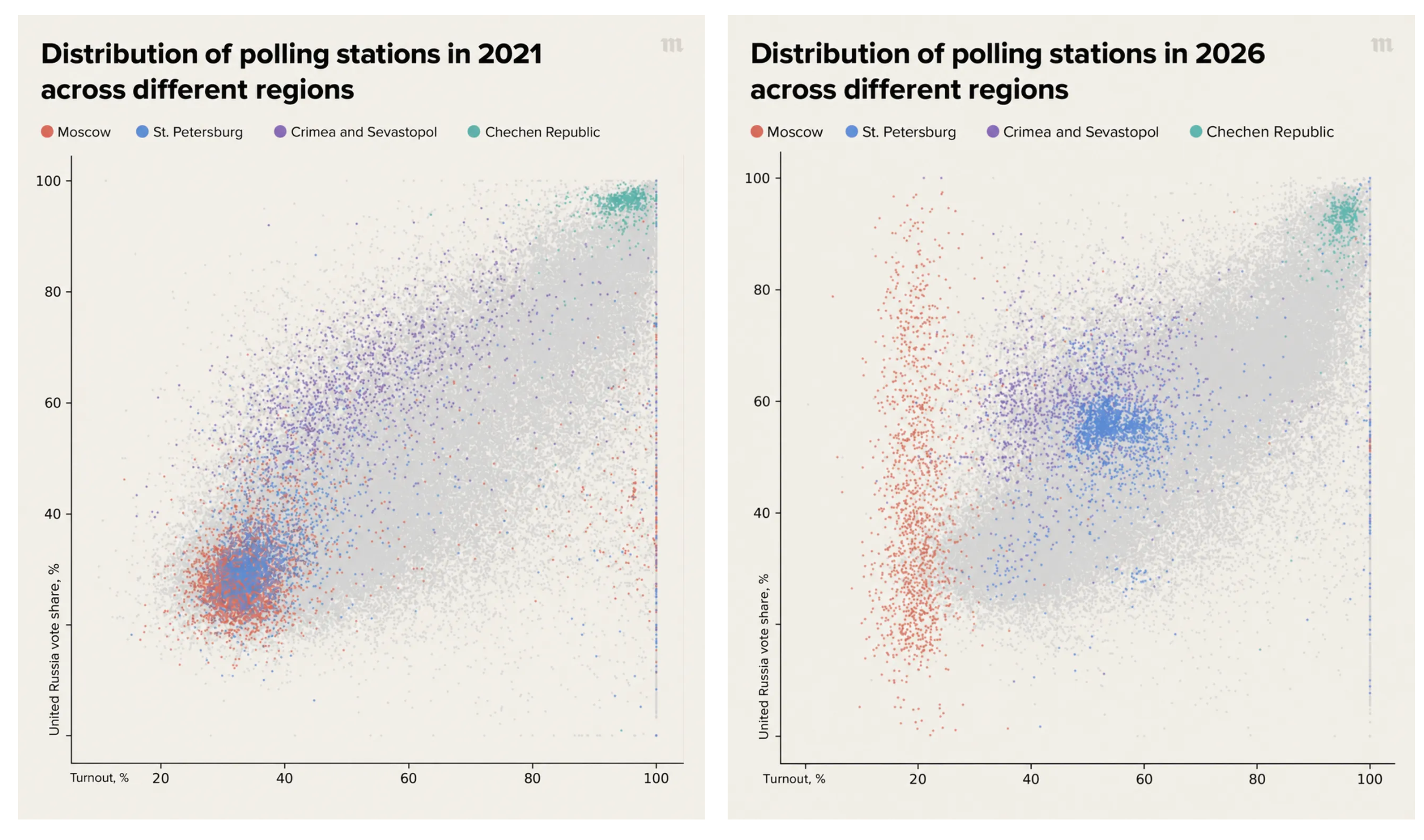
Moscow (red) went from a round cluster in 2021 to a vertical "column" at around 20% turnout in 2026, after most of the city voted online. St Petersburg (blue) roughly doubled both turnout and United Russia's share. Chechnya (green) barely changed. Source: Meduza
Moscow produced a pattern not seen before. Nearly 78% of the capital's voters cast their ballots remotely, leaving paper precincts with low turnout that line up in a thin vertical column, with United Russia's share spread evenly from under 10% to above 90%. Meduza says the column is not the product of ballot stuffing, which would stretch it into a conventional comet tail, nor of crudely rounded returns, which would show up as horizontal bands. Manipulating precinct returns in the winner's favour or pressure on voters could explain it, but the uniformity of the spread needs further study.
St Petersburg went the other way. In 2021 it looked almost identical to Moscow; in 2026 both its turnout and United Russia's share doubled, and small clusters of St Petersburg precincts appeared across the chart. Chechnya, where turnout and the ruling party's share both sit in the mid-90s, has barely changed in five years.
Tracked across the last six Duma elections, the near-normal distribution of 2003 first became a comet with a core and a tail and has now become something with no readily identifiable cluster of normal precincts. Russia's geography and population have not fundamentally changed over that period, Meduza argues, but its vote-counting methods have. The Central Election Commission maintains that results falling outside a normal distribution are not evidence of falsification.
The 2024 presidential vote, which returned Putin with 87%, still looks worse: that count showed spikes at round numbers visible to the naked eye and no honest-looking core at all. Putin has since said that the queues at polling stations showed Russia could not be intimidated. Returns from the Leningrad region and the occupied Ukrainian territories were still missing from the commission's precinct data on the evening of September 23.
Unlock premium news, Start your free trial today.


