
China's mystery low-value exports to Russia surge as dual-use trade stays high


Chinese exports to Russia are climbing again, and the fastest-growing slice is an opaque customs category of "low-value articles" that could be used to hide dual-use goods, according to an analysis of Chinese customs data by Joseph Webster.
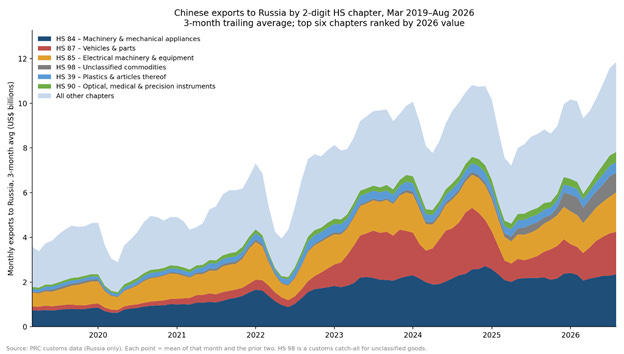
Chinese exports to Russia by two-digit HS chapter, three-month trailing average, March 2019 to August 2026. Source: China-Russia Report (Joseph Webster), from PRC customs data.
Webster, a senior fellow at the Atlantic Council's Global Energy Center and its Indo-Pacific Security Initiative who also edits the independent China-Russia Report newsletter, published the figures on September 24. Smoothed over three months to iron out volatile monthly data, Chinese shipments to Russia have risen to almost $12bn a month in the period to August, above the previous highs of 2023-2024, led by machinery, vehicles and electrical equipment.
Chinese customs totals confirm the rebound. Chinese exports to Russia rose 30.7% y/y to $84.7bn in January-August, while Russian exports to China grew 26.5% to $100.4bn, taking total trade up 28.4% to $185bn, according to Chinese customs data reported by Sputnik. The rebound follows a year in which bilateral trade dipped to $228bn after years of growth, and trade was already up 26.3% in the first seven months.
Chinese goods are what keep Russia's economy and war machine running. Western attention early in the full-scale invasion focused on Beijing's purchases of Russian crude, but its willingness to supply Moscow mattered far more, Webster argues: without Chinese imports, shortages and inflation would have spiked and Russia's defence industry "very likely would have been unable to sustain the war for very long".
"It's not an exaggeration to say that Beijing's exports to Russia have enabled Moscow to continue to prosecute the war," he writes.
The mystery category
Vehicles and instruments have grown fastest among the main product groups, but exports under HS chapter 98, which Chinese customs labels "unclassified", have exploded in recent months. Indexed to January 2022, the chapter has risen roughly ninefold, far outpacing every other category.
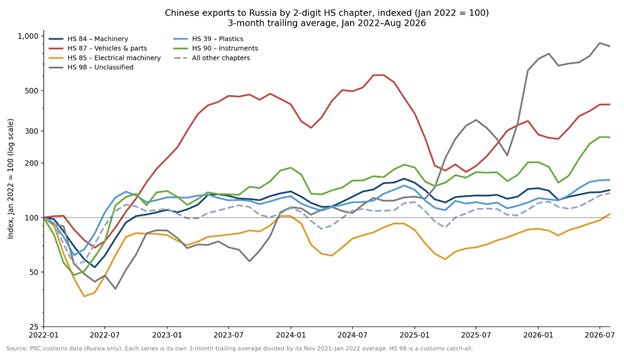
Chinese exports to Russia by HS chapter, indexed to January 2022 = 100 (log scale), three-month trailing average. Source: China-Russia Report (Joseph Webster), from PRC customs data.
Drilling down to eight-digit customs codes shows that almost all of the rise comes from a single line, 98040000, "low-value articles" cleared under simplified customs procedures. Shipments under that code ran at well under $100mn a month through 2024 but have surged to around $850mn a month on a three-month average since the start of 2026. Cross-border e-commerce parcels, by contrast, remain small.
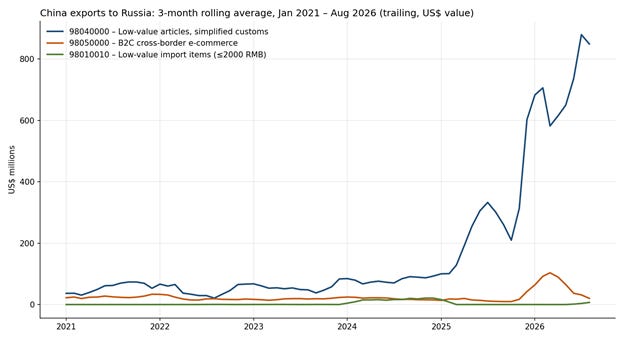
Chinese exports to Russia under three HS 98 sub-codes, three-month rolling average, January 2021 to August 2026. Low-value articles under simplified customs account for almost all the growth. Source: China-Russia Report (Joseph Webster), from PRC customs data.
Webster puts much of the growth down to booming border trade. Chinese border towns such as Manzhouli have promoted a strategy of "Russian supply, Chinese processing", and cross-border trade picked up after the Heihe-Blagoveshchensk road bridge over the Amur opened in 2022 and visa rules were relaxed.
The opacity of the code leaves room for other uses. "The non-transparent nature of this HS code raises the possibility that dual-use components may be smuggled into Russia via this account," Webster writes. It could also conceivably be used to route goods on to Iran: items declared as exports to Russia could be re-exported across the Caspian or overland and would never show up in China-Iran trade statistics. He stresses that "there is no direct evidence of this in the data".
The question is live. A Wall Street Journal investigation published on September 23 found Chinese suppliers had sent around 1,300 shipments of dual-use components to Iran's defence ministry in the first half of 2026, many of them by air.
Dual-use trade stays high
Exports of goods on the Common High Priority List, the dual-use items that the US, EU, UK and Japan have singled out as most important to Russia's weapons production, remain well above pre-war levels for most of the list's tiers. Tier 3A goods are running at about $200mn a month and Tier 2 at around $90mn, while Tier 1, integrated circuits, is far smaller in value.
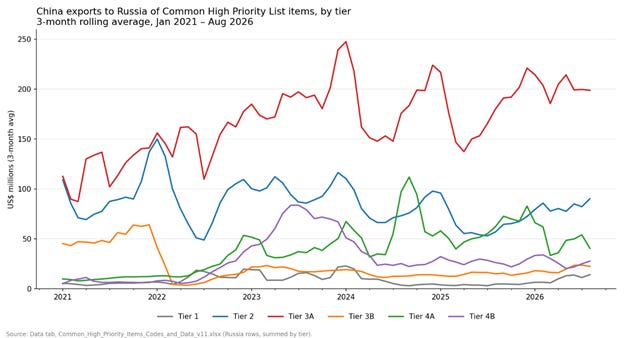
China's exports to Russia of Common High Priority List items by tier, three-month rolling average, January 2021 to August 2026. Source: China-Russia Report (Joseph Webster), from PRC customs data and CHPL definitions.
Chinese components have been traced into Russia's most important weapons programmes, including the surge in Iskander missile production, while the indirect route through Central Asia has been documented in reports on how the region's states abet sanctions-busting. Washington's hellish sanctions law, which threatens secondary sanctions on Russia's trading partners, is aimed squarely at this trade.
Oil pays the bill
Russia's side of the trade is still overwhelmingly oil and gas. Its exports to China have climbed to around $13bn a month on a three-month average, up from under $10bn in mid-2025, as the US-Israeli war with Iran pushed up crude prices. Russia has also become China's second-biggest LNG supplier.
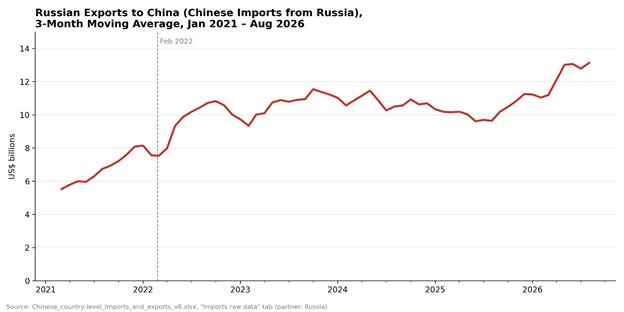
Russian exports to China (Chinese imports from Russia), three-month moving average, January 2021 to August 2026, $bn. Source: China-Russia Report (Joseph Webster), from PRC customs data.
Webster crunched the numbers in Washington while Chinese President Xi Jinping was in town for a summit shadowed by Taiwan and the AI race with US President Donald Trump. The trade data suggest that, whatever Beijing tells Washington, its economic lifeline to Moscow is getting thicker, not thinner.
Unlock premium news, Start your free trial today.


