Romania’s trade deficit narrowing trend halts in June and July


Romania’s trade deficit widened by 4.5% year-on-year to €2.8bn in July, after widening by 4.3% year-on-year to €8.65bn in the second quarter, halting a trend of improving external balances that began in mid-2025 as domestic consumption weakened along with fiscal consolidation measures, according to data from the National Institute of Statistics (INS).
Further improvements in Romania's external trade balance depend on an economic recovery, while lower domestic demand for investment in 2027, following the PNRR-driven rally in 2026, may also contribute.
Imports increased by 4.7% year-on-year in the second quarter and by 4.2% in July, returning to growth after declines in the previous two quarters (Q1 this year and Q4, 2025). The increase was driven by investment and higher energy prices amid the war in the Middle East, despite weaker domestic consumption.
Exports also rose, increasing by 4.7% year-on-year in the second quarter and 4.1% in July, supported by higher commodity prices. The broadly similar growth rates for imports and exports limited the deterioration in the trade balance.
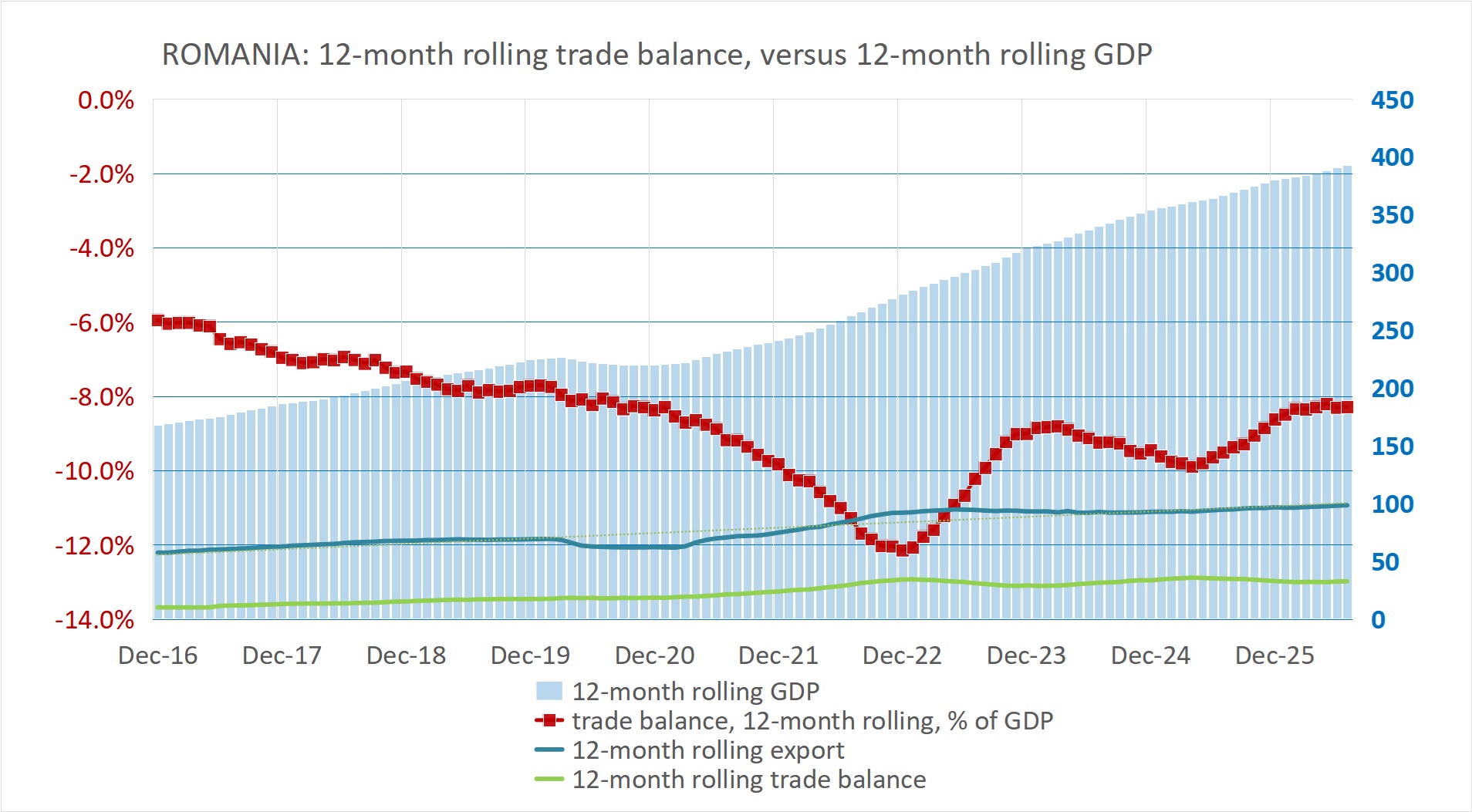
The rolling 12-month trade deficit-to-GDP ratio (chart) edged up to 8.3% in June and July, from 8.2% in May, ending more than a year of gradual improvement. The ratio had fallen by 1.7 percentage points from 9.9% in April 2025 (the past couple of years' peak) as fiscal consolidation and weaker consumption reduced import demand.
Nominal GDP growth has also helped reduce the deficit-to-GDP ratio in recent quarters. GDP increased by 7.2% year-on-year in nominal terms over the 12 months to June, despite contracting by 0.8% in real terms, with inflation contributing to higher nominal values for imports, exports and GDP.
Even at rates above 8% in recent months, Romania's trade deficit remains historically low relative to GDP, after having exceeded 12% during the initial phase of the war in Ukraine as higher energy prices increased Romania’s import bill. The ratio also deteriorated during the consumption-led expansion in 2024 before improving from April 2025.
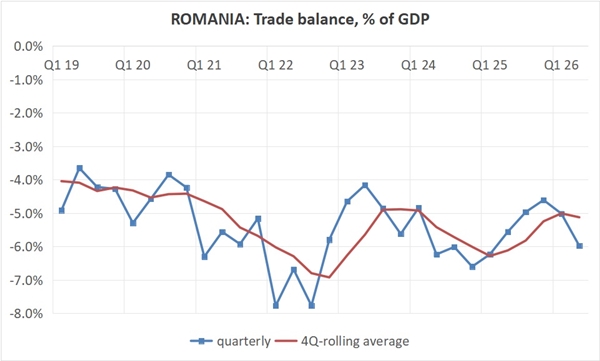
Volume-based trade data show a similar pattern, although the deficit looks smaller. The rolling 12-month trade deficit stood at 5.1% of GDP at the end of the second quarter (chart), up from 5.0% three months earlier but below 6.1% in June 2025.
Net imports represented 5.6% of total domestic demand for consumption and investment in the second quarter, up from 5.3% a year earlier. The increase is consistent with rising gross external indebtedness during periods of weak economic growth.
Unlock premium news, Start your free trial today.