Romania’s retail sales post third consecutive quarterly decline in Q1


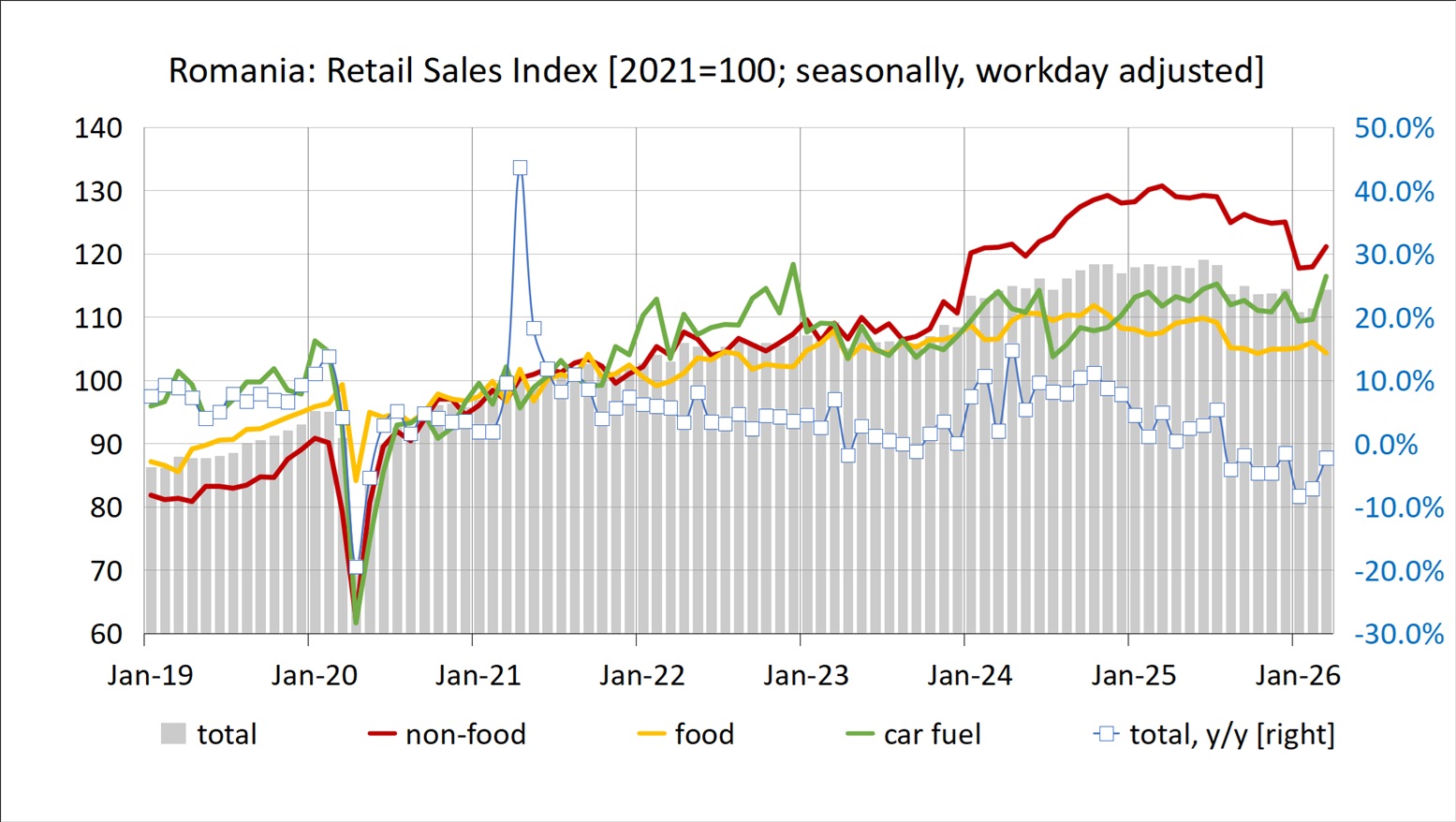
Romania’s retail sales (chart) partially recovered in March after contracting again in the first two months of 2026, although annual dynamics remained negative for the eighth consecutive month, according to data published by the statistics office INS.
The retail sales volume index increased by 2.6% month-on-month in March, but remained down 2.3% year-on-year, reflecting the lingering effects of the VAT increase introduced in August 2025, weakening consumer confidence and tighter household budgets.
For the first quarter as a whole, retail sales volumes declined by 1.6% quarter-on-quarter, marking the third consecutive quarterly contraction. On an annual basis, sales dropped by 5.8% year-on-year, the sharpest decline since the first Covid-19 lockdown.
Consumer sentiment deteriorated further in April. According to a research note by Erste Group, Romania’s consumer confidence indicator fell to -35.1 from -32.2 previously, remaining below the lows recorded during the 2020 pandemic for a fifth consecutive month and reaching its weakest level since 2011.
Erste noted that expectations regarding households’ future financial situation, the broader economy and past financial conditions all weakened in April. Only intentions regarding future major purchases showed a slight improvement.
Private consumption continues to face pressure from elevated inflation, expectations of further price increases and limited wage growth amid ongoing fiscal consolidation. Additional inflationary risks stem from higher fuel prices linked to the Middle East conflict and the depreciation of the Romanian leu in May.
Despite the recent correction in the past three quarters, retail sales levels in the first quarter (Q1) remained above those recorded in 2023, before the consumption boom driven by expansionary income policies during the 2024 electoral year.
The March recovery was driven mainly by non-food sales, which rose 2.7% month-on-month. However, the category still recorded the steepest annual decline, at 6.4% year-on-year, after the strong growth accumulated during 2024.
Fuel sales increased unexpectedly by 6.2% month-on-month and by 11.3% year-on-year, possibly reflecting precautionary purchases amid rising fuel prices rather than higher actual consumption.
Food sales, regarded as the clearest indicator of households’ financial constraints, continued to weaken, declining by 1.6% month-on-month and 3.4% year-on-year in Q1.
INS data indicate that food sales have broadly stagnated since their decline following the August 2025 VAT increase, while non-food and fuel sales have gradually weakened throughout 2025 and into the first quarter of 2026.
Unlock premium news, Start your free trial today.