
PANNIER: Uzbekistan’s air pollution officials search for lasting solutions


Uzbekistan’s air pollution problem has noticeably worsened over the last several years, but at the end of March authorities strengthened efforts to combat the dilemma.
The government introduced a series of measures aimed at lowering the choking pollution and effects caused by increasingly frequent dust storms.
Previous steps have not been sufficiently effective, but the government has unveiled a five-year plan specifically to deal with air quality issues.
Toxic to breathe
It is not only Uzbekistan but most of the eastern part of Central Asia, where most of the region’s population lives, that suffers heightened levels of air pollution.
Decades of using coal as a primary source of generating electricity and heating homes has contributed to the pollution problems now being seen.
More recently, winds blowing over the desiccated Aral Sea bed in western Central Asia have brought ever greater amounts of dust eastward, darkening the skies as far away as Tajikistan in the region’s southeastern corner.
On January 3, 2024, the website IQAir, which monitors air quality globally, rated the air quality in the Uzbek capital Tashkent as “very unhealthy,” and second only to New Delhi in terms of pollutants.
On February 21-22, 2024, IQAir ranked Tashkent as having the worst air quality in the world. Also on February 22, Kazakhstan’s capital Astana and Kyrgyzstan’s capital Bishkek ranked 9th and 19th, respectively.
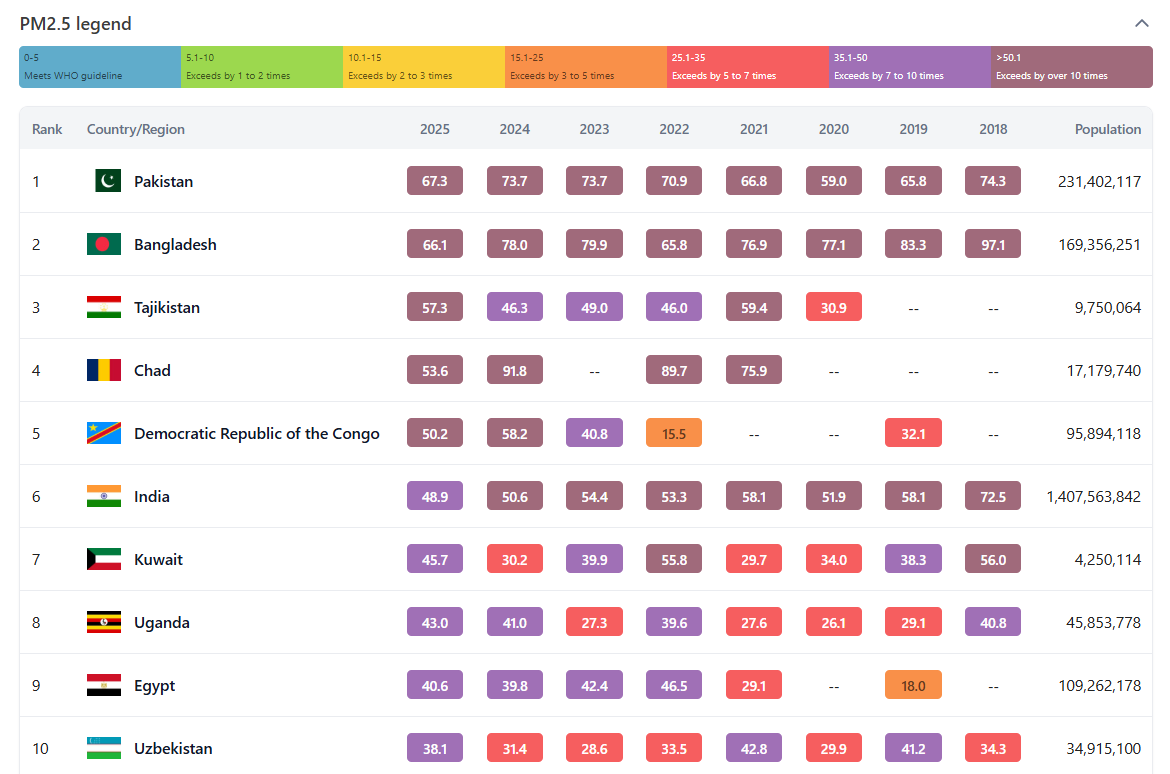
World's most polluted countries & regions
(Ranking based on annual average PM2.5 concentrations (μg/m³). PM2.5 refers to fine particulate matter air pollution that is 2.5 micrometres or less in diameter, in other words, small enough to enter deep into the lungs and bloodstream).
Graphic credit: IQAir.
Tashkent does not even have the worst air pollution in Uzbekistan. Yearly averages show Uzbekistan’s eastern city of Ferghana, home to one of the country’s oil refineries, has the worst air quality problem.
Then there are the dust storms. Not long ago, dust storms were rare in Central Asia, but in recent years they have become common events.
In 2025, Tajikistan was hit by 63 dust storms, up from 35 in 2024.
A huge dust storm blew into Tashkent on May 17, 2025, cutting visibility on main streets to a few hundred metres.
Dust blown from the dried-out Aral Sea area often carries alkaline soil left as the water evaporated from the seabed. This alkaline soil causes respiratory ailments in people and destroys crops.
Time to get serious
In January 2024, as air pollution was growing worse, activists staged a flashmob under the hashtag #TozaHavoKerak (clean air needed), calling on authorities to find a lasting solution to the problem.
Protests of any kind are extremely rare in Uzbekistan, so the event itself was an indication of public desperation at the air quality situation.
After the horrible air pollution in the first two months of 2024, Uzbek authorities started to broadcast warnings to alert the public about rising levels or air pollution or to when dust storms were coming. It didn’t ease the problem. It only reminded the population that it was hazardous to breathe.
On February 21, 2024, Uzbek President Shavkat Mirziyoyev signed an order for a “Day without Automobiles” in Tashkent. One day per month, people in the Uzbek capital were to leave their vehicles at home and use public transportation to get to work.
State employees were told to set a “personal example” by taking public transportation to and from work.
It was billed as part of the “Uzbekistan-2030” strategy, but it never caught on and air pollution in Tashkent and other parts of Uzbekistan continued to plague residents.
So, two weeks ago, Mirziyoyev signed a decree on “Measures to Implement the National Project ‘Clean Air’ Aimed at Improving Air Quality.”
The project establishes targets for cleaning up the air, such as a 10.5 % reduction in the release of toxic substances and reducing the number of days when pollution hits dangerous levels.
The strategy is being rolled out gradually, starting in Uzbekistan’s section of the Fergana Valley, where the highest concentration of people lives, and then moving west, and finishing in Karakalpakstan and Khorezm in December this year.
The strategy also specifies that starting in May, the 10th and 25th of every month will be the “Day without Automobiles,” though the decree also mentions a “Week with Automobiles.” This time, “civil servants are strictly prohibited from using official vehicles.”
New bicycle lanes will appear across Tashkent and starting from August 1, people can trade in their older vehicles and receive financial credit on the purchase of new cars.
Tashkent will introduce a system that alerts residents via SMS, the media, and using digital platforms to an expected drastic worsening of air quality. And naturally, fines for violating air protection rules are substantially increased and fines for repeat offenders will be fined more than doubled.
Companies that fail to report full and accurate data on emissions also face stiff fines.
On April 1, the Green Nation programme was launched. The goal is to increase Uzbekistan’s “green coverage” area from the current 14.2% to 30% by 2030.
There are also plans to plant “green belts” in 33 districts to mitigate the effects of dust storms.
The same day the programme was unveiled, work started on planting “green walls” in the Surhandarya and Syrdarya provinces to screen out dust.
The race Is on
Uzbekistan has been working on developing the country’s renewable energy output, particularly solar and wind.
Of some 86.7-billion-kilowatt hours (kWh) of domestically produced electricity in 2025, some 16.8 billion kWh came from renewable energy sources, a 29% increase from 2024. Uzbekistan’s Energy Ministry noted that the boost in renewable energy use prevented some 4.7 tonnes of pollutants from being released into the air.
But Uzbekistan is aiming at a rapidly moving target. A big push in industrialisation combined with a population that since 2015 has been increasing at an average of 700,000 people annually creates an expanding demand for energy.
Uzbekistan was once a natural gas exporter, but for the last four years the country has been boosting gas imports, mainly from Russia and delivered via a pipeline that not long ago carried Uzbek gas to Russia.
It seems that every autumn, officials say the country can meet its energy needs through winter, but shortly after the New Year reports appear about sales of coal and wood soaring.
The new “clean air” programme Mirziyoyev signed runs from 2026 to 2030. Previous attempts at combatting air pollution did not include a long-term strategy, so this latest attempt is, if nothing else, more structured and enduring with specific goals.
The question now is whether these new regulations and targets, coupled with developing renewable energy sources can meet the demands of a growing number of factories and plants and an increasing population and still alleviate a pollution problem that has accumulated over the course of decades.
Unlock premium news, Start your free trial today.


