US hiring rate falls to near pandemic-era low
The US labour market is showing signs of strain as the Iran war compounds the stress that resulted from Trump’s Liberation Day tariff regime. Now the economy is being hit by rapidly rising fuel costs.
Hiring activity declined to levels last seen during the pandemic in March, according to data released on April 7. The number of hires as a percentage of total employment fell by 0.3 percentage points in February to 3.1%, matching the low recorded in 2020. The figure marks the weakest level since January 2011 and sits just 0.3 percentage points above the 2.8% trough reached during the 2008 financial crisis.
Private sector hiring also slowed, with the hiring rate declining by 0.4 percentage points to 3.3% in February. This represents the lowest level since February 2010, when labour market conditions were significantly weaker.
At that time, the US unemployment rate stood at 9.7%, more than double the current rate of 4.4%, indicating a divergence between hiring activity and headline unemployment figures.
Meanwhile, worker confidence appeared to weaken further. The quits rate, which measures the share of workers voluntarily leaving their jobs, edged down by 0.1 percentage point to 1.9% in February. This is the lowest level recorded since the pandemic period in 2020.
The decline in both hiring and quits rates suggests reduced labour market dynamism, with fewer workers changing jobs and employers showing increased caution in recruitment.
The data points to a continued cooling in labour demand despite relatively low unemployment, reflecting a more subdued phase in the US economic cycle.
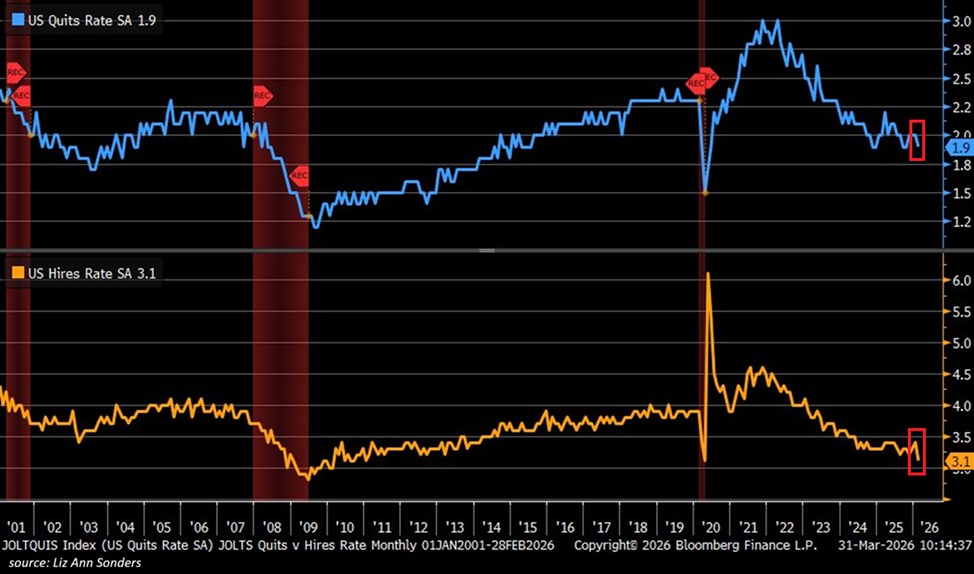
The US jobs market is under strain with the quits rate and hire rates down.
Inflation shock making itself felt
US inflation has shown early signs of upward pressure since the onset of the Iran conflict, largely driven by a surge in energy prices rather than a broad-based acceleration across the economy.
Recent data indicate that headline inflation has ticked higher in March and early April, with petrol prices contributing the largest share of the increase. Energy costs tend to feed quickly into the Consumer Price Index (CPI), and the sharp rise in fuel prices has begun to reverse some of the disinflation seen in late 2025. However, core inflation — which excludes food and energy — has remained relatively stable so far.
Economists say that the full inflationary impact typically takes up to six months to feed through after the initial commodity shocks. If elevated oil prices persist, they could begin to push up transportation, logistics and production costs more broadly in the coming months.
Federal Reserve officials are watching closely and say while the recent increase in headline inflation is being closely monitored, policy decisions will continue to focus on core inflation trends and labour market conditions. However, bond investors are now pricing for rate hikes later this year, whereas pre-war they were pricing for rate cuts.
With yields on bonds already rising and cost of borrowing expected to climb, that is now having knock on effects on the financial system as the crisis virus spreads.
Subprime loan delinquency rate reaches 11-year high
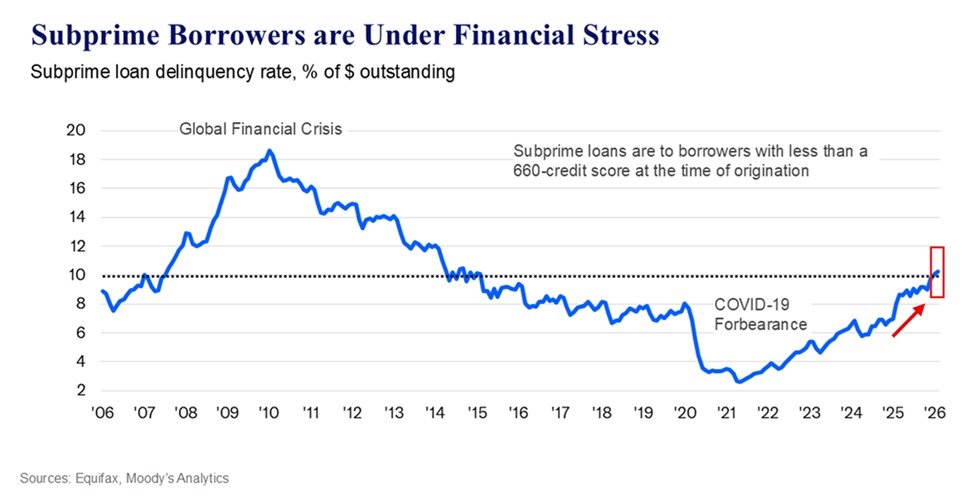
The delinquency rate on subprime loans has risen to 10% of total outstanding debt, marking its highest level in 11 years as more borrowers fall behind on repayments.
Subprime loans, defined as lending to borrowers with credit scores below 660, are considered higher-risk at the point of issuance due to weaker credit profiles.
The current delinquency rate has more than tripled since 2021, when pandemic-era forbearance programmes allowed borrowers to delay payments without being classified as delinquent.
During the 2008 financial crisis, the delinquency rate on subprime loans peaked at approximately 19%, when subprime debt totalled $3.5 trillion and accounted for roughly 30% of overall household debt.
By comparison, subprime debt now stands at $2.7 trillion, representing about 15% of total household debt, indicating a smaller but still significant share of the market.
Rising delinquency levels reflect mounting financial strain among US borrowers, with an increasing number of households struggling to keep up with debt obligations.
US trade deficit widens in February amid tariff uncertainty
The whole point of the Liberation Day tariffs was to reduce the size of the US current account deficit, but it has become larger. The US trade deficit widened in February according to government data released on April 7, marking one year since sweeping tariffs were introduced by Trump.
The overall trade gap increased by 4.9% to $57.3bn, as both imports and exports rose, the Department of Commerce said. Uncertainty surrounding US trade policy continues to affect global trade flows. The latest data follows a ruling by the US Supreme Court in late February that struck down a broad range of tariffs imposed by Trump.
Separately, public confidence in US trade policy has weakened. A survey released by the Pew Research Center on April 6 found that nearly six in 10 US adults said they were either not too confident, or not at all confident, in Trump’s ability to make sound decisions on trade. The survey also showed that 63% of respondents expressed little or no confidence in his handling of tariff policy.