
PANNIER: Taliban look north for friends


Central Asia’s governments were probably not best pleased when the Taliban returned to power in Afghanistan in August 2021, but most of them have since tried to make the most of the status quo.
Kazakhstan, Kyrgyzstan, Turkmenistan and Uzbekistan have dealt individually with the Taliban since shortly after the Islamic movement retook Kabul following the US exit. Tajikistan, though, has only lately established a dialogue with the current rulers of Afghanistan.
Sunday April 5 thus goes down as an important date as on that day representatives of all five of the Central Asian countries (the “C5”) gathered in Kabul at the invitation of the Taliban’s acting Foreign Minister Amir Khan Muttaqi to discuss regional cooperation.
They all came to Kabul
Among the Central Asian officials who attended the “Afghanistan-Central Asia Consultative Dialogue” were the deputy foreign ministers of Kyrgyzstan and Uzbekistan and the ambassadors of Tajikistan, Turkmenistan and Kazakhstan.
Especially significant was the attendance of the Tajik envoy. Tajikistan was the lone Central Asian state to initially reject contact with the Taliban after they were restored to power.
The Afghan embassy in the Tajik capital Dushanbe is in fact still staffed by representatives of the ousted government of former Afghan president Ashraf Ghani, though interestingly, the Afghan consulate in the eastern Tajik city of Khorog is occupied by Taliban representatives.
Authorities in cash-strapped Tajikistan surely noticed the briskness of expanding business between their Central Asian neighbours and Afghanistan. That will have concentrated minds.
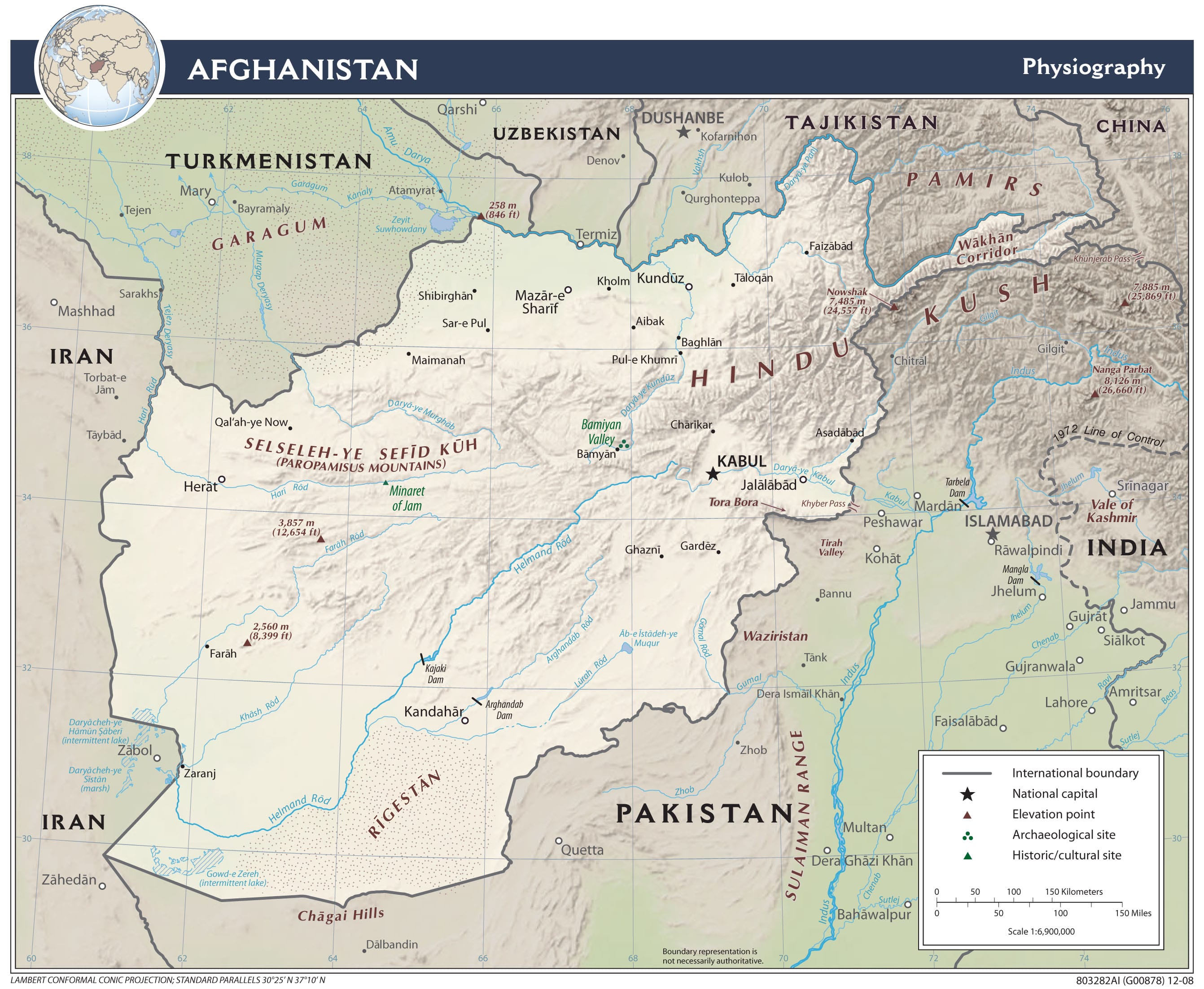
Right now, geography is particularly unkind to Afghanistan, with economic relations to the east, south and west imperilled (Credit: cia.gov).
Trade between Central Asia and Afghanistan in 2025 amounted to some $2.6bn. Most of it was made up by Afghanistan’s trade with Uzbekistan and Kazakhstan. Uzbek-Afghan trade totalled $1.7bn and Kazakh-Afghan trade more than $500mn.
Ever crisis-wracked, Afghanistan right now has even more reason to make economic cooperation and trade urgent priorities. The US-Israeli bombing of Iran has cut off Afghanistan’s trade access to the west, while ongoing clashes between Taliban and Pakistani forces greatly constrict the trade route to the east.
The situation leaves Central Asia to the north (with Russia, the only country in the world to grant the Taliban administration formal diplomatic recognition, beyond it) as the only open trade route for Afghanistan. So when at the Kabul ‘C5+Afghanistan’ meeting, Muttaqi called for boosting Central Asian-Afghan annual trade to $10bn, there was little surprise.
Muttaqi addressed projects that connect Central Asia and Afghanistan and could strengthen relations.
He pointed to the CASA-1000 project that would bring 1,300 megawatts (MW) of hydroelectric power from Kyrgyz and Tajik plants to Afghanistan (300 MW) and Pakistan (1,000 MW).
Kyrgyzstan and Tajikistan have built their sections of the CASA-1000 power transmission line. In Afghanistan, state power company Da Afghanistan Breshna Sherkat has stated that the required line is 75%-complete. The World Bank has said construction should conclude by the end of 2027.
Muttaqi also mentioned the Turkmenistan-Afghanistan-Pakistan-India (TAPI) gas pipeline project, a decades-old idea to bring Turkmen gas to Afghanistan, Pakistan and India. However, 800 kilometres (497 miles) of the 1,814-kilometre pipeline requires building in Afghanistan. Progress, so far, only amounts to 25 km.
In any case, neither CASA-1000 nor TAPI seem likely to extend any further than Afghanistan due to the drastic deterioration in Afghan-Pakistan relations.
Not mentioned, at least not publicly, was the looming threat that the Taliban’s emerging Qosh Tepa irrigation canal could pose to Central Asia’s fragile water security.
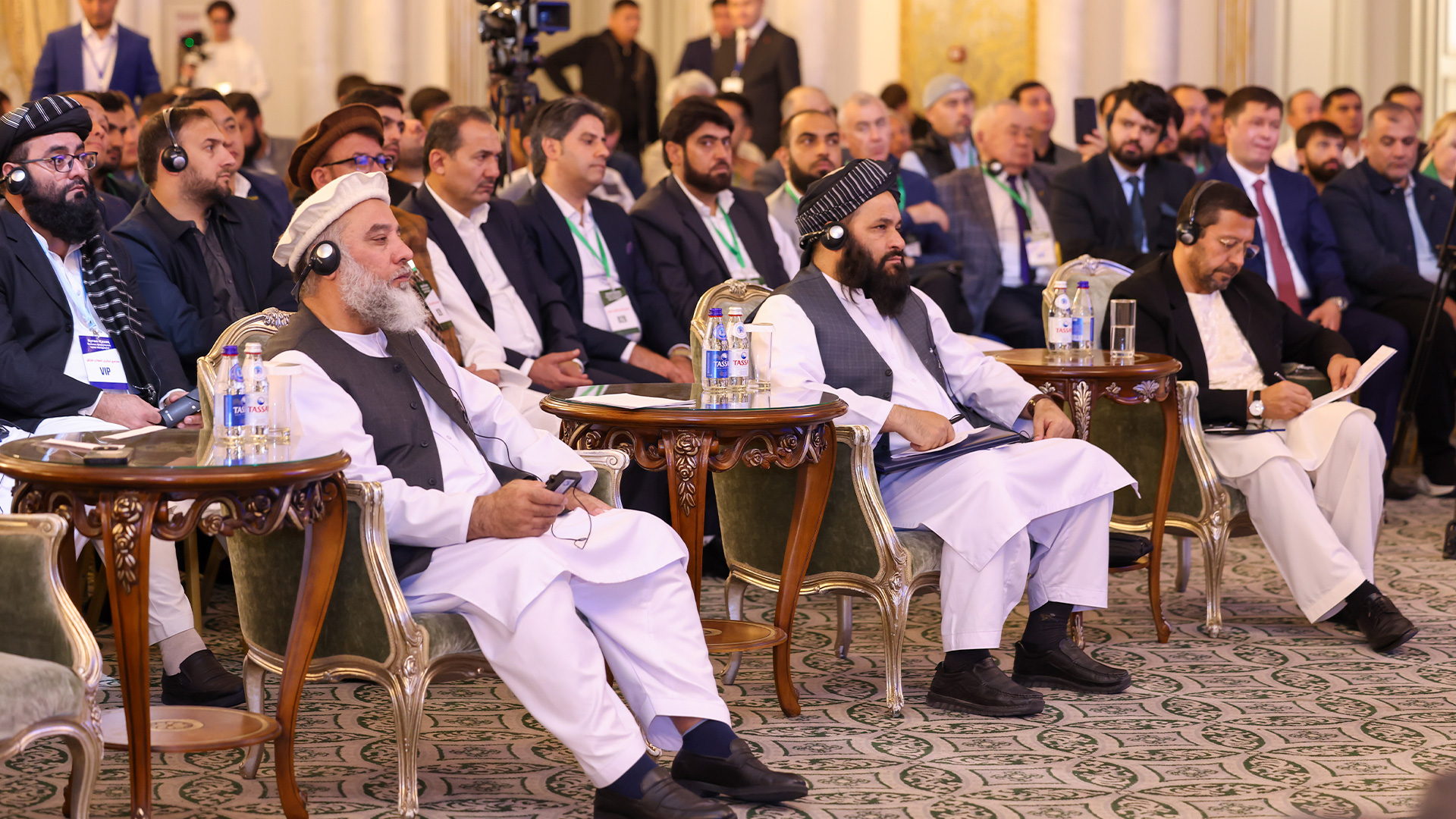
The bonds of business between Afghanistan and Central Asia are increasingly in evidence. Here, Taliban representatives are seen in the audience at a third annual exhibition of Afghan goods in Shymkent, southern Kazakhstan (Credit: primeminister.kz).
But Muttaqi did briefly turn to the issue of Afghan trade transit corridors. There are plans for two railways to run from Central Asia through Afghanistan to Pakistan, but these projects could also be thwarted by the hostilities between Afghanistan and Pakistan.
Muttaqi alluded to the current problems his government has with Pakistan, saying Kabul is committed to finding “peaceful resolutions based on mutual respect and dialogue, but we also retain the right to protect our territorial integrity.”
Security, border cooperation
Security and border cooperation were high on the meeting agenda, with Muttaqi saying that the activities of militants and narcotics smugglers “are common concerns for both sides.”
Since Taliban rule was re-established, security has remained a primary concern for Central Asia. In the ranks of militant groups inside Afghanistan are many Central Asian citizens. Some of the groups are allied with the Taliban, others, such as Islamic State of Khorasan Province (ISKP, or ISIS-K), see the Taliban as an enemy.
After reclaiming Afghanistan, the Taliban leadership quickly pledged that Afghan soil would not be used in the plotting or carrying out of attacks on neighbouring countries. The promise helped facilitate the opening of dialogue between most of Central Asia and the Taliban.
However, in April and July of 2022 ISKP militants launched rockets into Uzbekistan. No one was injured, though the July attack caused some minor property damage. ISKP also fired several rockets into Tajikistan in July 2022, again, without causing any casualties or serious damage.
There has been no repeat of such attacks since, but ISKP continues to operate inside Afghanistan and spreads propaganda online in the Tajik and Uzbek languages, urging citizens in Tajikistan and Uzbekistan to overthrow their governments.
At the Kabul meeting, border security, a topic especially important to Tajikistan, was also addressed.
From August to late November last year, there were at least four serious incidents along the Tajik-Afghan border. Two were clashes between Tajik border guards and Taliban fighters. The fighting prompted officials on both sides to quickly arrange meetings to discuss calming tensions. And in November, a Tajik Foreign Ministry delegation, which included the Border Forces Committee deputy chief, visited Kabul to meet with Muttaqi.
Matters then took on an added seriousness in late November when five Chinese workers were killed in two cross-border attacks mounted by unknown assailants into Tajikistan. Three of those killed were working at a gold mine near the border, while the other two were roadworkers who lost their lives to sniper fire from the Afghan side of the border.
Other border incursions followed. In December, two Tajik border guards and three Afghan smugglers were killed in a shootout. Subsequently, in mid-January, Tajik border guards shot dead four Afghans whom Tajik authorities said were members of an unspecified terrorist group, then several days later Tajik border guards killed three Afghan drug smugglers.
Muttaqi commented that the cultivation of plants used to produce narcotics had been nearly eradicated in Afghanistan, but added that synthetic drugs production was increasing and was now a problem that Afghanistan and Central Asia are combatting.
Several Central Asian states are known to have a growing drug problem.
Muttaqi also remarked: “[I]n light of shared security challenges, there should be discussion and an exchange of views on a common approach between Afghanistan and the Central Asian countries.”
It would be difficult to argue with that. Despite the political differences between Central Asia and Afghanistan, there is a common history and the six countries face many of the same trade and security problems. Cooperation and coordination can only be to everyone’s benefit.
Unlock premium news, Start your free trial today.


