
PANNIER: Central Asian leaders work to keep dream of linking to South Asian markets and seaports on track


Kazakhstan and Uzbekistan’s leaders last week both paid visits to Pakistan, with trade and connectivity right at the top of their agendas.
When it comes to land-linking landlocked Central Asia with the big markets and seaports of South Asia, there is, of course, the not-so-small obstacle of Afghanistan to negotiate. So for Kazakh President Kassym-Jomart Tokayev and Uzbek President Shavkat Mirziyoyev, the development of routes through Afghanistan to Pakistan remains an essential objective.
The Central Asian states have enjoyed good relations with Pakistan for many years. What’s more, until recently, each time Central Asian-Pakistani relations required the participation of Afghanistan, it was Central Asia that looked to Pakistan to take the lead in negotiations with their immediate neighbour.
Of late, however, the situation has reversed. It is now Pakistan that leans more on Kazakhstan and Uzbekistan and the three other, small Central Asian countries to facilitate deals that involve Afghanistan.
Two railroads
Since the early days that followed the independence achieved by the countries of ex-Soviet Central Asia in 1991, the Central Asians have dreamed of opening southward trade routes that would link them to Pakistan, India and the Middle East.
Unfortunately, the only possible routes must go through either Iran, long subject to international sanctions, or Afghanistan, where security problems have prevented any serious efforts at developing the required transportation infrastructure.
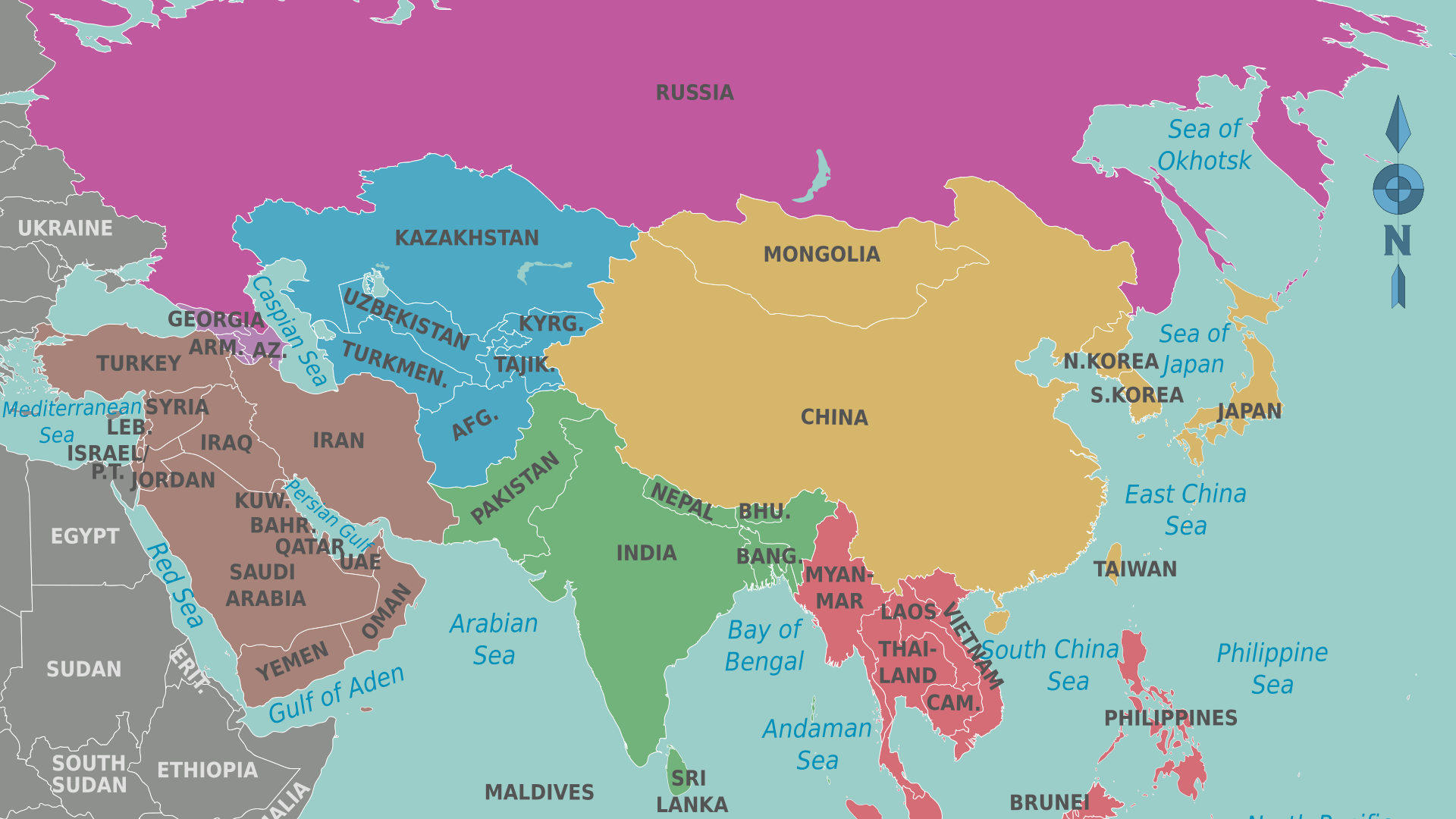
Constructing a trans-Afghan railway linking Central Asia and South Asia is the key to unlocking a whole new world of trade (Credit: Cacahuate, Wikivoyage, cc-by-sa 4.0).
In 2011, the Soviet-era railway running from the Uzbek border city of Termez, which barely reached inside Afghanistan, was extended by 75 kilometres (47 miles) to Mazar-i-Sharif, the biggest city in northern Afghanistan.
Pakistan saw an opportunity. A line could be built from Mazar-i-Sharif running eastward for 600 kilometres to the Pakistani city of Peshawar. There it could link up with Pakistan’s domestic railway network and Arabian Sea ports.
The Taliban’s 2021 return to power in Afghanistan did nothing to curb Pakistan’s, or Uzbekistan’s, enthusiasm for this project. If anything, the Taliban’s harsh rule created a level of stability not seen in Afghanistan for nearly a half century.
In February 2018, a short railway dating back to the Tsarist era that connected Turkmenistan to the Afghan border town of Torghundi was repaired and commissioned. A dry port was also built on the frontier and, in 2024, Kazakhstan, Turkmenistan and Afghanistan signed an agreement to establish a joint logistics centre at Torghundi.
Also in 2024, Kazakhstan became interested in a project that would extend the railway south from Torghundi to Herat and from there to Kandahar and Spin Boldak on the border with Pakistan.
In April 2025, Kazakhstan said it would provide $500mn to start constructing the railway. Five months later, Kazakh Deputy Transport Minister Maksat Kaliakparov told a government session that the 120-km stretch from Torghundi to Herat should be ready by the end of 2027.
Two trips to Pakistan
Tokayev was in Islamabad during February 3-4, as he paid the first visit by a Kazakh president to Pakistan since 2003.
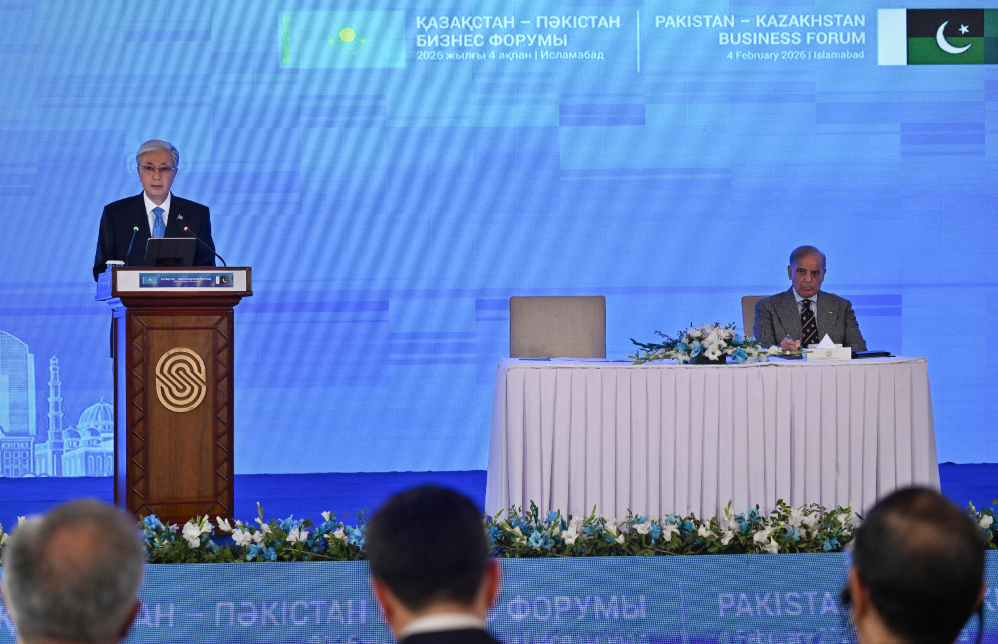
Kazakh President Kassym-Jomart Tokayev addresses a business forum as Pakistani PM Shehbaz Sharif looks on (Credit: Akorda.kz).
After he met with Pakistani Prime Minister Shehbaz Sharif, Tokayev, in an interview with Pakistan’s Geo News, said: “Connectivity has indeed become a top issue of our joint agenda.”
He added that “Kazakhstan is ready to get involved in building the Kazakhstan-Turkmenistan-Afghanistan-Pakistan corridor” and that Astana and Islamabad were already “in close coordination” on the project.
Mirziyoyev was in Pakistan during February 5-6. Shebaz said after his meeting with Uzbekistan’s leader that “[W]e are both in total agreement that the Uzbekistan-Afghanistan-Pakistan rail project will be a game changer, not only for our countries but for the entire region.”
The two presidents released a joint statement saying that the “Uzbekistan-Afghanistan-Pakistan (UAP) Railway Project is the key driver of regional connectivity between Central Asia and Pakistani seaports.”
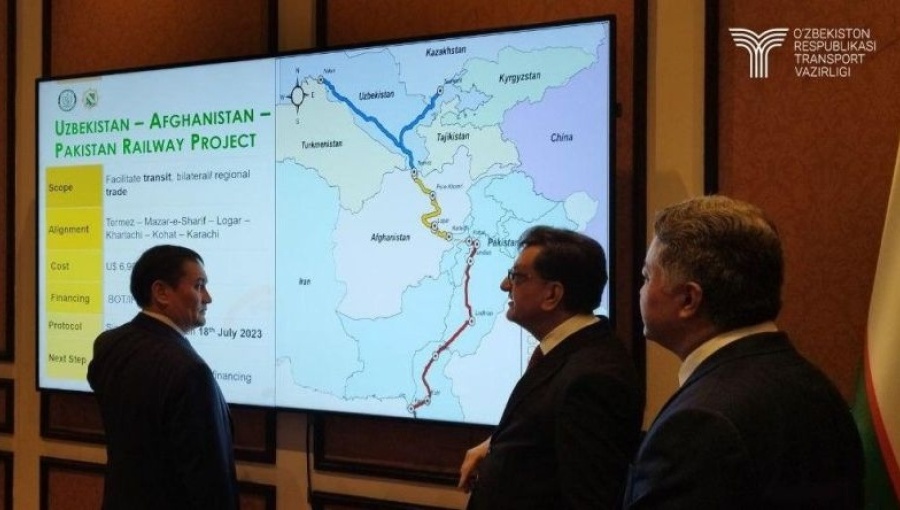
Projects such as the Uzbekistan-Afghanistan-Pakistan (UAP) railway are yet to go anywhere fast. What's more realising them would require costly engineering feats such as building track through the Salang Pass in the Hindu Kush mountains at 3,500 metres (Credit: Transport ministry, Uzbekistan).
One agreement that Pakistan signed with both Kazakhstan and Uzbekistan offers the two Central Asian countries “preferential port arrangements at the ports of Karachi, Gwadar and Qasim”.
Both Kazakhstan and Uzbekistan would stand to profit immensely simply from transit fees charged on railways stretching across Afghanistan as their own rail freight networks connect to destinations in Russia and China.
If the Afghan railways are built, even the Indian Ocean and Baltic Sea could be connected via Pakistan, Afghanistan, Uzbekistan and Kazakhstan.
Two different relationships with the Taliban
When the Taliban ruled nearly all of Afghanistan in the late 1990s, only three countries recognised their government – Saudi Arabia, the United Arab Emirates and Pakistan.
Elements in the Pakistani government have longtime connections to the Taliban and when the latter returned to power four and a half years ago it was easy to reestablish the old relationship of the 1990s.
However, since 2024, Taliban fighters have clashed with Pakistani forces in Pakistan several times, notably in Spin Boldak toward the end of 2025.
The Taliban have accused Pakistan of bombing Afghanistan several times since late 2024.
In the late 1990s, the Central Asian governments, with the exception of Turkmenistan, viewed the Taliban as a regional threat and refused to have any contact with the group.
After the Taliban took control of Afghanistan once again in 2021, most of the Central Asian countries chose the pragmatic course of engaging with the Taliban in a business dialogue.
During the 20 years the Taliban were out of power, Central Asia and Afghanistan saw unprecedented connectivity established, especially in terms of Central Asian electricity exports that now account for some 80% of Afghanistan’s electricity imports.
The new policy has paid off, especially for Kazakhstan and Uzbekistan.
Kazakh-Afghan trade in 2022, with nine-tenths of it made up of Kazakh exports to Afghanistan, totalled almost $1bn. By 2024, that figure had fallen to $545.2mn but importantly, Kazakhstan has become the major supplier of wheat and flour to Afghanistan.
The Kazakh wheat and flour exports have grown because tensions between Afghanistan and Pakistan have caused frequent closures of border crossings between the two countries.
Uzbek-Afghan trade turnover amounted to $1.6bn in 2025, nearly double the 2023 figure. As in the case of Afghanistan’s trade with Kazakhstan, little of the commerce comprises Afghan exports.
Prior to the outbreak of hostilities, Pakistan was the major trading route for Afghanistan imports and exports. But in 2025, Pakistani-Afghan trade plummeted by some 40% to $1.77bn.
This reversal of fortunes leaves Kazakhstan and Uzbekistan as point men in railway talks with the Taliban, whereas previously Pakistan took the role.
Security problems caused by groups such as the Islamic State of Khorasan Province (ISKP) remain, but ISKP is a problem faced by both Central Asia and the Taliban and, for the Taliban as things stand, it is less of a security threat than Pakistan.
Pakistan and Afghanistan are making slow progress toward some sort of reconciliation. Afghanistan needs Pakistan as a trade and transit partner. And Pakistan needs Afghanistan to open up the trade routes north.
However, currently, and for the first time, it is Central Asia, most particularly Kazakhstan and Uzbekistan, that is best positioned to negotiate with Afghanistan to make a reality of long-sought railways, roads and pipelines leading to Pakistan.
Unlock premium news, Start your free trial today.


