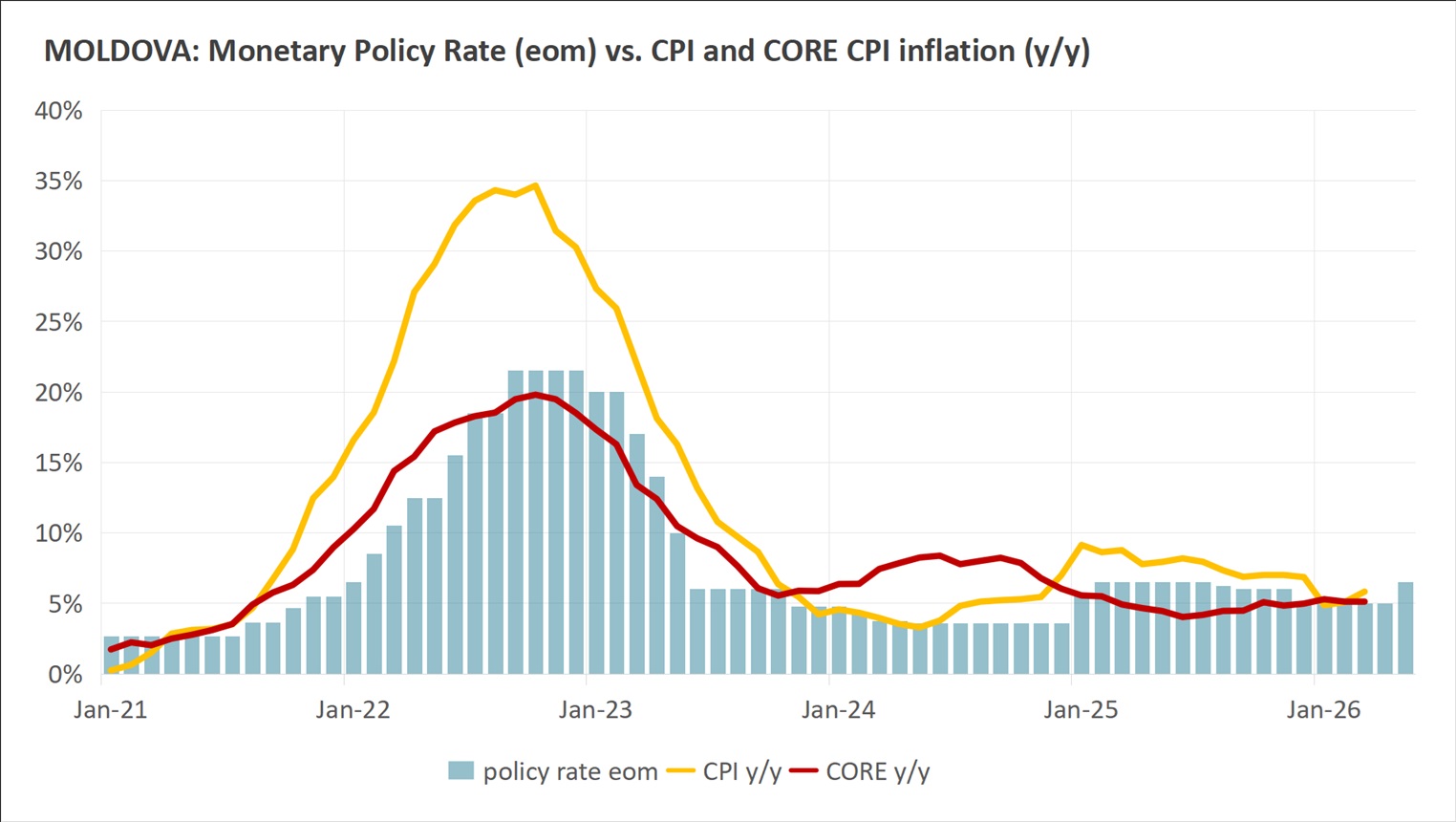
Moldova hikes policy rate amid expected inflationary pressures


The National Bank of Moldova (BNM) raised its key policy rate by 1.5 percentage points to 6.5% at its May 7 board meeting (chart), citing expected inflationary pressures linked to the increase in international prices for energy resources, food products and raw materials and their impact on the forecast of regional economic activity. The central bank upped the average inflation forecast for 2026 by 2 percentage points and for 2027 by 1.3 pp.
The central bank acted before the publication of April inflation data by the statistics bureau. In March, Moldova’s headline inflation had already accelerated to 5.8% y/y from 5.1% y/y in February.
“The upward trajectory of inflation during the current year, in the context of an inflationary nature of the balance of risks related to the current forecast round, indicates the need to initiate monetary policy measures distinct from restrictive conduct,” the BNM said in a statement accompanying the decision.
According to the central bank, the increase in the base rate aims to contain inflationary pressures, limit second-round effects from supply shocks and anchor inflation expectations, with the objective of bringing inflation back within the target corridor over the medium term.
The more hawkish stance also reflects improved economic growth prospects. During 2025, the BNM had largely avoided excessive monetary tightening amid weak economic activity.
The Executive Committee of the central bank noted that recent economic indicators point to favourable growth dynamics in the first quarter of 2026.
Data published by the National Bureau of Statistics (BNS) for the first two months of the quarter showed industrial production increasing by 2.8% y/y, while domestic retail trade advanced by 16.3% on average. Wholesale trade declined marginally by 0.4% y/y.
External trade indicators also improved, with exports rising by 11.6% y/y and imports decreasing by 0.6% y/y in January-February.
Agricultural production, an important sector for Moldova’s economy, increased by 8.6% in the first quarter of 2026 compared to the same period last year.
The central bank said the latest data support a more favourable outlook for economic growth despite mounting inflationary risks linked to external energy markets.
The BNM now expects that during the current year, the annual inflation rate will have an upward trend, and starting with the first quarter of 2027, it will decrease until the end of the eight-quarter forecast horizon. In the second quarter of 2026, the annual inflation rate will remain close to the upper limit of the target band (5% +/-1.5pp), and subsequently, for three consecutive quarters, it will exceed the upper limit and starting with the second quarter of 2027, it will return within the limits of the interval where it will remain until the end of the forecast period.
The average annual inflation for the years 2026 and 2027 will be 7.0% and 5.8%, respectively, higher by 2.0 and 1.3 percentage points compared to the previous forecast in February.
Unlock premium news, Start your free trial today.