
Moldova has the winter gas contracted, but not in the ground


State trader Energocom has contracted 76% of Moldova's gas needs for the year to September 2027, but most of that is contract rather than stock in the ground, Eugeniu Buzatu, Energocom's director general, told an energy panel at Moldova Business Week in Chisinau on October 2.
He announced that deals struck with Romania would be enough to see consumers through the winter, and that the country also holds gas in storage. “The deal is done and we have secured enough gas to meet consumers needs for the whole winter.”
Moldova has no underground storage of its own and relies on imports of both gas and electricity from its neighbours to meeting the increased demand during the heating season that is about to start. The weather in Chisinau remains pleasant but even during the week-long investment summit temperatures have already become noticeably more chilly. Every cubic metre Energocom describes as stored is sitting in someone else's reservoir, in Romania, in Ukraine or elsewhere in the EU and the Energy Community, under agent contracts. Everything else is a delivery obligation that has to travel.
Energocom has contracted the entire volume needed for the heating season from October 2026 to March 2027, a total of 3,832,693 MWh, which amounts to about 76% of the full gas year running to September 30, 2027, the company said on August 13. Procurement began in July and ran through 24 tender rounds, of which 23 were completed. Eleven companies took part, from Romania, Austria, Bulgaria, Luxembourg, Switzerland, Malta, Germany and Greece.
What Energocom has not bought is price certainty. The final price on those contracts is set by a formula indexed to the TTF front-month index published by Argus Media for the following month of delivery, so the volumes are fixed and the cost is not. A cold European winter that lifts the Dutch benchmark lifts Moldova's import bill with it, and the government is already subsidising household tariffs.
Representatives of the energy ministry, the State Property Agency, the prime minister's office, the Information and Security Service and civil society sat in on all of the tenders, a level of supervision that says something about how politically exposed gas buying has become in Chisinau.
On the storage side, the obligation Energocom is working to is 15% of projected volume, or about 134.5mn cubic metres, to be held in neighbouring countries that have the facilities. Separately the energy ministry decided on June 2 to raise the country's security stocks by 6.3mn cubic metres, from 50mn to 56.3mn cubic metres, for the 2026-2027 cold season, with Energocom instructed to have the extra gas in place by October 1, according to the ministry. It attributed the increase to higher consumption during the previous winter. The Energy Community Secretariat recommends that countries without storage infrastructure hold reserves worth at least 15% of national consumption, and has cited Moldova as an example of good practice.
The security stock of gas is the equivalent of roughly 10 days of winter consumption and are reserved for emergencies. The gas that actually gets Moldova through a cold January is the commercial stock, and last season it was run almost to zero.
Energocom began the 2025-2026 season with more than 100mn cubic metres stored in Ukraine and more than 30mn cubic metres held elsewhere under agent contracts. It drew on those commercial reserves steadily from November to the middle of February, heavily in January when temperatures fell, and by February 18 had about 8mn cubic metres left of the roughly 134mn cubic metres it started with, the company said at the time. The strategic reserves were never touched. Buzatu, then acting general director, said efficient management of stocks had been the key element in getting through the cold season safely and without interruptions, but the company has tried to manage demand by appealing to the people to restrict electricity use during peak periods last year.
The system worked last but ended the season literally running on fumes. The largest single block of Moldovan gas was held in Ukrainian storage, in a country whose gas production and storage infrastructure is under repeated Russian attack. A contract with a Romanian counterparty is only as good as the molecules behind it and the pipe they travel down.
The wider position has improved out of recognition since the winter of 2022, when Gazprom cut volumes and Moldova was buying gas at crisis prices. Chisinau has since stopped taking Russian gas for the right bank completely since that crisis, and now sources on the European market, mainly through Romania, and the transmission system has been unbundled and reoriented westwards. The country nonetheless imports all of its gas, most of its electricity and all of its petroleum products.
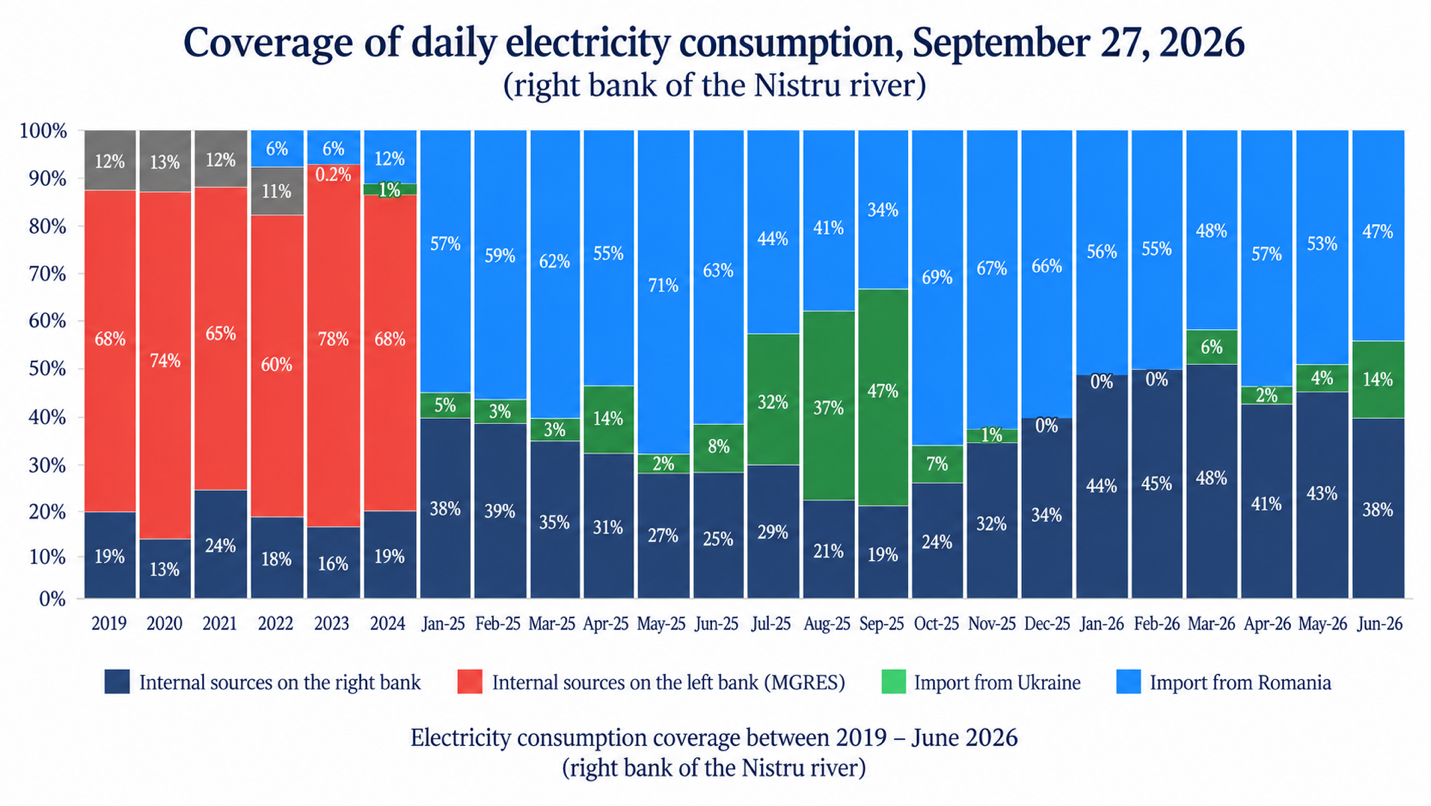
The security position has not improved. Moldova's National Security Council met on September 21 under President Maia Sandu and agreed that the government should ask parliament for a state of emergency in the energy and hydrological sectors, citing risks to electricity, gas and fuel supplies and a sharp fall in flows on the Dniester river. Contingency measures approved that day included keeping alternative import routes open, the potential emergency use of the 110 kV interconnections with Romania, building emergency stocks of petroleum products and stockpiling spare parts for rapid intervention, with institutions told to report back by December 15.
The country recorded 39 violations of its airspace in the first nine months of 2026, against 17 in the whole of 2025, according to the Presidency.
The remaining quarter of the gas year is the April to September 2027 tail, outside the heating season and the cheaper half of the calendar to buy in. Energocom has the harder months covered. Whether it has them covered securely is a question about Ukrainian storage, Romanian pipelines and the TTF curve, none of which Chisinau controls.
Unlock premium news, Start your free trial today.


