
Kazakhstan rejects idea of Turkic states military alliance


Kazakhstan does not support the idea of turning the Organization of Turkic States (OTS) into a military alliance or geopolitical project.
That was the message from the country’s president, Kassym-Jomart Tokayev, on May 15 as fellow leaders in the group, including Turkish President Recep Tayyip Erdogan, assembled for an informal OTS summit.
As analysts debated the significance of the summit – held in Turkistan, southern Kazakhstan, and also attended by the leaders of group members Azerbaijan, Uzbekistan and Kyrgyzstan – Tokayev dismissed any idea of backing the creation of an OTS military union.
"Recently,” said Tokayev, “some have expressed opinions about a military alliance. Their negative intentions are clear to us. It is also known that their goals have nothing to do with reconciliation. Kazakhstan believes that such a stance should be rejected.
“For us, strengthening the unity of the Turkic world is a critically important and urgent priority. The Organization of Turkic States is not a geopolitical project or a military organization. It is a unique platform that strengthens trade, economic, high-tech, digital, cultural and people-to-people cooperation among brotherly countries." said Tokayev.
Tokayev – tipped by some to become the next UN general secretary – added that the Turkic world should "live in peace and develop together without straying from its goals".
Tokayev also stressed the importance of the unity of the Turkic states during the "extremely complex international geopolitical situation".
In April, Russian Defence Minister Andrei Belousov made it clear Russia would find the presence of outside powers in ex-Soviet Central Asia unacceptable.
Azerbaijan proposed military drills
Azerbaijan has previously proposed that the OTS countries should hold joint military exercises. As well as the full members, the 17-year-old OTS has three observer members – Turkmenistan, Hungary and the internationally unrecognised Republic of Northern Cyprus.
The topic of the annual informal summit this year was artificial intelligence (AI) and digital development.
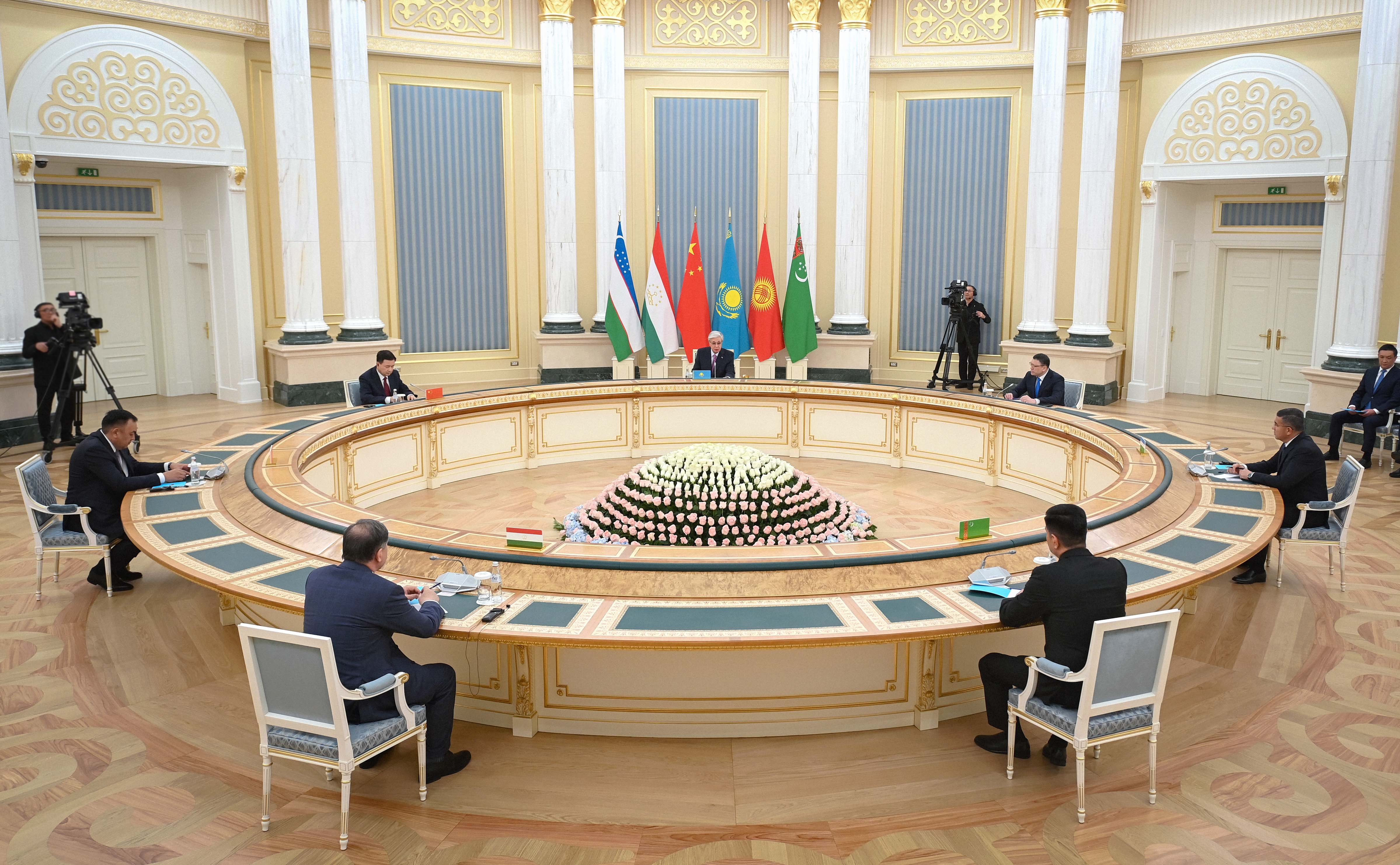
The leaders of the OTS countries met for the summit in Turkistan at a time when Middle East conflict and other uncertainties have regional leaders in the dark over an uncertain path ahead (Credit: Akorda.kz).
However, Erdogan, who arrived in Kazakhstan for a state visit two days before the summit, frequently delved into geopolitical matters in his comments made in Turkistan.
"The crises in Palestine, Lebanon, Iran, Ukraine and other countries have highlighted the need to strengthen our defence and increase cooperation in the industrial sector," Erdogan was cited as saying by Azattyk.
He also remarked on how transportation and communication projects, especially the Middle Corridor connecting China and Turkey/Europe via Central Asia and the South Caucasus, have to remain a strategic priority.
"As the crisis in the Strait of Hormuz shows, transport projects connecting the Turkic world, including the Middle Corridor, will remain our main priority for many years to come,” said Erdogan.
“Digital Turkic Corridor”
Uzbek President Shavkat Mirziyoyev, speaking at the summit, proposed the creation of a "Digital Turkic Corridor" and a cybersecurity alliance.
The Turkic countries, he added, should create a common network of cooperation in the field of AI and jointly develop modern technologies.
The Uzbek president also proposed a "Turkish Cybersecurity Alliance" to protect digital infrastructure and jointly counter cyber threats.
Stating that the total economic potential of the OTS member states exceeded $2.4 trillion in 2025, while the overall economic growth of the OTS countries was twice as high as the global average, Mirziyoyev added: "If we can unite the intellectual potential and creative power of our countries in the new era, the Turkic world will become a space for advanced solutions and sustainable development."
Kyrgyz President Sadyr Japarov agreed technologies have become a key factor in economic growth and global competition and said that strengthening cooperation between Turkic states in the field of AI and digitalisation should be conducted to create an independent geoeconomic and technological centre.
Azerbaijani President Ilham Aliyev pointed to the digital OTS integration within the framework of the "Digital Silk Road" project linking Europe and Asia. A fibre-optic cable network linking Azerbaijan and Kazakhstan that runs beneath the Caspian Sea would be launched in the coming months, he said.
Aliyev also spoke about the geopolitical side of the OTS, saying: "Dear friends, our family – the Turkic world – should become one of the influential geopolitical centres of the 21st century. Azerbaijan will continue to spare no effort to strengthen the Organization of Turkic States."
How formal and organised the geopolitical side of the OTS should be in Azerbaijan’s eyes was not outlined by Aliyev in remarks reported by Azattyk.
Central Asia diversifying arms purchasing, revising defence doctrines
On the military side, there is no doubt that amid the geopolitical instability, the Central Asia states intend to ensure a diversity of arms purchasing, with Turkish and Chinese military equipment, for instance, becoming more prominent in their armed forces, and Russian equipment less so.
Turkey is enjoying some success selling attack and other defence drones to Central Asia and during the OTS summit it was announced that Ankara and Astana have agreed to a joint venture in Kazakhstan under which Turkish ANKA drones will be assembled in the country.
Kazakhstan has lately committed to a two-year programme of military upgrades. Tokayev has spoken of transforming the Kazakh armed forces into a “high-tech fist”.
Uzbekistan, meanwhile is revising its Defence doctrine. It will adopt modernisation driven by AI, drones and cyberwarfare, expand its domestic defence industrial capacity and lower reliance on Russia’s legacy security architecture.
Notably, in Kazakhstan, in 2023, the ASPAN project to build four factories to produce Nato-standard ammunition, artillery shells and mines was launched.
At the OTS summit, Tokayev also told fellow leaders that he believes the countries of the OTS possess sufficient scientific and technological potential to jointly pursue space industry development.
“Our countries' scientific, technological, and financial potential is sufficient to develop this field systematically. In particular, we need to implement joint projects in satellite communications, navigation and monitoring. This will strengthen our integration. This will strengthen our technological independence and boost innovation,” he said.
Unlock premium news, Start your free trial today.


