Log In

Try PRO

AD
Ben Aris in Berlin

Israel, US have armed themselves for the wrong war


The Israeli Army took its heaviest tank losses in over 40 years after Hezbollah ambushes destroyed 21 Merkavas main battle tanks in a single day on March 26. Israel and the US have armed themselves for the wrong war.
Israel, US have armed themselves for the wrong war
America has the biggest and best weapons in the world but in an asymmetric war it's not about having the best weapons it's about having the right weapons. Israel and the US have armed themselves for the wrong war.
March 27, 2026

Hezbollah published footage of striking an Israeli Merkava tank in the town square of Taybeh, southern Lebanon on March 26.

The Israeli Army took its heaviest tank losses in over 40 years after Hezbollah ambushes destroyed 21 Merkavas main battle tanks in a single day on March 26.

Multiple ambushes launched against Israeli forces in southern Lebanon caught them off guard and destroyed the tanks using a mixture of drone and infantry attacks. Independent verification of the scale of damage and weapons used remains limited.

According to local reports, cheap anti-tank guided missiles and drones were effectively used to destroy the large main battle tanks valued at several million dollars each.

It was an engagement strongly reminiscent of the opening stages of the war in Ukraine, Russian forces were also wrong-footed by lightly-armed Armed Forces of Ukraine (AFU) using US-supplied Javelin missiles that “popped the tops” or Russia’s heavy tanks in fast moving but devastating attacks.

Hezbollah’s weapons have been upgraded, and in addition to shoulder-fired missiles it has gone straight to the drone phase of the war using its advanced drone technology and that supplied by Russia.

Other footage released on social media has shown Iranian forces flying First Person View (FPV) drones, guided by an unjammable fibre optic wire controls system that have stuck and destroyed US Black Hawk helicopters inside a US Gulf base.


The fibre optic guidance system was a Russian innovation that was initially scorned by the AFU, then adopted wholesale by the Ukrainian forces. Since these technological advances both Russia and Ukraine have developed myriad new systems and countermeasures, but it appears that both the US and Israel are still relying on old school thinking and armed themselves with heavy mechanised armour that is increasingly helpless in the rapidly evolving modern warfare techniques developed in the wheatfields of Ukraine.

As bne IntelliNews reported, in a modern asymmetrical war it is not about having the best and most powerful weapons, but having cheap, but “good enough” weapons in massive numbers. The old school “Command of the Commons” military doctrine that emphases military “primacy” that has been standard for decades, has given way to the “Command of the Reload” since the short war between Azerbaijan and Armenia in 2020 pioneered drone-use, where the emphasis is on overwhelming your opponent with an almost limitless supply of cheap but deadly drones.

Iran and its proxies like Hezbollah have adopted these tactics and have largely been able to negate the US and Israeli advantages in the sophistication of their weapons.

As Ukraine’s former commander-in-chief General Valerii Zaluzhnyi wrote in an editorial recently: “The large-scale changes that have occurred on the battlefields of the Russian-Ukrainian war have changed the paradigm of how warfare is waged… Today, in a relatively cheap way, any country can have combat capabilities that completely outstrip its economic or demographic situation if there is a desire and political will for it.”

Israel found this out to its cost after Hezbollah destroyed 21 Merkava main battle tanks in less than a day between the towns of Taybeh and Qantara on March 26. Other reports claim Hezbollah destroyed more than 100 tanks in total in 48-hours, according to Iran’s state-run Press TV.

Hezbollah artillery units also targeted Israeli command positions in the Taybeh region, Rab Thalathin and Oudaiseh, while also firing on Israeli reinforcements that were dispatched to evacuate casualties, Military Watch reports. Hezbollah attacks were supported by longer-range missile strikes against Israeli positions by Iran.

As bne IntelliNews reported, Israel launched a large scale invasion of southern Lebanon after Hezbollah fired rockets in retribution for the assassination of Supreme Leader Ayatollah Ali Khamenei. The IDF has been targeting civilians as part of a drive to depopulate the region and take complete control up to the Litani river. More than one million people have already been displaced as Israel adopts tactics similar to those used in Gaza by flattening residential buildings and destroying local infrastructure.

The success of the Hezbollah counterblow represents the most extreme losses Israeli armour has suffered in over 40 years since the early stages of the Lebanon War when Merkavas and older US-supplied tanks engaged newly supplied Syrian Army Russian-made T-72 tanks and anti-tank guided weapons.

Ammo running low

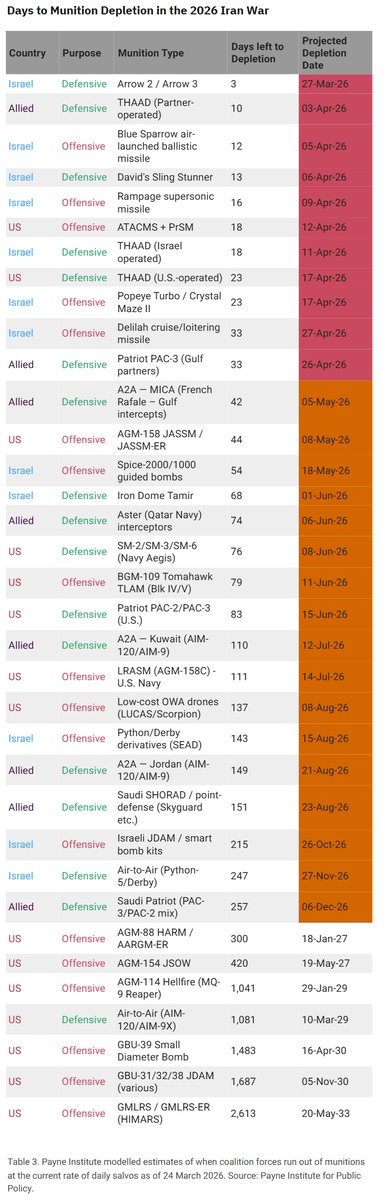
To compound the attacking coalitions problems, they are already running low onf the very powerful ammunition they put such store in. A new report from the Royal United Services Institute for Defense and Security warns that Israel has used most of its Arrow 2 and 3 interceptors, while U.S. THAAD missiles protecting Gulf allies are heavily depleted.

A previous report from The Foreign Policy Research Institute (FPRI) and the Payne Institute also identified critical shortages in 14 of the 35 munitions used in Iran after just the first 96 hours of fighting.

The Royal United Services Institute for Defence and Security estimates that Israel has already fired 80% of its Arrow 2 and Arrow 3 interceptors, 54% of its David’s Sling missiles, and 45% of the American-made THAAD interceptors it operates. By contrast, only 20% of Iron Dome interceptors have been used. The institute estimates that 60% of the THAAD missiles deployed to protect Gulf states from Iranian attacks have already been expended.

Israel’s stockpiles of offensive weapons remain in better shape; for instance, only half of its Rampage missiles have been launched, Haaretz reports.

Israel’s interception capabilities are finite and cannot match the rate at which Iran is launching missiles at Israel and the Gulf states. Each Arrow interceptor costs between $2mn and $3mn, limiting how many Israel can afford. The cost of the missiles and the size of the stockpile — which cannot be expanded quickly — put a mathematical limit on how long the war can run using the current mix of weapons and methods.

The institute estimates that it could take the United States up to five years to restore its Tomahawk missile reserves.

IDF sources responded last week to reports suggesting Israel’s interceptor stockpiles are running low, but did not give any details.

In addition to running short of interceptors, Iran’s latest missiles have received a technological upgrade and have proven able to evade interceptors and hit their targets. All 13 of the US Gulf bases have been badly damaged by Iranian strikes, and most are now largely without staff.
IDF under pressure
Israel’s military leadership has warned the government that after roughly 900 days of near-continuous conflict, the army is approaching a breaking point. In remarks delivered to ministers, the IDF Chief of Staff set out a picture of a force stretched across too many fronts, with too few people, and no clear relief in sight.

Reservists are now deployed simultaneously across Gaza, Lebanon, Syria, the West Bank and, increasingly, in preparation for a direct confrontation with Iran. Senior IDF officials have warned of a “manpower crisis” as repeated call-ups stretch the system beyond its design limits. What was once a surge force has become a standing one. The system was not designed for that.

At the same time, a structural gap remains unresolved. No ultra-Orthodox conscription law has been passed, leaving thousands effectively outside the draft. Israeli defence officials have warned that without changes to conscription policy, “the model will not hold”. The political compromise that sustained this arrangement in peacetime is colliding with wartime reality.

Pressure is also being generated internally. The cabinet’s decision to legalise dozens of additional outposts and farms in the West Bank has created new security obligations, each requiring troops on the ground. Parallel to this, a rise in Jewish nationalist violence in the territory has already forced the deployment of an additional battalion, with the prospect of more to follow. Military officials have described the current operational tempo as “unsustainable over time”.

And then there is a manpower problem. Mandatory service is set to fall to 30 months from January 2027, moving in the opposite direction to the military’s request to extend it to 36 months. Fewer soldiers, staying for less time, entering a system already under strain. Former and current officials have warned of an “erosion of readiness” if forces remain continuously deployed.

Key legislation covering conscription, reserve mobilisation and service length has been delayed, in large part due to tensions surrounding exemptions for the Haredi community. The issue has been described internally as “no longer tenable in wartime conditions”. The result is a widening gap between operational demand and legal supply. The commitments are expanding faster than the force that sustains them.

The warning from the Chief of Staff is stark: without a reduction in operational scope, the system will begin to fail under its own weight.


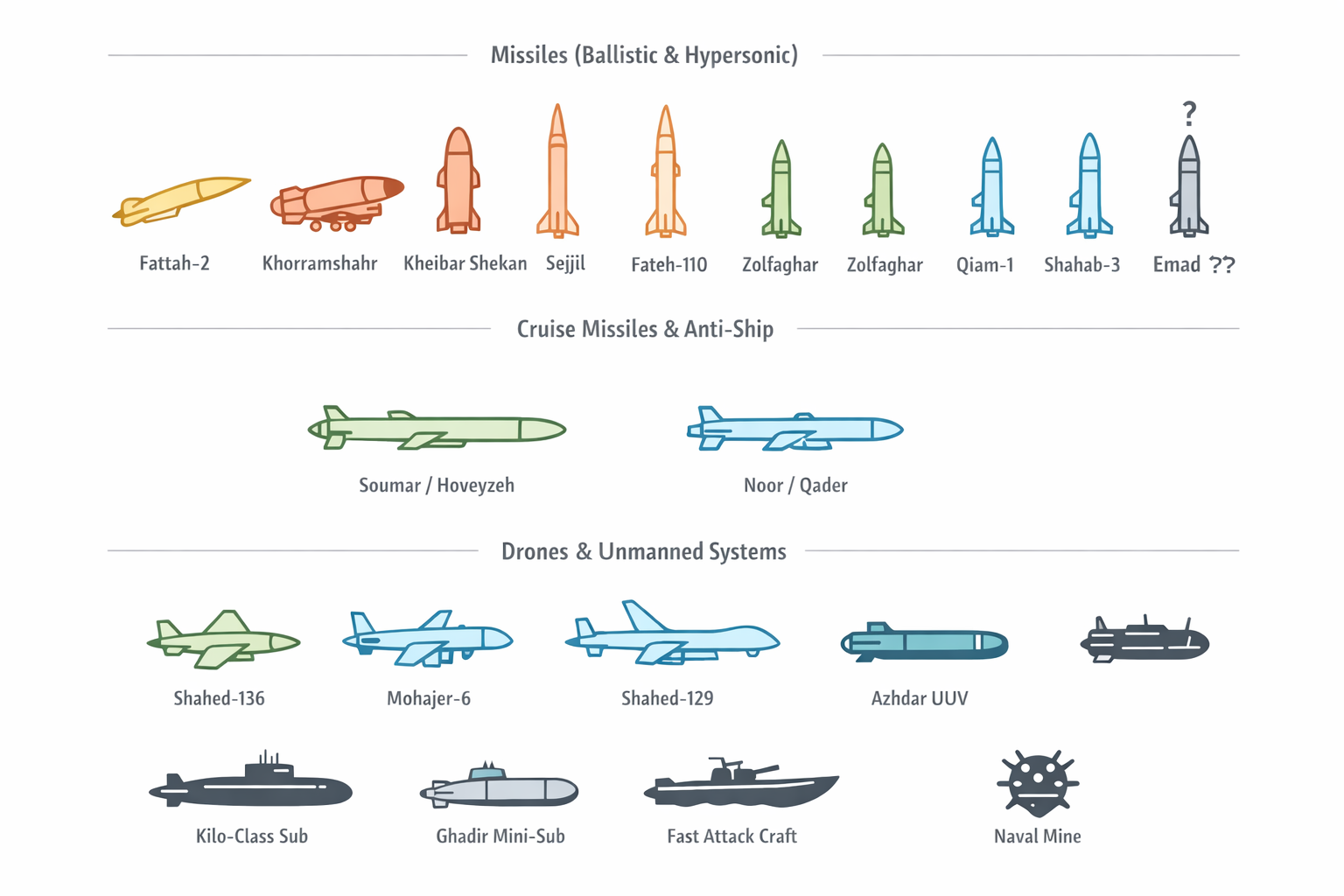
Selected leading Iranian weapons systems

Missiles (ballistic and hypersonic)

Fattah-2 hypersonic missile: Iran’s Fattah-2 is presented as a next-generation hypersonic system designed to evade air defences through high speed and manoeuvrability, using a glide vehicle that can adjust its trajectory in flight.

Khorramshahr intermediate-range ballistic missile (IRBM): A heavy missile capable of carrying a 2-tonne cluster munition warhead, prioritising payload over precision and designed for high-impact strikes over intermediate ranges.

Kheibar Shekan: Unveiled in 2022, this newer-generation ballistic missile carries a one-tonne warhead and reflects a shift towards greater accuracy and mobility.

Sejjil missile: A solid-fuel ballistic missile offering faster launch times and greater survivability compared with liquid-fuel systems, forming part of Iran’s more modern strategic capability.

Fateh-110 family: A highly accurate, short-range ballistic missile and one of the most widely used systems in Iran’s arsenal, forming the backbone of its regional strike capability.

Zolfaghar: An extended-range variant of the Fateh family, with a range of around 700km, designed for precision strikes and used in operational deployments.

Qiam-1: A liquid-fuel missile derived from Scud designs but modified for greater efficiency, notably lacking stabilising fins, and used in several real-world strikes.

Shahab-3: One of Iran’s earliest medium-range ballistic missiles, with a range of up to 2,000km, forming a core part of its long-standing deterrent despite being less advanced.

Emad missile: An upgraded version of the Shahab-3 with improved guidance systems, marking a transition towards more precise targeting capabilities.

Nasrallah system missile: A newly identified system reportedly used in a strike on the Haifa refinery in Israel, signalling continued development of Iran’s strike arsenal, though details remain limited.


Cruise missiles and anti-ship systems

Soumar / Hoveyzeh cruise missiles: Long-range land-attack cruise missiles, believed to be derived from older Soviet designs, capable of flying at low altitude and evading radar.

Noor / Qader anti-ship missiles: Key components of Iran’s naval strategy, designed to target vessels in the Gulf and the Strait of Hormuz, reinforcing its ability to threaten maritime traffic.

Drones and unmanned systems

Shahed-136 MS series: A loitering munition equipped with an improved eight-channel, jam-resistant satellite navigation system known as Nasir, reflecting upgrades made following recent conflicts.

Mohajer-6: A surveillance and strike drone capable of carrying precision-guided munitions, widely used in regional operations.

Shahed-129: A longer-range unmanned aerial vehicle designed for reconnaissance and strike missions, comparable in role to US Predator-type systems.

Azhdar underwater drone: An unmanned underwater vehicle intended for reconnaissance and potential attacks on maritime infrastructure, forming part of Iran’s asymmetric naval toolkit.

Naval platforms and asymmetric warfare

Kilo-class submarines: Russian-built diesel-electric submarines known for their relative stealth, providing Iran with a conventional undersea warfare capability.

Ghadir mini-submarines: Smaller, domestically produced submarines optimised for shallow waters, suited to ambush tactics and operations in the Gulf.

Fast attack craft (IRGC Navy): Small, heavily armed boats designed for swarm tactics, central to Iran’s strategy for confronting larger naval forces in confined waters.

Naval mines: A critical but often overlooked capability, allowing Iran to disrupt shipping lanes and potentially close chokepoints such as the Strait of Hormuz.

 
Unlock premium news, Start your free trial today.
Already have a PRO account?
About Us
Contact Us
Advertising
Cookie Policy
Privacy Policy

INTELLINEWS

global Emerging Market business news