
Israel now occupies more of Lebanon than Russia does of Ukraine


Israel has occupied more of Lebanon’s territory after three weeks of fighting than Russia controls of Ukraine after four years of war.
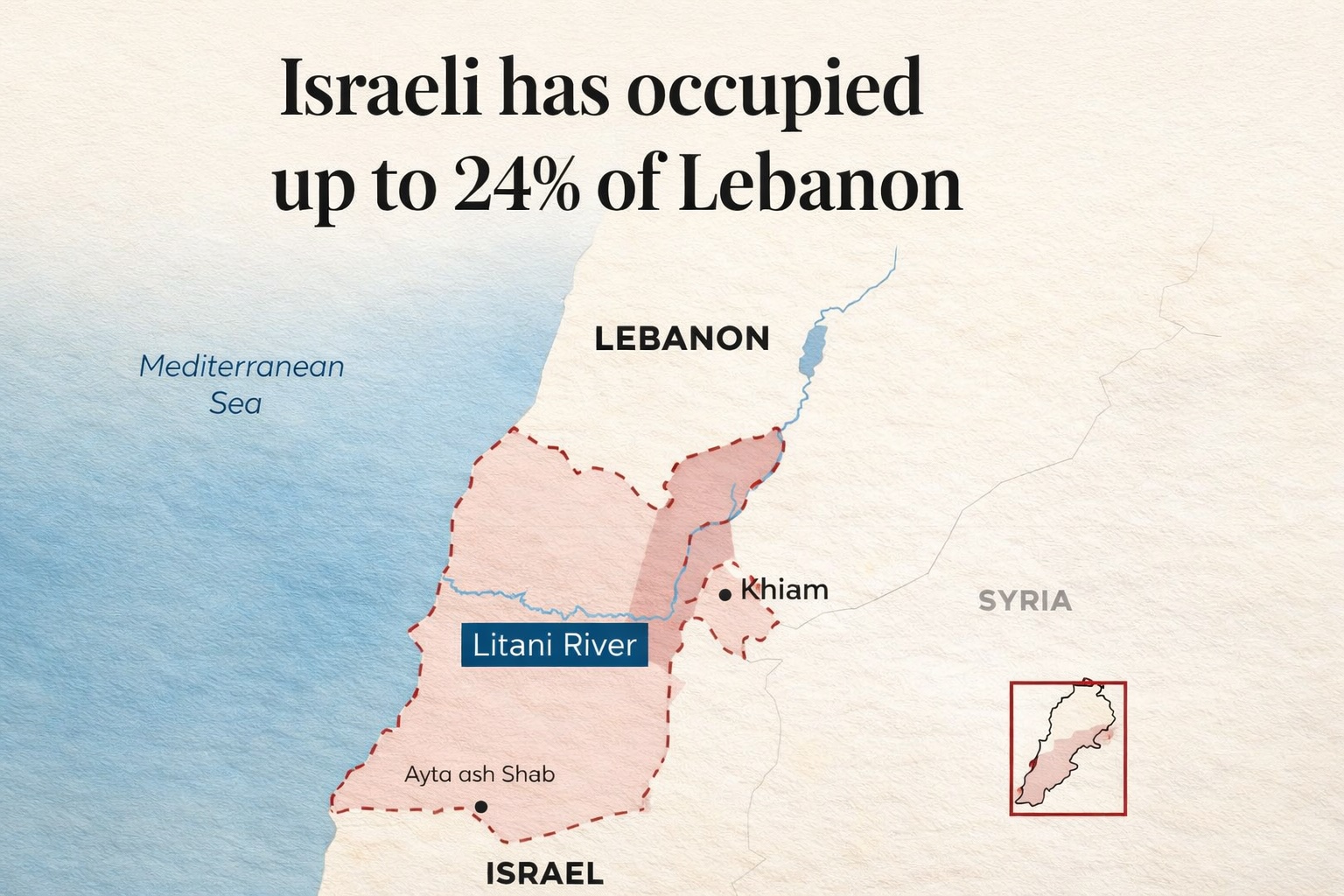
In the initial attack, Israeli forces quickly occupied the strip of land in southern Lebanon between the Israeli border and the Litani River –
about 14% of Lebanon’s territory and slightly less than the area of eastern Ukraine currently occupied by Russia, or 19.4%, according to the latest estimate from the Institute for the Study of War (ISW).
However, according to confirmed reports, the IDF has moved across the river and is pushing further north, although it remains unclear if Israel controls this land, or merely occupies it.
There are confirmed reports that the IDF controls a salient round Khiam in the east and has active forces in a belt running from Marjayoun in the west of the country to Khaim in the east, with Qlayaa and Hasbaya just beyond, marking how far north the extension appears to reach. Fighting is confirmed in the Marjayoun district and Nabatieh and surrounding villages just north of the Litani River, the main administrative and commercial centre for the region.
Five bridges, "used by Hezbollah for the passage of terrorists and weapons" were destroyed last week, Israeli Defence Minister Israel Katz said on March 26, adding that Israeli troops will “control a large swathe of southern Lebanon” as part of their campaign against Hezbollah.
If the line between Marjayoun, Nabatieh and Khiam is assumed as the northern border of the occupation, then the IDF now controls between 20% and 24% of the country, more land than Russia occupies in Ukraine.
The difference between the two conflicts is that Russian and Ukrainian forces are now dug into their positions having built extensive defences, however, the fighting in Lebanon remains at an early stage and is still very fluid.
In the first round of fierce fighting, Israel has been attempting to push the population out of the southern part of the country and has largely consolidated its control of the land up to the Litani River. The IDF has reportedly been attacking civilian areas and using illegal ordinances like white phosphorus to push residents out of the region. The stated aim of Tel Aviv is to depopulate the southern region up to the Litani River and create a “buffer zone.”
One in five Lebanese, more than a million people, have already been displaced, threatening to create a humanitarian crisis. Israel has already adopted the same tactics that it used in Gaza and has begun to bulldoze residential buildings and key local infrastructure to ensure refugees cannot return to their homes. Confirmed video released by the IDF shows the destruction of residential buildings in regional towns in built up areas using missile attacks.
An IDF video showed a building collapse in the southern Lebanese town of Yohmo on March 23.
Russia has pursued similar tactics in Ukraine but after four years of fighting has only managed to occupy a fifth of the country. However those areas it does control are being rapidly reconstructed, with new roads and buildings to house Russians who are being imported into the area, now known as Novorossiysk, according to a recent investigation by Reuters.
Russia's invasion and destruction of cities in the east of Ukraine caused international outrage in 2022, bringing down an extreme sanctions’ regime on the Kremlin. However, a similar invasion and the same tactics of destroying towns and villages by Israel has caused little comment.
Past Israeli invasions of Lebanon have been more limited in geographic scope, including its occupation of a “security zone” in southern Lebanon between 1985 and 2000.
The Litani River plays a key role in conflicts between Lebanon and Israel. Under UN Security Council Resolution 1701, which ended the 2006 war between Israel and Hezbollah, armed groups are barred from operating south of the river. Israel says Hezbollah maintains a significant presence there.
Iran has told intermediaries in the last week that Lebanon must be included in any ceasefire agreement with the US and Israel, six regional sources familiar with Iran's position said, Reuters reported on March 25. Iran's Press TV cited an Iranian official last week saying Tehran wanted any deal with the US to secure an end to the war both on Iran and other "resistance groups" in the region.
The conflict between Israel and Lebanon has been running for decades.
In 1978, Israel invaded south Lebanon and set up a narrow occupation zone in an operation against Palestinian guerrillas after a militant attack near Tel Aviv. Israel backed a local Christian militia called the South Lebanon Army (SLA).
Four years later, Israel invaded Lebanon all the way to Beirut in an offensive that followed tit-for-tat cross-border fire. It pulled back from central Lebanon in 1983 but retained forces in the south.
In 1985, Israel established a wider occupation zone in southern Lebanon, about 15 km deep, controlling the area with the SLA.
Israel withdrew from southern Lebanon in 2000, after continued attacks on Israeli military positions in occupied Lebanese territory by Hezbollah, ending 22 years of occupation.
In 2006, Hezbollah crossed the border into Israel, kidnapping two Israeli soldiers and killing others, leading to a five-week war involving heavy Israeli strikes on both Hezbollah strongholds and national infrastructure.
On October 8, 2023, Hezbollah opened fire at Israel, one day after the Hamas-led attacks on southern Israel that killed 1,200 people in Israel and led to war in Gaza, pitting Israeli forces against the Palestinian militant group. Israel responded to Hezbollah with a bombing campaign and eventually sent its ground troops into southern Lebanon again. After a 2024 ceasefire, Israel kept troops on five hilltops in southern Lebanon.
Reportedly a total of 1,072 civilians have been killed in Lebanon so far, according to the Lebanese health ministry, including at least 121 children and 42 health workers.
Unlock premium news, Start your free trial today.


