
Is Ukraine already a failed state?


There is an uncomfortable question looming over the Ukraine war: has Russia already done so much damage to the country that it will eventually emerge from the war as a failed state that will take decades, or even generations, to recover, if ever. Compared to other conflicts, Ukraine’s destruction to GDP ratio is already at 3.5 – the largest in modern history. And that is before Vladimir Putin’s winter bombardment campaign gets fully underway.
The cost of the destruction has already reached $588bn, according to the World Bank’s latest appraisal, but could reach $700bn, or 3.5 times GDP, by end-2026 according to their experts thanks to Russia’s missile dominance and the dwindling supplies to Ukraine’s interceptor air defences. Those strikes have already destroyed two thirds of Ukraine’s power sector, and since the escalation of a brutal tit for tat missiles war since the summer, now Russia is systematically attacking ports and railways, retail and warehousing infrastructure, fuel distribution, and most recently moved on to datacentres, telecoms and higher educational institutes, erode the country’s very economic base. As IntelliNews reported in 2024, Ukraine already had a mountain to climb in terms of repairing the damage to each sector after only two years of fighting.
Ukrainians are putting up a heroic resistance, but the lack of money, missiles and men is becoming acute. The fifth joint Rapid Damage and Needs Assessment (RDNA5), published on February 23 by the government, the World Bank, the European Commission and the UN, put the cost of recovery and reconstruction at almost $588bn over the next decade and direct physical damage has passed $195bn as of December 2025, up from $176bn a year earlier. That is nearly three times Ukraine's estimated 2025 nominal GDP.
The bill has risen with every assessment since the full-scale invasion began, from $349bn in the first RDNA in 2022 to $411bn, $486bn, $524bn and now $588bn. A $700bn figure by the end of this year would mean adding $112bn in 12 months, almost double the $64bn added in 2025. That only happens if Russia's campaign against rail, ports and power steps up again, and the RDNA5 data shows it already has: transport needs rose by around 24% in 2025 after intensified attacks Odesa that accounts for some 90% of grain exports, and the locomotives that get the wheat and corn there.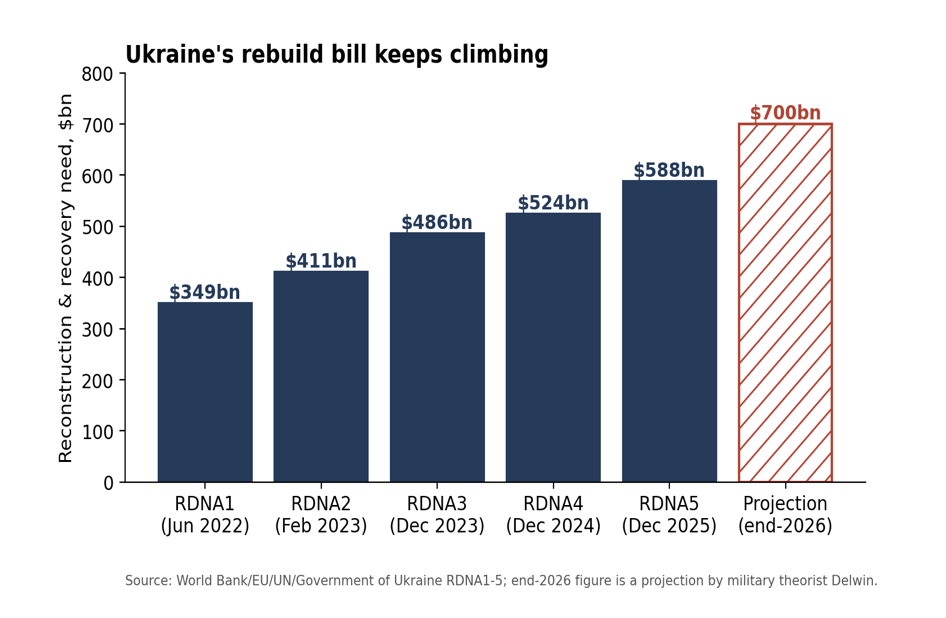
Ukraine's reconstruction need by assessment, $bn. Source: RDNA1-5 (Government of Ukraine, World Bank, European Commission, UN); end-2026 projection by Delwin.
"This scale is unprecedented in the modern era," french milblogger Arthur Delwin said in a recent substack commentary. "Another year of relentless strikes risks leaving Ukraine without an industrial footprint, a functional rail system, energy infrastructure, logistics, or an agriculture sector."
Only Syria and Gaza are worse
Measured against the size of the economy, two recent wars have left bigger holes although both are smaller in scale. The World Bank's Syria Physical Damage and Reconstruction Assessment put that country's rebuild at $216bn in October 2025, within a range of $140bn to $345bn, or nearly 10 times its projected 2024 GDP of $21.4bn. The fighting damaged close to a third of Syria's pre-war capital stock, and real GDP fell by 53% between 2010 and 2022. Syria, "has not begun to recover", says Delwin.
Gaza's case is starker still. The final Gaza RDNA, released by the EU and the UN with the World Bank on April 20, puts recovery needs at $71.4bn over a decade and says the economy has contracted by 84%. Against the strip's output of about $2.7bn in 2022, according to the Palestinian Central Bureau of Statistics, that is a bill of around 26 times annual GDP.
However, in both cases, the capital stock was not well developed and the economies were smaller so the level of destruction needed to produce relatively more dramatic collapses was not as intense. Ukraine has been the poorest, or second poorest, country in Europe for most of the last three decades, but thanks to its Soviet legacy its capital stock, especially in metallurgy, was relatively significant.
The other post-Cold War comparisons are an order of magnitude smaller. Bosnia's Priority Reconstruction Program after the Dayton agreement called for $5.1bn of external financing over three to four years. In Kuwait, rehabilitating the oil industry after the 1991 well fires cost more than $5bn, and the Pentagon's assessment put the total economic cost of the Iraqi occupation at $30bn-$50bn. Donors pledged $4.5bn to Georgia after its five-day war with Russia in 2008, against early damage estimates of about $1bn.
Afghanistan shows the limits of money. The US Congress appropriated about $144.7bn for Afghan reconstruction between 2002 and mid-2021, more in inflation-adjusted terms than the Marshall Plan, according to the final report of the Special Inspector General for Afghanistan Reconstruction (SIGAR). Nearly $90bn of that went on the Afghan security forces, which collapsed quickly once US troops left, and SIGAR documented $26bn-$29.2bn lost to waste, fraud and abuse. In Iraq, the government put the cost of rebuilding after the war against Islamic State at $88.2bn in 2018, against $45.7bn of physical damage. Donors at a Kuwait conference offered about $30bn, most of it as credit.
In absolute terms Ukraine stands alone. Its $588bn bill is 2.7 times Syria's, more than six times Iraq's, eight times Gaza's and four times everything Washington appropriated for Afghanistan over two decades.
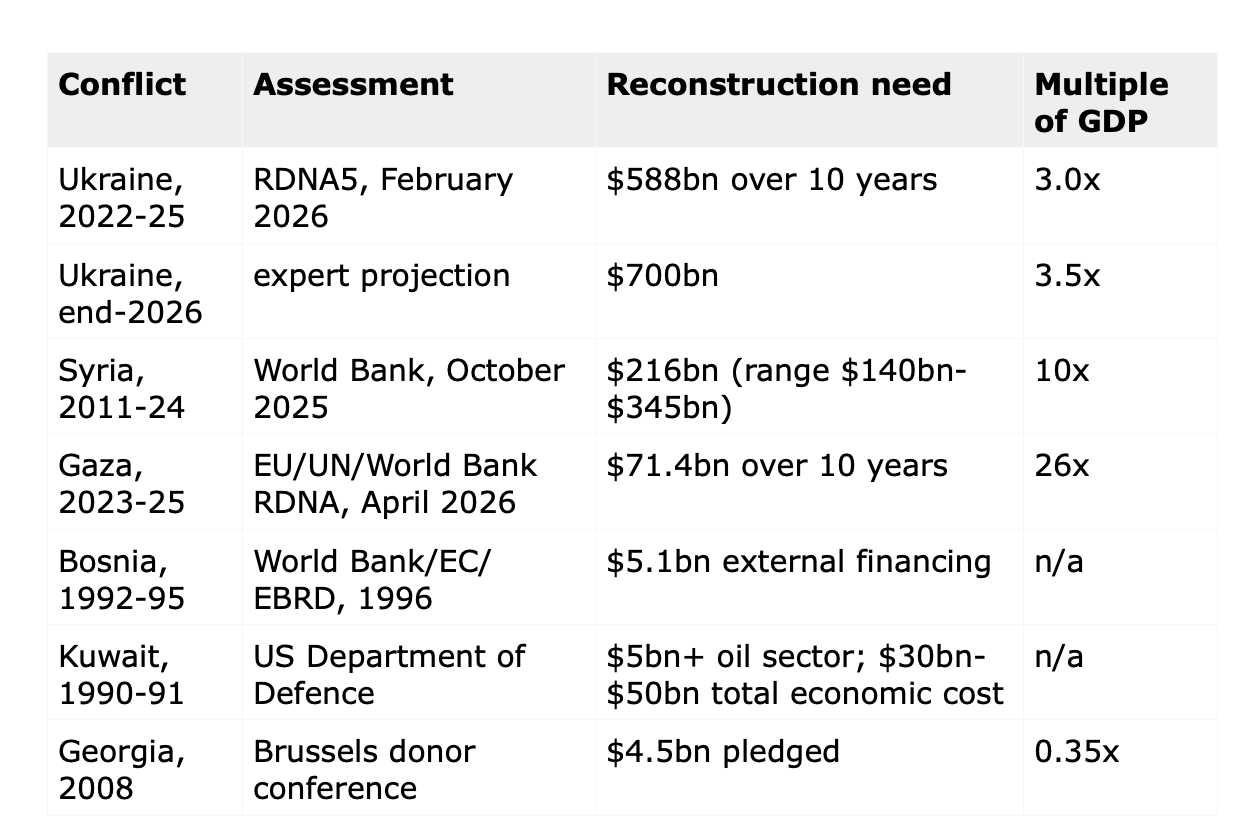
Post-war reconstruction bills compared. GDP multiples: World Bank for Syria and Ukraine; Gaza calculated against PCBS 2022 GDP at constant 2015 prices; Georgia against 2008 GDP.
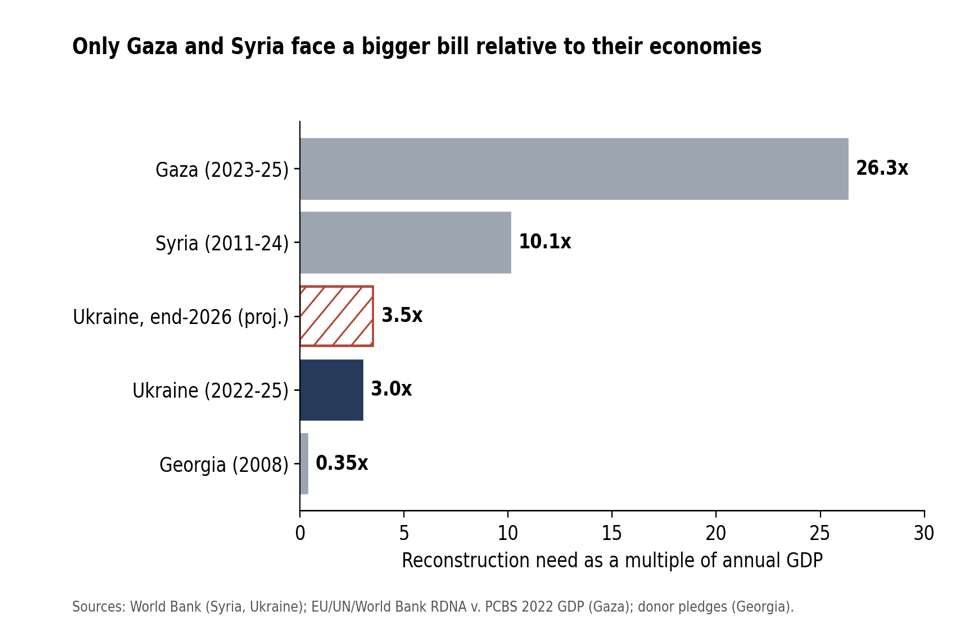
Reconstruction need as a multiple of annual GDP.
No demographic dividend
Perhaps more significant that the physical destruction has been the effect on human capital – the gutting of the country’s youth who have either fled to Europe or have been killed in the trenches.
The long-term outlook for Ukraine's demographics was already poor. The country started its independence in 1991 with about 50mn people, which dropped to 45mn pre-war. The latest estimate is 25mn people. Even when the war ends, Ukraine's recovery is doubtful, because the population is set to continue to shrink; the UN says that because the fertility rate is so low the population will drop to just 15mn by 2100.
After the Second World War Korea and Vietnam did not suffer a similar level of destruction and could rely to some extent on young, dynamic populations for reconstruction. Ukraine went into the war with some of the worst demographics in the world, and the fighting has cost it between 525,000 and 625,000 military casualties, including 125,000 to 150,000 dead, between February 2022 and June 2026, according to CSIS estimates.
A July paper from the Tallinn-based International Centre for Defence and Security found the number of refugee intending to return home after the war is falling every year it continues, at the same time as the number of men mobilised and wounded climbs. Manpower is an overriding constraint on the Armed Forces of Ukraine (AFU) ability to fend off Russian attacks, but it will also stymie any rebuilding plans as effectively: infrastructure sized for a population that does not come back is money wasted.
The money is not keeping pace either. The RDNA5 counts at least $20bn of needs met since February 2022, and more than $15bn of recovery spending lined up for 2026. Transport, energy and housing alone need almost $277bn over the decade and clearing mines and rubble another $28bn. Some 14% of the housing stock has been damaged or destroyed.
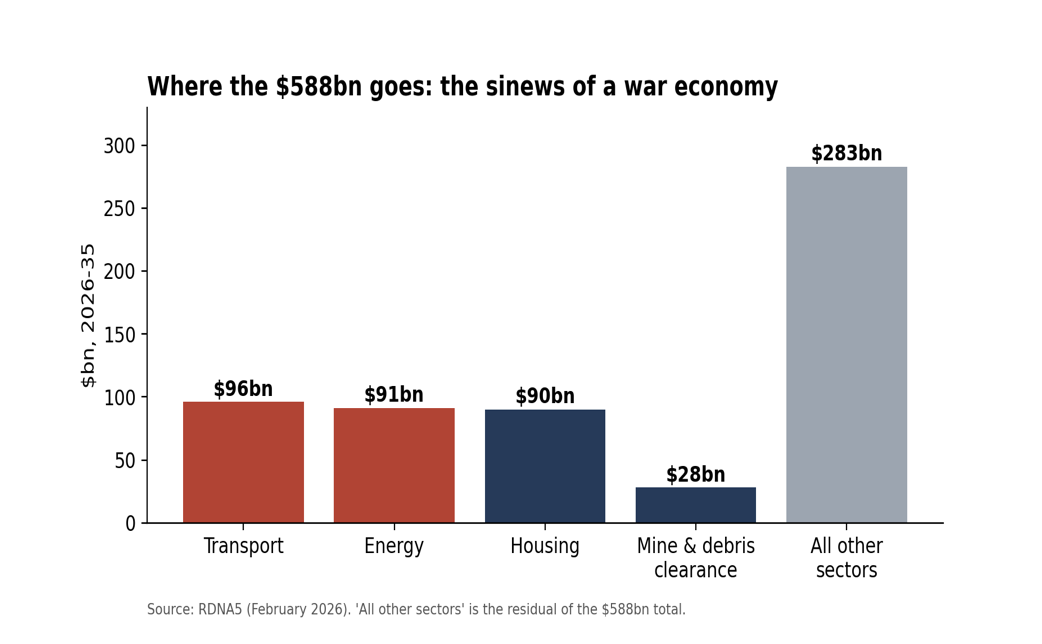
RDNA5 recovery and reconstruction needs by sector, 2026-35, $bn.
A war of endurance
An asymmetry sits at the core of Putin’s tactics. After Bankova launched Operation Wildberries, destroying the warehouses of Russia’s biggest e-commerce firm, Putin said Ukraine had opened a “Pandora’s box” and retaliated with disproportionate forces to systematically destroy Ukraine’s retail sector. Two months on and supermarket shelves in Kyiv are starting to empty, whereas Russians have merely suffered an inconvenience of online orders not working as well as before.
And Russia is extending its lead in missiles and more recently with a new class of super fast drones that can evade Ukraine’s air defences. It now builds some 3,000 jet-powered Geran-4 drones a month to outrun Ukraine's interceptors, and has used them over successive winters to try to freeze Ukraine into submission by hitting the 750kV substations that form the backbone of the grid.
"This is where and how the war will be decided: the strategic attrition lever on the critical capacity to endure," Delwin says. The front line is the means of keeping up the pressure while manpower losses and spending compound "until the strain becomes unbearable", which is why square kilometres and tactical engagements count for little at the strategic level.
Running out of money
In the short term, Ukraine may be pushed into the corner simply as it is now running out of money fast. During his Independence Day speech in August, President Volodymyr Zelenskiy announced that the budget is short of 427bn for the rest of this year, and the ministry of finance this week warned that next year’s budget has a $75bn unfunded hole.
"Ukraine's own officials now say the war costs $155bn a year - $175bn in 2027. The budget covers about $100bn. The rest is a hole of $70bn, with only a fraction of the sources even identified," Iuliia Mendel, a former press secretary to President Volodymyr Zelenskiy, said in a comment on September 28.
The published budget numbers are smaller but point the same way. The draft 2027 budget presented to parliament on September 16 sets record defence spending of UAH4.89 trillion ($110bn), about two-thirds of total spending of UAH7.27 trillion ($163bn), against revenues of UAH5.6 trillion ($126bn), Reuters reported.
The daily cost of the war has risen to $190mn this year from $116mn in 2022, budget committee head Roksolana Pidlasa told lawmakers. Finance Minister Sergii Marchenko said Ukraine will need more than $52bn of international aid in 2027, of which partners have committed around $20bn, and in an earlier interview put the uncovered gap at $32.6bn.
Russia's federal budget is likewise under pressure and military spending continues to climb – but it has significantly larger resources to draw on. War funding reached about RUB16 trillion ($190bn) in 2025, or 7.5% of GDP, according to SIPRI. The 2026 budget cut planned military spending to RUB14.9 trillion ($172bn), or 6.3% of GDP, but war-linked spending hit a record RUB10.687 trillion ($123.4bn) in the first half of the year alone, about 10.5% of GDP and 1.5 times the plan, according to Janis Kluge of the German Institute for International and Security Affairs. The federal deficit reached 2.8% of GDP in the first seven months, twice the target for the full year, and in its latest draft budget released this week the Ministry of Finance admitted that full year deficit is likely to be 3% of GDP – double the 1.6% it was predicting at the start of this year.
Ukraine, meanwhile, spent $84.1bn on defence in 2025, some 40% of GDP, the highest burden of any country, SIPRI data shows. The US peaked at 37.5% of GDP in 1945, according to the Congressional Research Service. But Russia’s spend on defence is still running at around 10% of GDP.
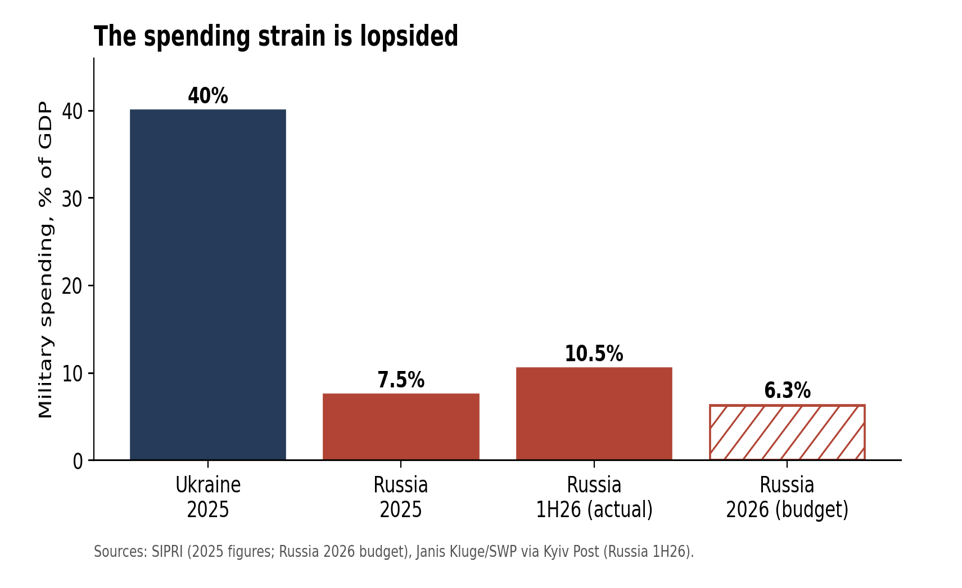
Military spending as a share of GDP.
On the battlefield the trend has lately favoured Kyiv. CSIS estimates Russia has taken about 1.4mn casualties since February 2022, and the ratio of Russian to Ukrainian casualties, which ran between 2:1 and 3:1 for most of the war, has likely risen to nearly 8:1 in the first half of 2026, largely thanks to Ukraine's drones. Russia suffered a net loss of about 400 sq km in April and May. That discounts exactly this kind of gain as tactically real but strategically marginal when set against the prospects for recovery. For example, a recent reports from Reuters estimated that 80% of Russia’s grain production and trade would immediately bounce back to pre-war levels as soon as hostilities end. However, the destruction of Ukraine’s ports and the need to clear wheatfield mines means the same is not true for Ukraine; currently it is only exporting about 45% the volume of grains compared to pre-war levels.
Blood and treasure in context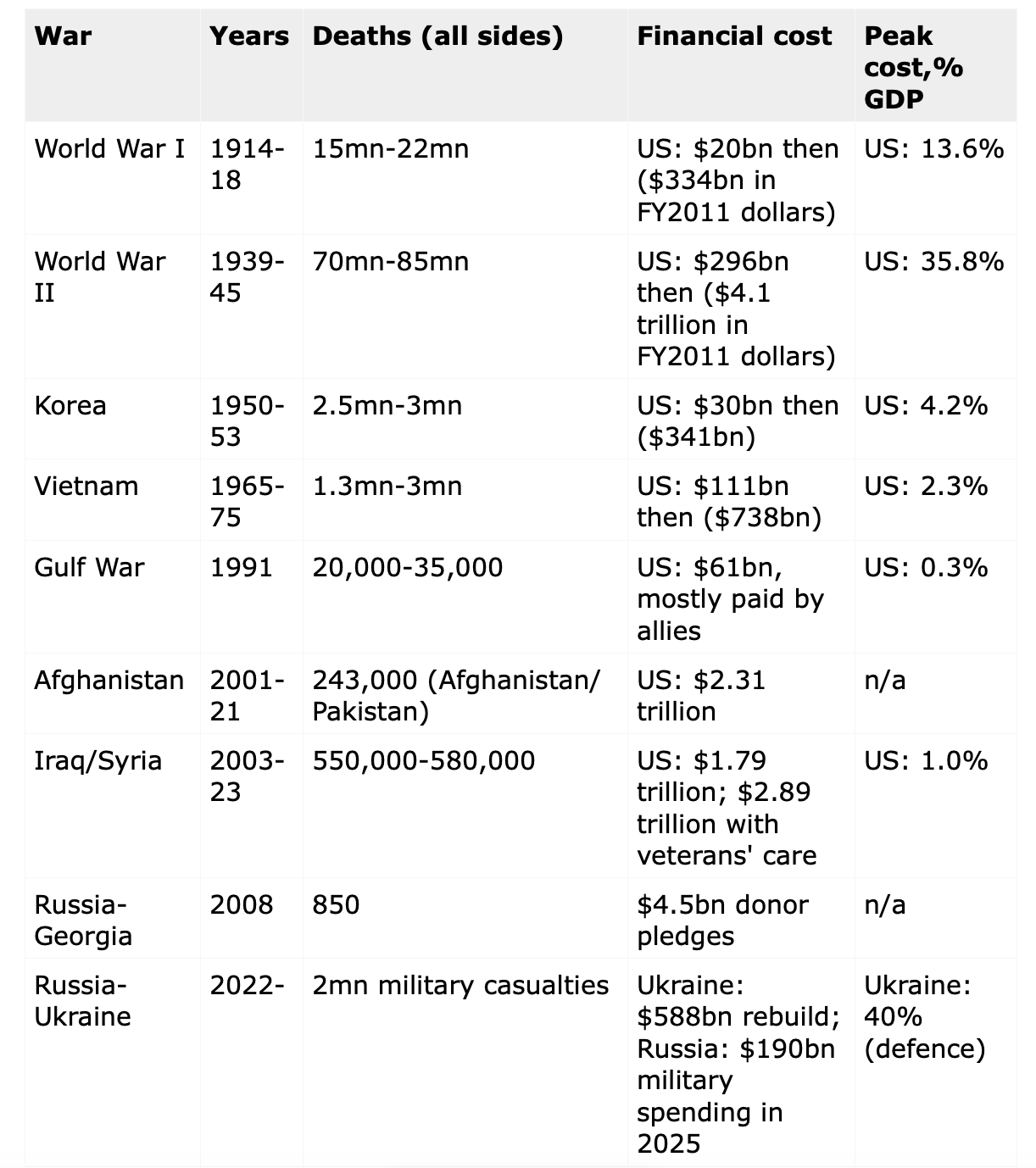
Sources: Congressional Research Service (US costs, constant FY2011 dollars); Costs of War Project, Brown University (Afghanistan, Iraq/Syria); CSIS; SIPRI; RDNA5. Historical death tolls are ranges from standard estimates.
On the Congressional Research Service's figures, the US spent $4.1 trillion in today's money fighting the Second World War. The Costs of War Project at Brown University puts the price of the Iraq and Syria campaigns at $2.89 trillion including veterans' care, and Afghanistan at $2.31 trillion. Those were the budgets of a superpower fighting far from home. Ukraine is spending a World War II share of its economy on defence while trying to hold together the industrial base, rail network and power system its reconstruction depends on.
Unlock premium news, Start your free trial today.


