
Is Trump going to abandon the Iran war?


Is US President Donald Trump the war in Iran? Having failed to meet any of his as yet unstated objectives Trump is clearly frustrated and contemplating giving up on an unwinnable war.
Adding to his problems, Washington’s allies are refusing to come to America’s aid in the war and the prospects for a negotiated settlement at the earliest stages. Trump announced there were “strong” talks with Tehran on a mooted US-proposed 15-point plan, but Tehran denied any talks have begun and have countered with a maximalist three-point list of demands that the White House has rejected. On March 31, Pakistan and China released a five-point proposal to end the war, as the first compromise position in talks as the regional players step up their efforts to mediate a ceasefire agreement.
After posting that he could open the Strait of Hormuz in the first days of the campaign, since then it's become increasingly clear that Trump has underestimated Iran's firepower, and the Strait would become a kill-zone for the US Navy if it attempted to enter.
Trump has beefed up the military presence and at least 17,000 troops have recently arrived giving him the option of a land invasion, but military analysts argue the same conditions apply and that any marines caught on the shore or the islands in the Strait would be massacred by Iran's drones.
The war in Iran is due to reach another pivotal point this week, when the a to open the Strait of Hormuz set by Trump expires on April 6, or he will “irreversibly” destroy Iran’s power sector. If that threat is carried out, Tehran has promised to retaliate in kind that would also take the region’s desalination plants offline, the main source of drinking water.
The Trump administration called on its Nato allies to send their navies, but they universally declined. That annoyed Trump, who responded by saying the US doesn’t need Gulf oil, but Asia and Europe does and if they want it they can open the Strait themselves. In a tweet post the truth social he told allies they should “just TAKE IT.”
“All of those countries that can’t get jet fuel because of the Strait of Hormuz, like the United Kingdom, which refused to get involved in the decapitation of Iran, I have a suggestion for you: Number 1, buy from the US, we have plenty, and Number 2, build up some delayed courage, go to the Strait, and just TAKE IT.
You’ll have to start learning how to fight for yourself, the USA. won’t be there to help you anymore, just like you weren’t there for us. Iran has been, essentially, decimated. The hard part is done. Go get your own oil! President DJT,” Trump posted on social media on March 31.
As IntelliNews has reported, the US-Israeli coalition has armed itself for the wrong war. Iran is taking advantage of its superior cost-to-kill ratio where it can overwhelm the US navy’s superior firepower with the sheer number of cheap, but still effective, drones and missiles. And some of those missiles are very sophisticated; an Iranian missile has shot down an F-35 in combat for the first time ever in this war.
Both Israel and the US are widely reported to be running low on interceptor missiles after only a month of fighting, while Iran triggered its Decentralized Mosaic Defence doctrine (DMD) in the first days of the war and disbursed its troops and weapons to caches and cells across the country. While the US has made progress against Iran’s navy and air force, the IRGC is believed to have thousands of missiles and drones in impenetrable mountainous caches.
While Trump has repeatedly claimed the “hard part is done” in this asymmetric war, even if Iran retains some of its drones and missiles they continue to pose a significant threat that rules out navy escorts though the Strait of Hormuz or a land invasion.
Who is going to help?
The Gulf states are moving towards becoming proactively involved in the war in order to hasten its end. As tensions continue to escalate Iran is increasingly targeting economic, not military assets, threatening a scorched earth policy.
Tehran has threatened to destroy power plants across the entire region and answer any attacks on its industrial assets with multi-fold retaliations. The threat to destroy Gulf power plants is especially ominous as most of the Gulf countries rely over 80% on their desalinization plants for water.
Riyadh in particular appears to be betting on a trade-off between short-term escalation for a long-term improvement in its local geopolitical standing. Crown Prince Mohammed bin Salman (MbS) is reportedly pushing the White House to increase the ferocity of its attacks and to bring the war to a speedy end. Other countries have also indicated that they may become militarily involved. Most of the leading Gulf countries already host US military bases and can be used as platforms to launch a ground-based assault which has been discussed by the White House in the last week.
“The United Arab Emirates is preparing to help the US and other allies open the Strait of Hormuz by force,” Arab officials said on April 1, a move that would make it the first Persian Gulf country to become a combatant, after being hit by multiple Iranian attacks.
Ceasefire initiatives
In a parallel track, Others are working hard to try and bring about ceasefire talks. Pakistan’s Foreign Minister Mohammad Ishaq Dar has led the effort, trying to broker mediated talks between Iran and the Trump administration.
Last week Trump announced that talks had begun and that a 15-point plan was on the table. Iranian Speaker of Parliament Mohammad-Bagher Ghalibaf, who is effectively running the country at the moment, posted on social media that no such talks had begun and Tehran has already rejected Trump's plan out of hand. Iran's Supreme Leader Mojtaba Khamenei has released Tehran’s own three-point list of demands on March 12 of maximalist counter demands. As IntelliNews reported, The gulf between the two positions is very wide.
Now Pakistan, together with China, has released a new five-point list of concessions to end the hostilities. The suggestions were made by Chinese Foreign Minister Wang Yi and Dar on March 31 that includes:
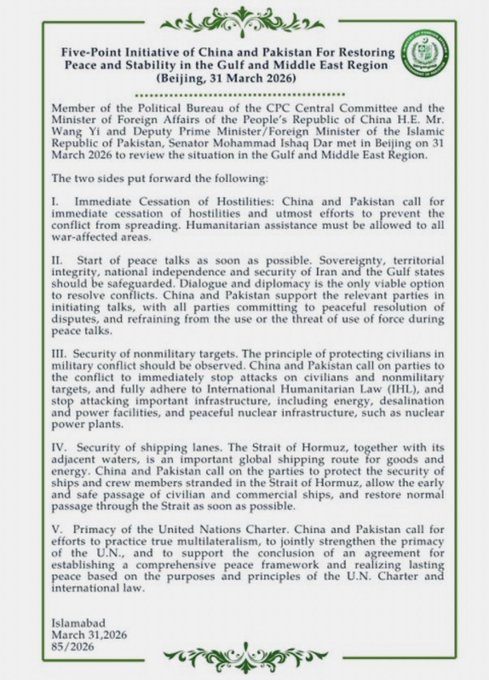
I. Immediate Cessation of Hostilities: China and Pakistan call for immediate cessation of hostilities and utmost efforts to prevent the conflict from spreading. Humanitarian assistance must be allowed to all war-affected areas.
II. Start of peace talks as soon as possible: Sovereignty, territorial integrity, national independence and security of Iran and the Gulf states should be safeguarded. Dialogue and diplomacy is the only viable option to resolve conflicts. China and Pakistan support the relevant parties in initiating talks, with all parties committing to peaceful resolution of disputes, and refraining from the use or the threat of use of force during peace talks.
III. Security of nonmilitary targets: The principle of protecting civilians in military conflict should be observed. China and Pakistan call on all parties in the conflict to immediately stop attacks on civilians and nonmilitary targets, and fully adhere to International Humanitarian Law (IHL), and stop attacking important infrastructure, including energy, desalination and power facilities, and peaceful nuclear infrastructure, such as nuclear power plants.
IV. Security of shipping lanes: The Strait of Hormuz, together with its adjacent waters, is an important global shipping route for goods and energy. China and Pakistan call on all parties to ensure the security of ships and crew members stranded in the Strait of Hormuz, to allow the early and safe passage of civilian and commercial ships, and restore normal passage through the Strait as soon as possible.
V. Primacy of the United Nations Charter: China and Pakistan call for efforts to practice true multilateralism, to jointly safeguard the primacy of the UN, and to support the conclusion of an agreement for establishing a comprehensive peace framework and realizing lasting peace based on the purposes and principles of the UN Charter and international law.
Unlock premium news, Start your free trial today.

_6.jpg)
