
Is Kazakhstan’s banking industry facing a test of resilience?


Cast your mind back to the years of the global financial crisis. Ahead of the turmoil that climaxed with the bankruptcy of Lehman Brothers in late 2008, Kazakhstan’s banks had expanded rapidly. Heavily reliant on external funding, they came under severe pressure when liquidity and international financing dried up.
The country’s biggest lender at the time, BTA Bank, by 2008 saw its loan portfolio reach Kazakhstani tenge (KZT) 2.2 trillion (around $18.3bn at the applicable exchange rate back then), while the bank owed more than $15.7bn to around 180 foreign financial institutions.
As the financial crisis progressed, problem loans across Kazakhstan’s banking sector rose sharply, from 4.6% at the beginning of 2008 to 10.6% in 2009 and 30.9% by January 2010. BTA’s own problem-loan ratio reached 45.5%.
The state ultimately intervened on a scale that remains only too relevant to the sector today. Forbes Kazakhstan estimated in 2014 that the documented cost of the BTA rescue exceeded $10.3bn, while a banker familiar with the process estimated the total cost at no less than $14bn.
Later banking interventions followed a different pattern but left another layer of state support embedded in bank balance sheets.
A retrospective published by Forbes Kazakhstan earlier this year in March found that the banks still owed the state more than KZT 1 trillion ($2.27bn) at the end of February, despite the sector having recorded a record KZT 2.7 trillion in aggregate profit in 2025.
Much of those remaining obligations originated from the Financial Stability Enhancement Programme implemented between 2017 and 2020.
The legacy is particularly visible in the case of Alatau City Bank. Its predecessor, Jusan Bank, inherited state-supported assets connected to the rescue of ATF Bank and Tsesnabank. By the beginning of 2026, Alatau City still had roughly KZT 950bn in state obligations, according to Kursiv.
In July and August, the bank began making further repayments, but the process also affected its financial results.
Kursiv reported on September 7 that Alatau City Bank’s January-July 2026 profit had fallen 95.8% y/y, partly because of the accounting treatment of its state-supported subordinated debt and early repayments.
The recorded decline in profit is no exception in the country’s banking sector, though Alatau City Bank’s case might be the worst one by far.
In fact, Kazakhstan’s banking sector entered the second half of 2026 facing a combination of slower lending, rising problem loans and falling profitability, even as regulators introduced tighter requirements intended to contain credit risks.
The deterioration raises questions about whether the sector is entering another difficult credit cycle, or whether the current pressure is a symptom of authorities’ efforts to address other banking sector vulnerabilities.
Problem loans on rise again
Kursiv reported on September 21 that the banking sector’s loan portfolio grew 0.5% m/m in July to KZT 44.6 trillion in a marked slowdown from growth recorded in the earlier months of this year. For comparison, monthly growth stood at 1.62% in May and 1.46% in June.
At the same time, defaulted loans increased by 16.4% from the beginning of the year to KZT 3.07 trillion, pushing their share of total lending from 6.07% to 6.82%. Kursiv reported on September 7 that the increase in problem loans was running roughly three times faster than the growth of the healthy loan portfolio.
Kazakhstan’s biggest lender by assets Halyk Bank and the second biggest lender Kaspi Bank recorded the largest increases in non-performing assets, at KZT 250bn and KZT 125bn, respectively.
The news outlet’s report also said that the sector’s net profit fell 14.9% y/y to KZT 1.40 trillion in January-July (accelerating from a 13.3% decline recorded in January-June).
Profit declines affected most universal lenders. Home Credit Bank was the only lender in the group to report profit growth.
The report noted that profitability came under further pressure in July from higher minimum reserve requirements and fiscal changes. For context, minimum reserve requirements grew to 5% (up from 3.5%) for tenge and to 12% (up from 10%) for foreign currency in April – another increase for foreign currency reserve requirements to 15% came on September 1.
Banks under pressure amid deteriorating credit quality
An analysis by Forbes Kazakhstan published on July 27 suggested that Kazakh banks this year were facing pressure from several directions at once, including a higher corporate income tax rate for retail lending, an increase in VAT, a 17% base rate, more expensive funding and tighter risk-weighting requirements.
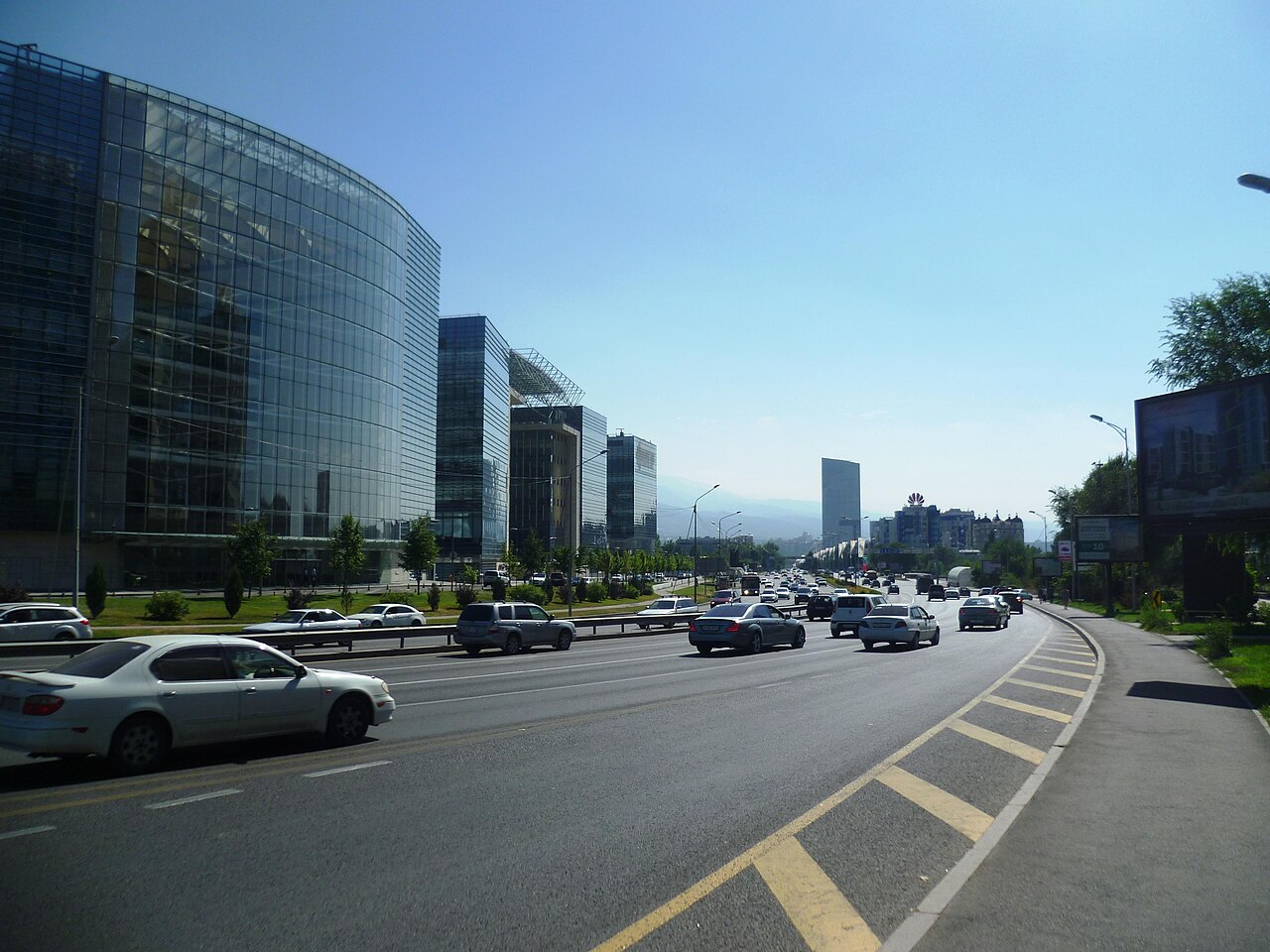
Al-Farabi Avenue with bank buildings in Almaty, Kazakhstan (Credit: Radosław Botev, cc-by-3.0).
Forbes’ analysis said consumer lending had been growing by an average of about 30% annually before 2025. The regulator began tightening restrictions on consumer loans last year, bringing growth down to 15%, while the first quarter of 2026 showed almost no growth.
Among notable restrictions, “lending to individuals with overdue payments of 30 days has been restricted, whereas previously the ban applied to arrears of more than 90 days. This is because the agency identified a risk of defaults emerging at the initial stage of delinquency,” Forbes wrote.
The rationale for the tighter measures is linked to signs that household credit quality is beginning to deteriorate due over-indebtedness among Kazakh households.
Speaking to LS on March 26, economist and director of applied research at the Applied Economic Research Centre (AERC), Askhat Mukhtaruly, said the regulator’s logic was understandable because the authorities were responding to a gradual deterioration in retail loan quality.
"According to the available data, since the beginning of 2025, the share of overdue debt on loans to individuals at second-tier banks has increased from 7.2% to 8.5%, while at MFIs it has risen from 20.9% to 22.8%. This cannot yet be described as a critical deterioration, but the trend itself indicates that regulators are acting pre-emptively," he told LS.
LS wrote, citing Mukhtaruly, that “within this logic, the most justified measures appear to be those that directly limit the accumulation of problem debt, as they increase the resilience of the system.”
“[Mukhtaruly] mentioned among these [measures] the introduction, from April 1, 2026, of a 2% sectoral countercyclical capital buffer for retail lending; a ban on issuing consumer loans to borrowers with arrears of more than 30 days, compared with the previous threshold of 90 days; and a reduction in the maximum debt-service-to-income ratio from 0.5 to 0.25 for borrowers who had arrears of more than 90 days during the previous 12 months,” the report said.
The expert, nevertheless, argued that tighter lending rules alone could not resolve the underlying problem of household indebtedness, as indebtedness in Kazakhstan was primarily driven by weak household finances.
In March, financier Galim Khusainov told LS that weak real household incomes could eventually affect the quality of consumer loan portfolios because borrowers ultimately repay such loans from their earnings.
"Because people's incomes are the source of repayment for consumer loans,” Khusainov explained. “In nominal terms, incomes have increased, but in real terms they have fallen due to relatively high inflation. Clearly, people can now afford to buy fewer goods and services than, for example, last year, because prices have risen."
This could, in turn, imply that the resulting credit quality would simply continue to deteriorate, contributing to the ongoing growth in problem loans.
Some observers see no major harm in the expansion in non-performing loans (NPLs) for the Kazakh banking sector’s portfolio, however.
"No grounds"
“The current level of problem loans does not yet provide grounds to expect a sharp deterioration in the quality of the banking portfolio as a whole,” financial expert and Qazaq Expert Club member Venera Zhanalina told LS in early September.
Zhanalina further argued that the deterioration was concentrated in the more vulnerable part of the SME sector rather than representing a systemic deterioration across all bank portfolios.
“What we are seeing now is an increase in credit risk in the most vulnerable part of the small and medium-sized business sector," she added.
She attributed the pressure partly to prolonged high borrowing costs and higher operating expenses for businesses, including labour, rent and utilities. Changes to the tax system in 2026 had added another layer of pressure for some companies by increasing their tax and administrative burden and their need for working capital.
"In the second half of the year, I expect a further moderate increase in NPLs in the SME segment, particularly given the rise in early-stage delinquencies,” she said.
Yet should push, nevertheless, come to shove, there is an evolving situation to take into account in which the country’s financial sector regulators are changing the rules governing future rescues of systemically important banks. The changes might be a reaction to assessments made by the International Monetary Fund (IMF).
In an analysis published by Kapital.kz in 2024, economist Murat Temirkhanov pointed to successive assessments by the IMF of Kazakhstan’s bank-resolution practices. He wrote that the IMF’s 2014 Financial Sector Assessment Programme had found the resolution of troubled banks between 2008 and 2014 inconsistent with international best practice.
The IMF’s subsequent 2024 assessment found that government practice between 2014 and 2023 had not improved and had in some respects deteriorated, particularly regarding the use of public finances to rescue banks.
Things appear to have improved since then – S&P earlier this month upgraded Kazakhstan's banking sector industry risk score under its Banking Industry Country Risk Assessment (BICRA) to group 6 from 7, following an upgrade of Kazakhstan's sovereign credit rating to BBB.
“We revised the economic risk score to positive from stable, reflecting our expectation that resilient macroeconomic perspective could gradually ease potential sources of economic imbalances (specifically elevated inflation) domestic financial institutions face, and together with stronger regulatory oversight should translate into better asset quality metrics that we still see as a weakness of Kazakh banking sector,” S&P said.
“The upward revision of our industry risk assessment to '6' from '7' reflects the number of initiatives undertaken by the Kazakh regulator to enhance supervision of the financial institutions in Kazakhstan over recent years,” the ratings agency added. “We have observed tangible measures that should durably strengthen the financial regulator's oversight and control framework. In our view, this will support Kazakhstan's financial stability and, in periods of economic decline, help reduce the incidence of banking failures and systemwide asset-quality problems.”
Unlock premium news, Start your free trial today.


_Cropped_0.jpg)
