
Is Kazakhstan’s AI rollout turning into a lipstick-on-a-pig scenario?


Kazakhstan is rapidly embedding artificial intelligence into transport, energy, education and public administration, but the country’s expanding list of AI projects is increasingly being tested against a tough question: whether the AI technology is producing measurable improvements in productivity, government decisions and public services, or whether its deployment is running ahead of the delivery of the systems required to make it useful and accountable.
In short, if the AI rollout proves rushed and botched, officials may be accused of attempting to put lipstick on a pig. And a pig with lipstick is still a pig, after all.
The country’s president, Kassym-Jomart Tokayev, declared 2026 the Year of Digitalisation and Artificial Intelligence, while the authorities have moved to establish dedicated AI legislation, expanded digital infrastructure and a brand-new Ministry of Artificial Intelligence and Digital Development.

Kazakhstan's drive for an AI-driven digital nation is taking place under a dedicated new ministry, the Ministry of Artificial Intelligence and Digital Development (Credit: AI-generated image, The Astana Times).
Some applications have reportedly seen relative success. In the Kazakh transport sector, AI is being used to assess airline routes, monitor roads and process freight. For instance, the Echelon Alpha platform analyses passenger demand and competition between aviation hubs and has identified around 30 potentially promising routes, The Times of Central Asia reported on August 25. The Transport Ministry said the system processed approximately 200mn flights over five years and around 170 airline reports, combining geomarketing information with open and commercial data. Its developers estimate forecasting accuracy of up to 90%.
Echelon Alpha founder Rakhman Asambayev told Forbes Kazakhstan that the platform “uses artificial intelligence to analyse market dynamics in real time and provide a basis for fast, accurate solutions”. Developers estimate that the proposed airline network could have an annual economic impact of about $153mn, although that estimate has not been independently verified.
The newspaper’s report also mentioned the e-Joldar platform. It uses AI to monitor road conditions, repair expenditure and construction material quality. More than 25,000 miles (40,233 kilometres) of national roads have been digitised, with the government targeting the full network of about 115,000 miles, the report said.
Another AI-based system, Smart Cargo, combines information from 58 systems, uses QR codes to provide cargo information and applies AI to documentation, permits, routing and shipment tracking, the report said. The government claims that border-crossing speeds have increased by 30% and carrier waiting times have fallen tenfold thanks to the new system.
Railways are also being digitised, according to the report. KinetiX provides contactless rolling-stock diagnostics, while Trip Optimiser automates train operations according to track profiles, train weight and speed restrictions. The government reportedly said KinetiX has reduced technical inspection times by 30% and manual measurements by 70%.

Kazakhstan's railways are being digitised. Wabtech Corporation's KinetiX Inspection Technologies provide contactless rolling-stock diagnostics (Credit: @WabtecCorp, video, screenshot).
Among other projects, Kazakhstan’s Ministry of Energy plans to digitalise the country’s industrial sector from resource extraction and transportation to processing and final consumption. Digital twins are being developed for production and energy facilities in order to allow computer-vision systems to identify safety violations and risks at oil, gas and energy sites.
Yerzhan Koshkarov, director of the energy ministry’s digitalisation department, told Qazinform that computer vision systems could reduce the risk of workplace injuries by up to 98%. AI is also being used to forecast electricity generation and consumption by incorporating weather information.
“For example, if cloudy weather is expected and there will be less sunlight, we can increase additional resources in advance to support a region,” Koshkarov said.
Geological exploration provides another potentially high-value use of AI, according to the state news agency’s report. KazMunayGas (KASE: KMGZ) projects are analysing large volumes of geological information to identify promising drilling locations and areas where drilling may not be commercially viable. Koshkarov said sizeable financial stakes make better forecasting important.
“Drilling a single well can cost up to $30mn, or even $100mn, depending on the complexity of the area. If we are talking about offshore drilling, for example, the cost can reach $300-500mn,” he said.
All of these projects sound promising on paper. Yet a core question remains – can these and other AI projects actually substantially improve efficiency or is the entire AI integration drive simply an attempt by Kazakh authorities to “ride the hype train”, so to speak?
Economically viable?
Aziza Shuzheyeva, chair of TechnoWomen, told Informburo that “digitalisation of the state does not equal the digitalisation of the economy. Ninety-three percent of government services online is convenience for a citizen who submits a certificate through eGov. This is very good, it saves people time and increases the transparency of public administration. But it does not make a worker at a plant in Temirtau more productive.”
She argued that productivity growth remains heavily dependent on oil and other capital-intensive sectors rather than digital technology.
“There is a massive digital agenda, but productivity in the country is growing due to oil and forced reductions in employment in construction. Not because of technology,” she said.
Azamat Beisenbenov, managing director and director of the human capital development department at the National Chamber of Entrepreneurs “Atameken”, said companies cannot obtain the full benefit of AI while operating with outdated machinery and production processes.
“You cannot squeeze maximum efficiency from digital technologies if machines, production lines and production processes are physically outdated,” he told Informburo.
Zhanar Sabazova, an AI implementation expert, Astana Hub participant and founder of Steppe Tech Lab, said the problem with AI integration in Kazakh companies is often managerial rather than technological.
“Productivity appears where a company changes the way it works, rebuilds processes, removes manual operations, changes KPIs [key performance indicators), trains people, configures data and begins measuring the effect before and after implementation,” she said, according to Informburo's report.
Sabazova also warned against allowing individual employees to use neural networks without changing the wider operating model.
“The main mistake of business is to introduce AI as a tool for individual employees, rather than as part of the operating model,” she said.
The ineffectiveness of AI implementation in the ex-Soviet state can be observed in some sectors more than others – the Kazakh education sector in particular is worth consideration, as the authorities have found that announcing an AI programme is considerably easier than integrating it into existing institutions.
“Answers machine”
The president, Tokayev, has lately criticised delays in implementing his May decree on AI in schools, saying its implementation before the new academic year “has not been properly ensured”. This, he said, was “a major shortcoming”.
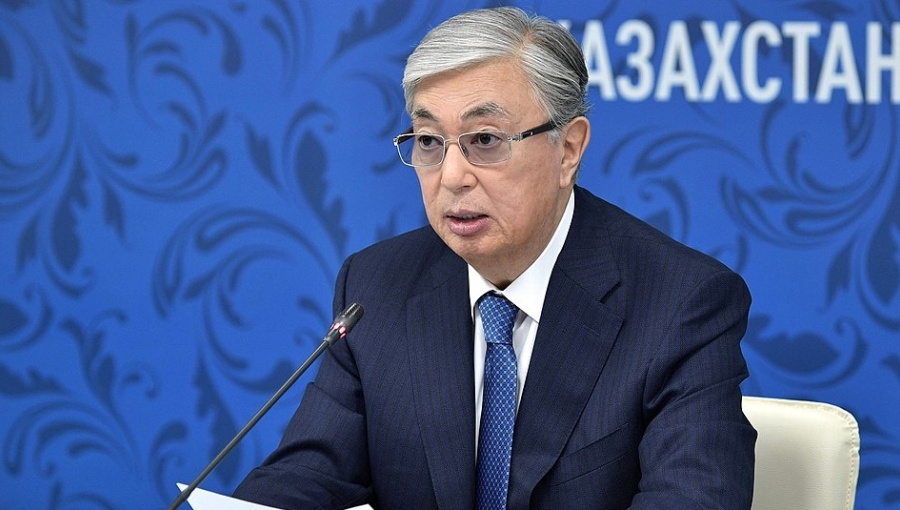
Those introducing AI to Kazakhstan's schools have received poor marks from the president, Kassym-Jomart Tokayev (Credit: kremlin.ru, cc-by-sa 3.0).
The decree required an implementation plan, pilot schools, internet-readiness measures and national standards covering AI-generated educational content, assessment, academic integrity, student data protection and teacher training.
As part of the programme, the government plans to incorporate AI into digital-literacy and computer-science courses starting from the 2026-2027 academic year. A rural pilot is scheduled to begin in 10 small schools in Pavlodar and Kyzylorda regions, with expansion to 50 schools in November and 300 in January 2027.
The programme is intended to test personalised learning in mathematics, digital literacy and native-language classes while helping address the urban-rural education gap.
The TALAP Centre for Applied Research, working with Global Education Futures, argued in a report published on July 16 that the introduction of AI in education risks being counter-productive for the country’s education system.
TALAP posits, citing its own study, that AI is already being used by pupils and teachers, often without common rules. Students tend to use chatbots for mathematics, assignments and essays, while teachers tend to use them to prepare materials. This presence of AI in education, however, is described by TALAP as a “grey zone” in which methodologies, standards and boundaries have not caught up with actual use.
TALAP writes that its study found that students tend to treat AI as an "answers machine”, particularly when they trust an always-available chatbot more than teachers or parents.
“The study uncovered a troubling detail: students often trust AI more than they trust teachers and parents,” the organisation wrote. “The algorithm responds instantly, does not judge them, does not give them a failing grade for asking a stupid question, and is available around the clock. For a child, it is the ideal conversational partner. The problem is that this ideal conversational partner can imperceptibly turn from a tool for thinking into a substitute for thinking — an ‘answers machine’ that students turn to not to think through a problem, but to get a ready-made result. And that directly undermines what school exists for.”
TALAP observes that teachers themselves may lack the skills and time needed to use AI effectively, turning a government-mandated transition into an additional workload.
“At the same time, the adults involved in the study faced their own challenges,” the report said. “Teachers lack the knowledge and skills needed to work with AI, while a rushed transition creates a real risk of burnout. A teacher who is simply told, ‘We’re working with AI now’, without being given a methodology, sufficient time or a clear explanation of why, is likely to see the innovation not as assistance, but as an additional unpaid workload.”
“And this is not a uniquely Kazakhstani problem: South Korea ran into exactly the same issue, with teachers responding to complex digital platforms with strong resistance,” the report added.
The organisation also points to infrastructure constraints, including weak internet reception, shortages of devices and limited Kazakh-language content. It argues that AI differs from previous education digitalisation projects because generative AI challenges the purpose of homework, assessment and examinations, rather than simply moving existing administrative processes online.
Seat on board for PM’s “favourite horse”
The Kazakh government is confronting similar questions about AI’s role in decision-making itself. The controversy around SKAI, the Samruk-Kazyna Artificial Intelligence system, became one of the clearest examples of this.

SKAI, appointed to the board (Credit: gov.kz).
In October 2025, Samruk-Kazyna announced SKAI as a digital and independent member of its board of directors with voting rights. The announcement prompted questions about whether an AI system could legally exercise the rights and responsibilities of a board member.
Daniyar Temirbayev, executive director of the Kazakhstan Association of Minority Shareholders, questioned the logic of the arrangement.
“If this is possible with AI, who prevents us from introducing into the board of directors of Samruk-Kazyna a favourite horse, say, of the prime minister, on the grounds that this horse possesses reason and will and can independently make decisions?” Temirbayev told Forbes Kazakhstan.
Alexander Kaplan, a lawyer specialising in economic disputes, told Forbes Kazakhstan in a separate report that an AI model is not a subject of civil rights and cannot legally be a member of a board.
“It cannot. This contradicts not only the Law on Joint-Stock Companies, but also the Civil Code,” he said.
In the same report, Forbes cited Alikhan Baidusenov, chair of the supervisory board of the association of independent directors, as likewise saying that AI did not meet the criteria for an independent director because it lacked professional judgement, personal responsibility and reputational capital. He nevertheless supported using AI to improve analysis, compare scenarios and identify risks.
The authorities sought to distinguish between AI assisting a board and AI legally exercising its powers, according to the report. The Ministry of Artificial Intelligence and Digital Development said SKAI was a voluntary Samruk-Kazyna initiative and that it analysed data and recommended decisions, while humans retained the decision-making authority.
“AI does not have voting rights and does not make decisions — all decisions are made by people,” the ministry was quoted as saying by Forbes Kazakhstan.
Samruk-Kazyna later described SKAI as a “digital member” of the board rather than as an independent director. An amendment to the law governing the fund, which entered into force on January 9, 2026, states that an AI system can be used in the board’s activities in accordance with Kazakhstan’s AI legislation.
The fund states that SKAI operates in a closed environment on the Al Farabium supercomputer owned by Kazakhtelecom (KASE: KZTK), using the Kazakh language Alem large language model (LLM). It analyses investment projects, regulations and board decisions dating back to 2008.
By the end of January, the system had participated in six board meetings and generated positions of “for”, “against” or “abstain” on agenda items.
This, of course, raises additional questions about the accuracy of SKAI’s analysis, especially given that SKAI is an LLM, not a tool designed to analyse investment projects. It leads us to wider questions about accountability.
“Nobody owes anyone anything”
Former Mazhilis (parliament) deputy Ekaterina Smyshlyaeva, who participated in drafting the legislation, told Time.kz that AI remains an auxiliary instrument and that responsibility belongs to the person making the decision.
However, Time.kz argues that a problem arises when several parties are involved in creating and operating a system: one company develops the model, another integrates it, an organisation owns it and an employee feeds it data before an official signs a decision based on its recommendation. This creates uncertainty as it remains unclear who should bear responsibility over any mistakes made by AI.
Cybersecurity expert Vyacheslav Katz told Time.kz: “When the law on artificial intelligence was adopted, all participants in this market in our country studied it very carefully. And, I am afraid, came to the conclusion that nobody particularly owes anyone anything.”
The law provides for risk management, monitoring and audits, and requires an operation to be suspended where serious harm is identified. But Katz said there was no mandatory liability insurance mechanism for owners of high-risk systems and that parties could seek to allocate responsibility contractually rather than through a clear universal mechanism.
The issue is compounded by the risk of automation bias, in which people give excessive weight to machine-generated recommendations. Time.kz reported that the law protects human rights and says AI should not replace freedom of choice, but does not establish a universal requirement that a human must independently verify each AI output before a strategically important decision is made.
Business and governance are not the only ones facing questions about the viability of AI integration – In the public sphere, Kazakh observers have noted a prevailing scepticism linked to whether AI projects address problems that citizens can actually see.
Public scepticism
Alim Khamitov, managing partner of venture fund Most Ventures, told Orda.kz that the simplest measure of impact for a citizen was whether their life had improved.
“If the same problems as before remain, then conversations about AI can really look like an add-on to an unresolved base. This is normal. Digitalisation can simplify some services, remove queues and speed up processes. But it does not replace proper management of a city or country,” he said.
Khamitov nevertheless pointed to healthcare as an example of a more tangible application. As an investor in AI company Cerebra, he talked of the enterprise’s system having been deployed in nine stroke centres and said that its use had been accompanied by a 40% increase in the use of thrombolytic therapy. There are plans to expand the project to 33 centres within this year. Khamitov also cited AI applications in oncology that have increased detection and reduced diagnosis times.
There is also a risk that AI could make ineffective administration harder to detect. Sabirov warned that officials could use neural networks to simulate activity, generate responses or create the appearance of digital progress, while Khamitov said AI could produce “more beautiful bureaucracy” where transparency, measurable KPIs and accountability were absent.
As Khamitov told Orda.kz: “AI is a tool that works only where there is already common sense and responsibility.”
The infrastructure required for AI brings its own costs. Khamitov said data centres, electricity, cooling and water consumption were particularly relevant to Kazakhstan, where electricity shortages and water security are already concerns.
Shavkat Sabirov, head of the Internet Association of Kazakhstan, told Orda.kz that the country would largely be adopting technology developed elsewhere but would still have to finance domestic deployment and data centre capacity.
All of the issues raised appear to underline that AI in Kazakhstan simply inflates problems already facing the country and, without the effective tackling of the problems, adopting major nationwide AI initiatives may not be worthwhile at all.
Unlock premium news, Start your free trial today.


