
India's energy majors bank a war windfall


India's three biggest energy groups have just reported bumper quarterly profits, but the fuel margins that paid for the largest slice of the windfall are already coming off their peak.
State-owned Coal India (NSE: COALINDIA), the world's largest coal miner, said on October 29 that net profit attributable to shareholders rose 53% year on year to INR65.16bn ($686.6mn) in July-September, the second quarter of India's April-March fiscal year (2QFY27), according to its results filing. Reliance Industries (NSE: RELIANCE) followed on October 30 with a 40.6% rise to INR255.48bn, its media release shows, while state gas utility GAIL (NSE: GAIL) more than doubled standalone profit to INR46.5bn, up 110% y/y, according to its quarterly results.
The three gains have different roots: tight world fuel markets for Reliance, a hot and dry Indian summer for Coal India and a rebound in gas trading for GAIL. All three lead back to the supply shock that followed the closure of much of the Strait of Hormuz after the Iran war began on February 28. Only one of them, refining, is priced every day on a screen in Singapore, and that is the one now turning.
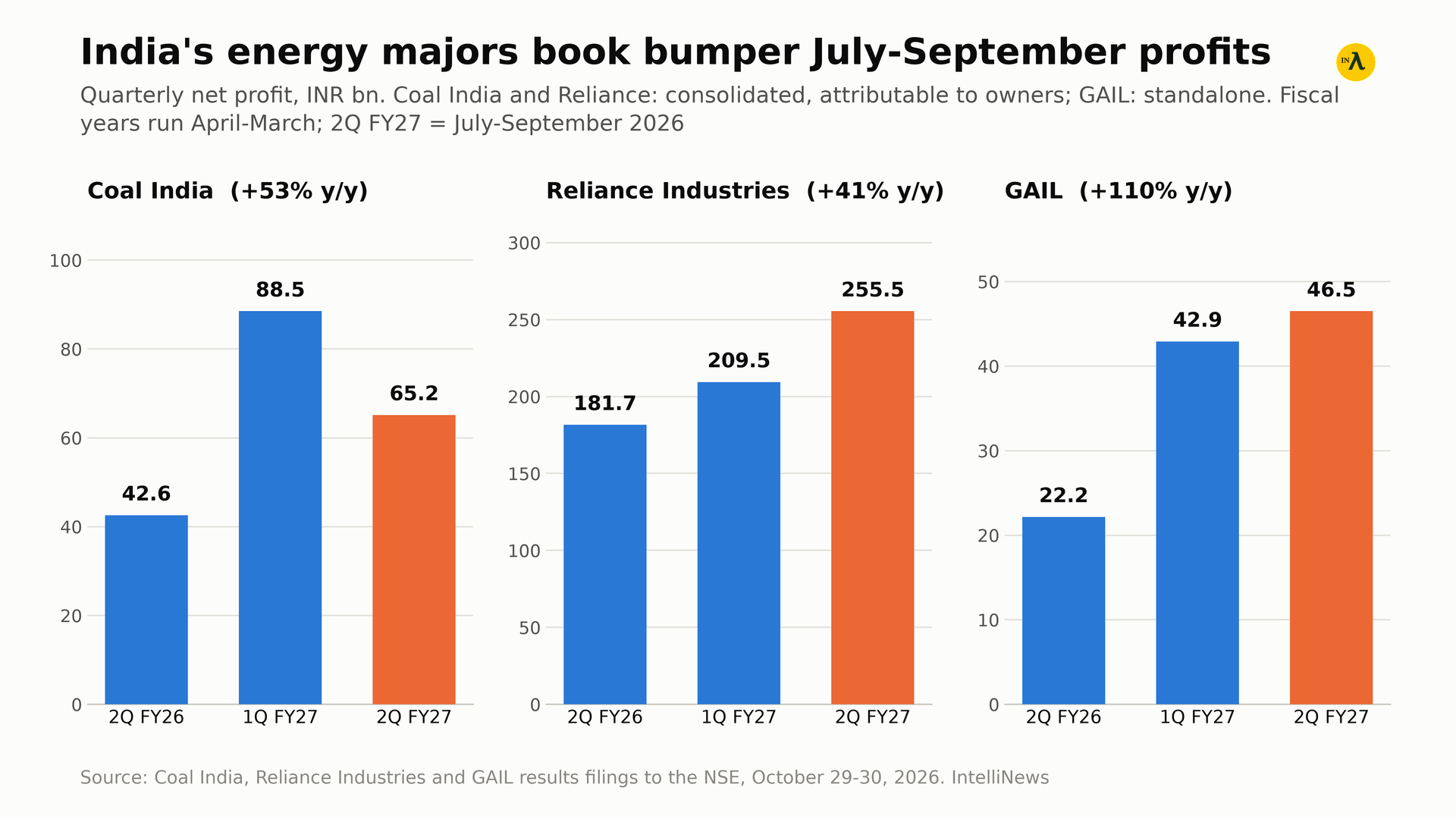
Quarterly net profit, INR bn. Coal India and Reliance consolidated, attributable to owners; GAIL standalone. Source: company results filings to the NSE, October 29-30, 2026. IntelliNews
Reliance shows most clearly where the money came from. EBITDA at its oil-to-chemicals division, which runs the Jamnagar refining complex in Gujarat, jumped 67.9% y/y to INR252.03bn, against 17.7% growth at the Jio digital business. Retail earnings fell 10.2% and the upstream oil and gas arm slipped 2%, the group's investor presentation shows. Including the shares of Jio and the retail arm held by outside investors, group profit rose a more modest 33.8%.
Fuel cracks, the gap between the price of a refined product and the crude it is made from, were three to almost four times their year-earlier level, according to industry data cited by Reliance. Diesel-grade gasoil in Singapore averaged $65.8 per barrel over crude in July-September against $18.7 per barrel a year before, and jet fuel $59.3 per barrel against $16.1 per barrel. Jamnagar also pushed its diesel exports to an 18-month high in October.
“Our O2C business has delivered its best ever quarterly performance amid a highly volatile and challenging global environment,” said Executive Director Anant Ambani.
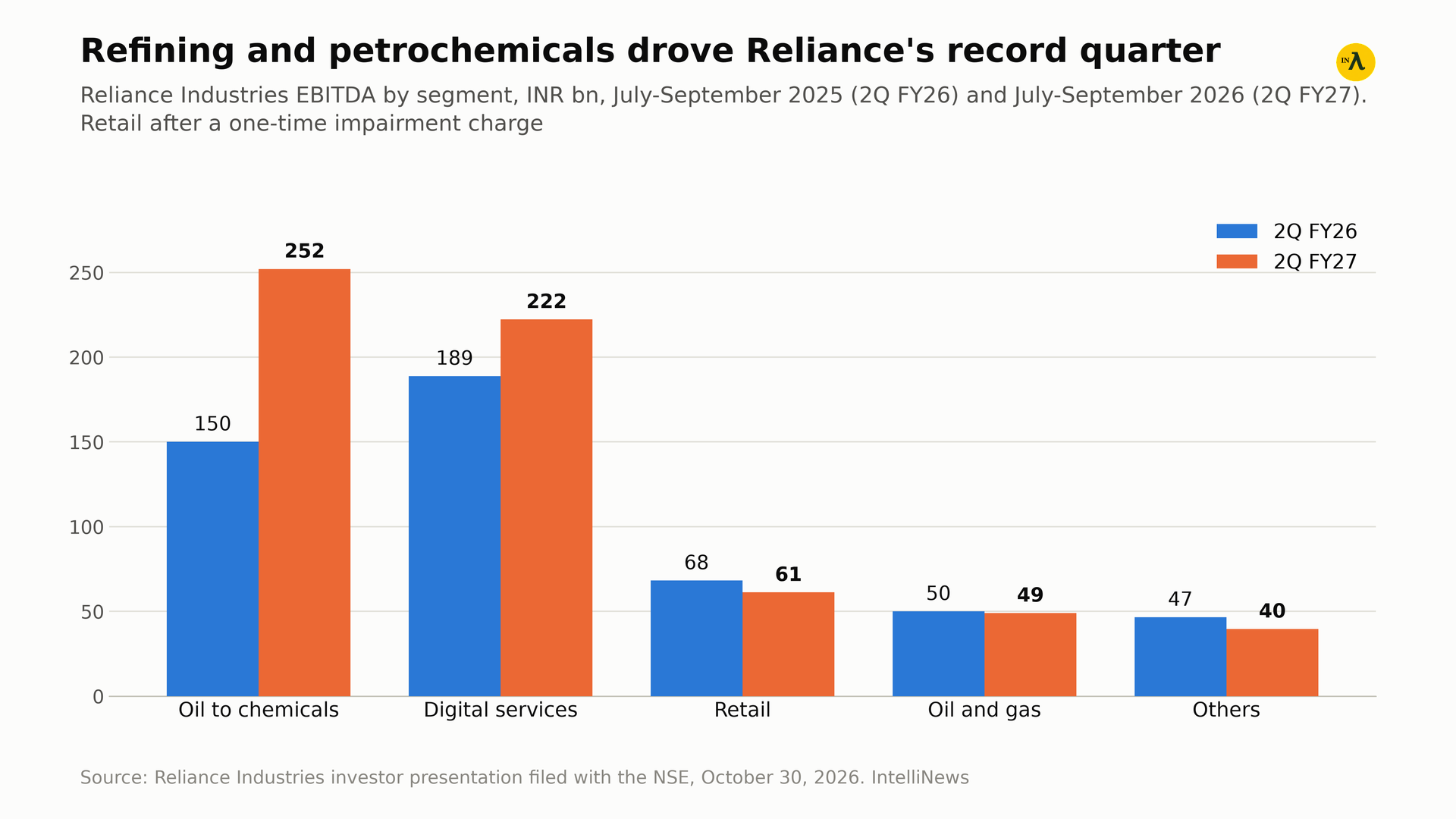
Reliance Industries EBITDA by segment, INR bn, 2QFY26 and 2QFY27. Source: Reliance Industries investor presentation, October 30, 2026. IntelliNews
Reliance's own figures also carry the first sign that the refining boom has crested. Singapore gasoline cracks averaged $24.9 per barrel in July-September, down from $25.6 per barrel in April-June, and jet cracks $59.3 per barrel against $62.9 per barrel. Gasoil was the only product still gaining.
October has been rougher. Beijing issued an unscheduled fourth batch of fuel export quotas on October 28, and by October 30 the Singapore gasoline crack had fallen to about $11 per barrel, 78% below its October 1 record of $50.53 per barrel, Reuters reported. Singapore's onshore product stocks rose 0.9% in the week to October 28 as distillate inventories recovered, and traders expect more Chinese and South Korean diesel in November, when Seoul will let refiners export up to 110% of their year-earlier volumes under looser diesel curbs.
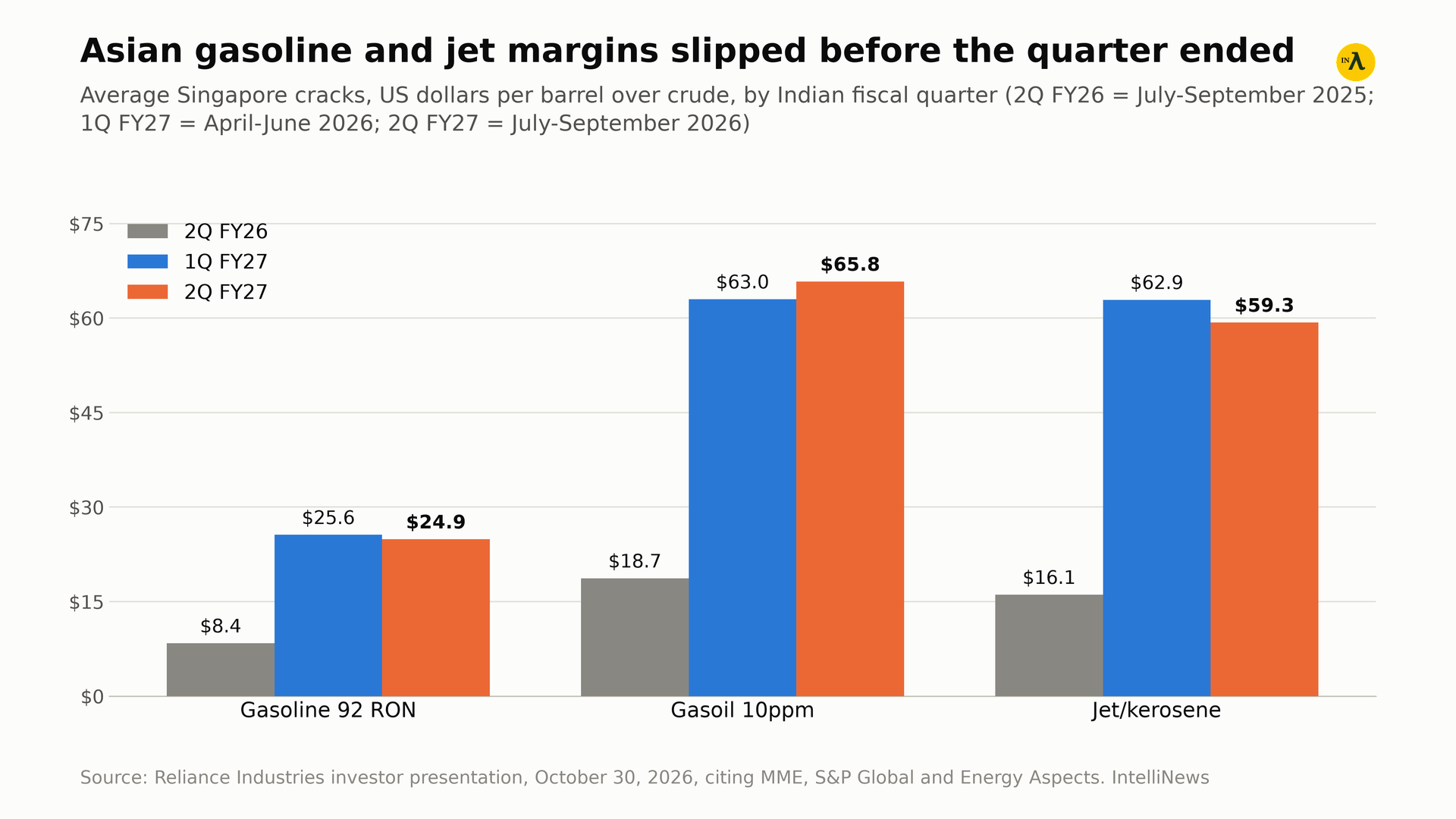
Average Singapore product cracks, $ per barrel over crude, by Indian fiscal quarter. Source: Reliance Industries investor presentation, October 30, 2026, citing MME, S&P Global and Energy Aspects. IntelliNews
Diesel has not cracked in the same way. Gulf refinery outages and Russia's export ban are unresolved, and Reliance expects supply disruptions and low stocks to keep middle-distillate margins high. The peak, if it has come, is in gasoline and jet fuel, and in a market where a single quota notice from Beijing can halve a margin in a day. China's own majors show the same pattern: Sinopec's quarterly profit rose 57.2% even as its nine-month refinery runs fell.
Coal India's windfall rests on volume rather than price. Sales rose 13% y/y to 186.3mn tonnes, coal sold through e-auctions jumped by half to 22.8mn tonnes and the average realisation per tonne rose 7%, the company's results presentation shows. A weak monsoon kept fans and pumps running and cut hydropower output, and coal-fired generation rose 12.9% y/y in July and 12.1% in August, according to Ember's monthly electricity data.
With seaborne coal at a three-year high and a weak rupee, New Delhi dropped a plan to make power stations import coal and told Coal India to dig more instead. The base also flattered the miner: its July-September 2025 profit had slumped, and the latest figure is 26% below April-June. Counting minority interests, the company reports a 57% rise. Its board declared a second interim dividend of INR10.25 a share.
GAIL earned its money trading gas rather than piping it. Its natural gas marketing segment made a profit of INR32.84bn, against INR13.04bn a year earlier, as marketing volumes rose to 97.23mn standard cubic metres a day from 93.82mn in April-June. That segment profit was still lower than in the previous quarter, and the petrochemicals unit stayed in the red.
The three windfalls will not fade at the same pace. Coal India's depends on power demand that usually eases in the cooler months, GAIL's on gas trading margins that have already begun to narrow, and Reliance's on refining cracks that Beijing can move with a quota notice. October's collapse in Asian gasoline margins suggests the refining part has passed its best, though the diesel market that matters most to Jamnagar has yet to follow.
This article was produced with the help of IntelliNews Lambda analytical tool
Unlock premium news, Start your free trial today.

