
How China captured the Gulf while Washington forgot to send an ambassador


There is a useful diagnostic for the state of an empire: count its ambassadors. In April 2026, more than 15 months into the second Trump administration, the United States has no Senate-confirmed ambassador in Riyadh, none in Doha, and none in Abu Dhabi. The Saudi post is occupied by a chargée d'affaires, Alison Dilworth, a career foreign service officer who has been holding the fort since the Biden-era envoy Michael Ratney departed in January 2025. The Doha embassy is run by another chargé, Mo Barghouty. The American Foreign Service Association's tracker recorded that, as of December 2025, fewer than 8% of Trump's 78 confirmed ambassadorial appointments were career diplomats. The Gulf, where Washington has historically stationed roughly 50,000 troops and on whose security its industrial economy still depends, has been left to acting officials.
Beijing, by contrast, has been very busy and continues to make inroads in all countries around the Gulf and beyond.
According to the China Briefing dataset compiled in October 2025, China-GCC trade rose from roughly $36bn in 2010 to nearly $400bn today. APCO Worldwide projects the figure will reach $325bn for the GCC alone by 2027 and $682bn for the broader Gulf-Asia corridor by 2030, surpassing Persian Gulf (mostly GCC) trade with Western economies. The Carnegie Endowment, in an October 2025 study by Jon Bateman titled Imports and Influence, traced the granular shift. In that article, he said that Chinese-made vehicles from JAC, GAC and SAIC now account for nearly 14% of GCC car imports by value, up from almost zero a decade ago, with many models not available outside those markets, including brands like MG. The same study found that imports from China are now displacing American goods across high-tech sectors that GCC governments are explicitly targeting for domestic development. Tesla and Apple versus Geely and Xiaomi.
In April 2025 alone, Abu Dhabi National Oil Corp signed three term contracts with Chinese buyers for liquefied natural gas, including a 500,000-tonne-a-year deal with CNOOC starting in 2026. A year earlier, China and QatarEnergy signed the world's largest LNG shipbuilding order, commissioning 18 ultra-large carriers. Saudi Aramco alone took a 10% stake in Rongsheng Petrochemical for $3.4bn and launched a joint venture refinery with Sinopec. The UAE's non-oil trade with China hit $90.1bn in 2024, with renminbi settlement tripling in five years. The Saudi Public Investment Fund and Abu Dhabi's ADQ are cross-investing in Chinese technology and green energy at a pace the Carnegie data shows accelerating year on year.
Behind the trade flows lies something more durable: alignment. In May 2025, China's Ministry of Commerce announced the completion of upgraded ASEAN-China FTA negotiations and is now moving towards the conclusion of a China-GCC free trade agreement that has been in stop-start negotiations for two decades. The Saudi Arabian Vision 2030, the UAE's Net Zero 2050 strategy, Qatar's National Vision 2030 and Kuwait Vision 2035 have all been explicitly synchronised with China's Belt and Road Initiative. The Baker Institute at Rice University, in a December 2024 brief by Jim Krane and colleagues, identified the underlying logic to this strategy. Krane's report shared a model of state capitalism in which sovereign-wealth-fund-controlled firms such as ACWA Power and Masdar collaborate with Chinese state-owned enterprises on the basis of "fewer bureaucratic hurdles" than Western counterparts can match. China is in the Gulf to make money and flog its goods; the US is in the Gulf to flex and extract wealth back to the New York Stock Exchange and Treasury bonds in exchange for a gas-guzzling Escalade, which looks like a dinosaur compared with what the Chinese are now offering the Arabian peninsula countries.
Iran and the recent war is the secondary front, but more telling for what it reveals about American leverage. The US-China Economic and Security Review Commission, in its March 2026 China-Iran fact sheet, calculated that China imported roughly $31.2bn of unreported Iranian crude in 2025, on top of $9.96bn in declared bilateral trade. The Institute for Energy Research, citing the Wall Street Journal, put China's share of Iran's seaborne oil exports at 90%, paid for through infrastructure investment rather than international banking. The 25-year, $400bn comprehensive strategic partnership signed between Beijing and Tehran in March 2021 has not been fully delivered, but it has provided the political architecture under which Iran has been quietly absorbed into the Shanghai Cooperation Organisation (SCO), which it joined as a full member in 2023, and into a yuan-denominated trading system that the US dollar can no longer police.
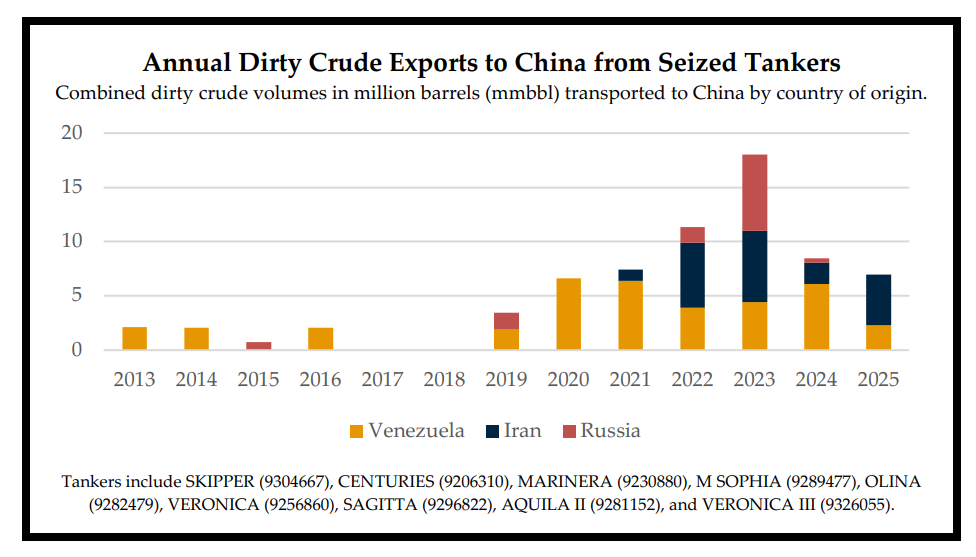
That last point is what should worry Washington most. The House Select Committee on the Chinese Communist Party's Crude Intentions report, released in March 2026, found that sanctioned crude from Russia, Iran and Venezuela now accounts for one-fifth of China's total oil imports, with Beijing using the resulting discounts to expand its strategic petroleum reserves by at least 169mn barrels across 11 new sites in 2025-26. The architecture China has built around Iran, in other words, is not just bilateral. It is a parallel financial system, settling roughly 80% of Iran-China trade in yuan, and the Gulf monarchies are watching it work.
The US-Israel war on Iran beginning February 28, and the closure of the Strait of Hormuz that followed, hit GCC economies harder than any single shock since the 1990 Iraqi invasion of Kuwait. The Middle East Council on Global Affairs, in its January 2026 trade-networks paper by Karen Young, noted that GCC oil and gas exports were running at near-record volumes when the war began. Within six weeks the Strait was effectively shut, Qatari LNG shipments stopped, Bangladesh, India and Pakistan were paying double for spot cargoes, and aviation across the Gulf was paralysed. The dollar value of the disruption to the GCC exceeded $180bn in the first quarter alone, Newsbase data previously showed, due to lost export earnings, insurance premium hikes, and re-routing costs. Saudi Arabia and the UAE absorbed the largest share, with Riyadh's quarterly hydrocarbon revenue down by an estimated 38% on the previous quarter and Abu Dhabi reporting comparable losses on the LNG side.
The American security umbrella, which the Gulf has paid for in arms purchases for decades, did not prevent any of this. Saudi Arabia, the UAE, Qatar, Kuwait and Bahrain remain among the world's top 25 arms importers, with the United States supplying between 42% (UAE) and 97% (Bahrain) of their imports. The arms keep flowing. So does the protection rhetoric from the White House. That even within the security relationship, "the depth and increasing sophistication of China-Gulf economic ties limit the willingness of Gulf states to align with the United States outside of core security matters."
The GCC countries will buy the F-35s and the Patriots for the moment and as long as they remain friendly with the US. However, they will no longer take Washington's calls on AI export controls, Russian oil sanctions, Iran policy, or which currency to settle their oil contracts in. This is now what we are seeing with the United Arab Emirates, following its recent humiliation after spending billions on security infrastructure with the Americans. Now that Abu Dhabi is breaking away from the OPEC consortium, it can freely export as much oil to China as it wants, replacing Iranian exports and likely irking the US in the process.
The political vacuum left by the US reinforces the economic one. Trump's senior adviser on Arab and Middle Eastern affairs is Massad Boulos, a Lebanese-American businessman whose principal qualification, on the public record, is being the father-in-law of Tiffany Trump. The National, reporting from Abu Dhabi in April 2025, noted that Boulos has been "largely quiet since the President took office," with the Gulf brief effectively ceded to special envoy Steve Witkoff, a property developer and Trump golf partner. Witkoff has conducted the flaky diplomacy, including ceasefire negotiations with Iran, in lieu of an ambassadorial system with Trump's son-in-law, Jared Kushner, hoovering up contracts for Trump Inc. and Kushner enterprises in flagrant violation of diplomatic rules. How this will play out over the long term is likely to bode well for the young Kushner, who is often seen circling around Wiktoff.
What this lack of diplomatic professionalism produces, for Gulf governments accustomed to dealing with seasoned American envoys who could pick up the phone to a deputy secretary, is a transactional and intellectual vacuum. Decisions that used to be brokered through Riyadh's American embassy are now made through opaque personal channels in Mar-a-Lago and the recently marbled Rose Garden at the White House. Saudi Crown Prince Mohammed bin Salman, the UAE's Sheikh Mohamed bin Zayed and Qatar's Sheikh Tamim bin Hamad have responded by routing more of their strategic business through Beijing, where the diplomatic apparatus is professional, the deals are implementable, and the political price of accepting Chinese investment is conspicuously lower than that of accepting American.
Lastly, the surprise China brokered the Saudi-Iran rapprochement in March 2023. China is now the largest trading partner of every GCC state bar none. China is the principal beneficiary of the Iran war's reordering of regional energy flows. Beijing's strategy of courting US adversaries threatens to jeopardise some of its interests, but the longer-term structural advantage remains with China. The American mistake has been to assume that arms sales and aircraft carriers are sufficient substitutes for diplomacy, presence and patient commercial engagement.
China is making hay while the sun shines.
Unlock premium news, Start your free trial today.


.jpg)