Amid the ongoing conflict in the Middle East and supply chain disruptions caused by the near-total closure of the Strait of Hormuz, concerns over global food security have intensified, Statista reports.
Amid the ongoing conflict in the Middle East and supply chain disruptions caused by the near-total closure of the Strait of Hormuz, concerns over global food security have intensified, Statista reports.
The region plays a key role in agricultural trade routes and fertilizer supply, while several countries are themselves heavily reliant on food imports. Disruptions to trade flows, higher transport costs and price volatility risk exacerbating vulnerabilities, particularly in import-dependent economies.
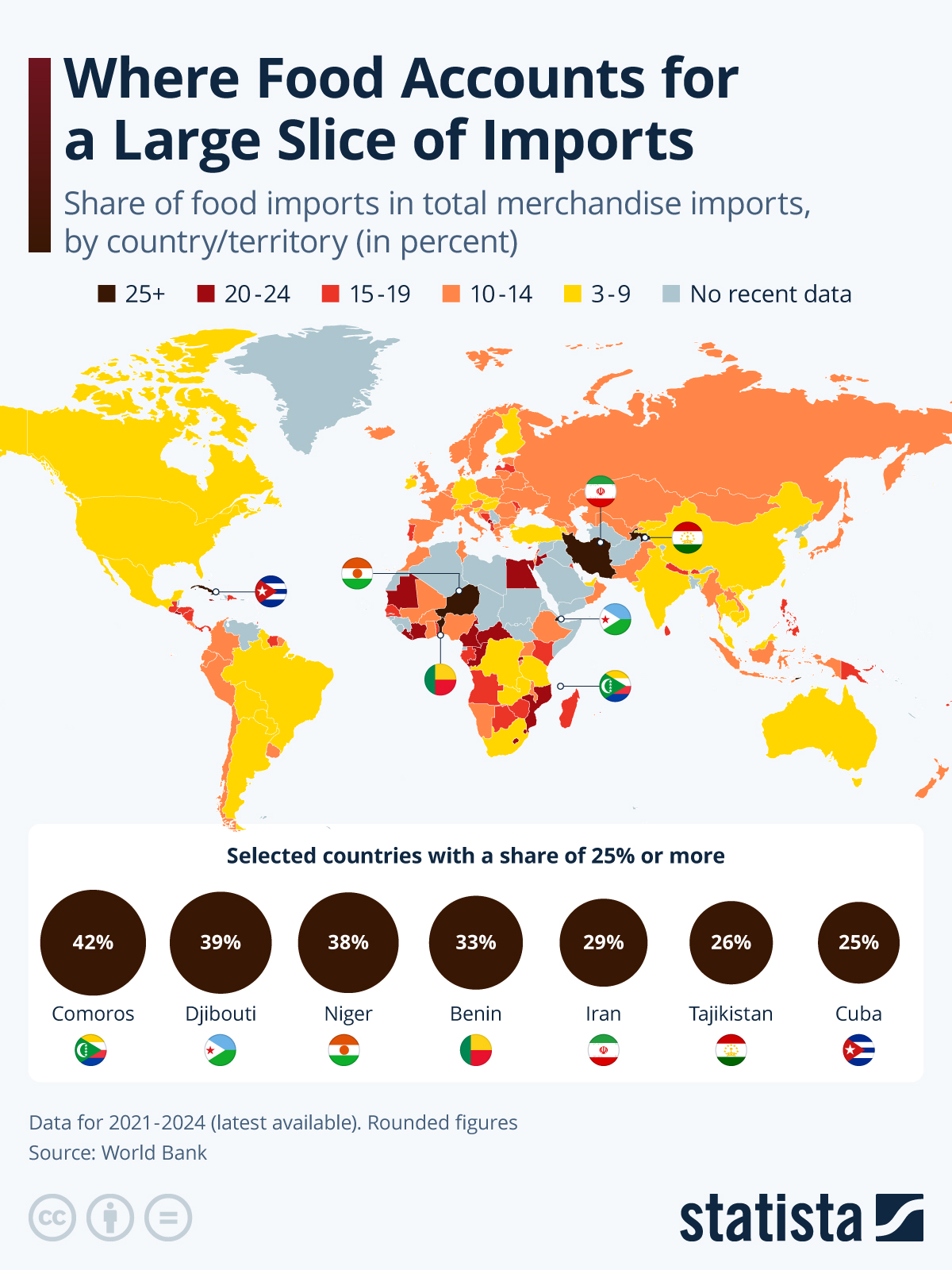
As our map shows, based on the most recent figures available from the World Bank (2021–2024), food imports account for a large share of total merchandise imports in many countries, especially small island states and lower-income nations. In Comoros, food makes up 42 percent of all goods imported, followed by Kiribati (41 percent) and Djibouti (39 percent). Niger (38 percent), Benin and Cape Verde (33 percent each) also rank among the most dependent. Several Middle Eastern and Central Asian countries also appear in the upper range, including Iran (29 percent) and Tajikistan (26 percent), highlighting their exposure to external supply shocks.
A broader regional pattern emerges across Sub-Saharan Africa, parts of the Caribbean and small islands in the Indian Ocean and Pacific, where structural factors such as limited arable land, climate constraints and economic specialization increase reliance on imported food. In contrast, large agricultural producers such as the United States, China, Brazil and India show much lower shares, typically below 10 percent, reflecting stronger domestic production capacity. Overall, the data underline a key vulnerability in the global food system: for many countries, food security is closely tied to international trade. In times of geopolitical instability, this dependence can quickly translate into heightened risks of shortages and rising costs.
 You will find more infographics at Statista
Where food insecurity is highest
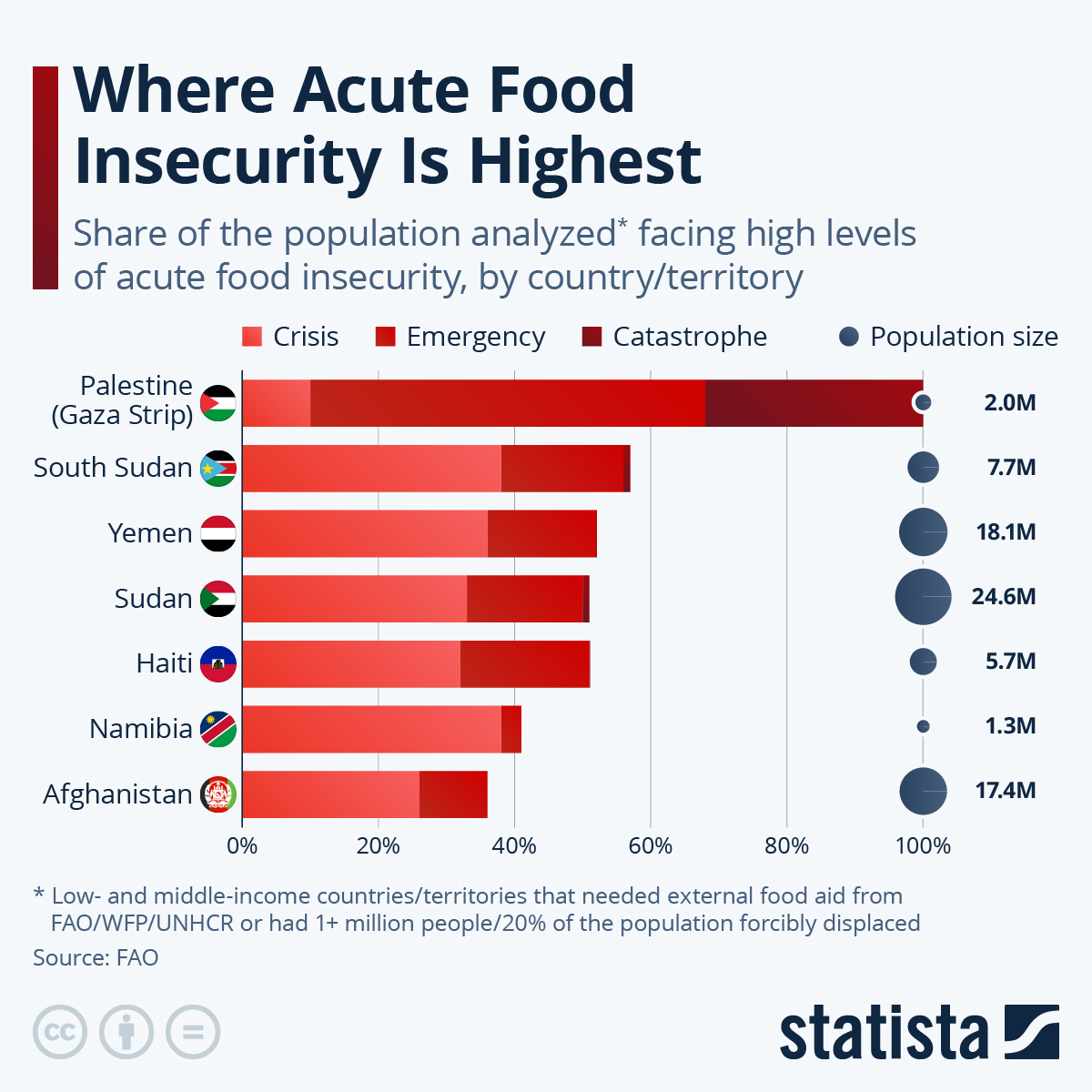
Every single Palestinian living in the Gaza Strip faced food insecurity to a level of crisis or worse in 2025, according to the FAO’s 2026 Global Report on Food Crises. At 100 percent, the territory presented the highest share of people facing high levels of acute food insecurity worldwide. This is the third year in a row for this to be the case. However, in 2025, the situation even deteriorated, with 90 percent of the analyzed population considered to be in IPC Phase 4 and 5 of food insecurity, i.e. a state of emergency and catastrophe, compared with 88 percent in 2024.
The FAO reports that famine was confirmed in Gaza Governorate in mid-August (IPC Phase 5) after Israel ramped up its restrictions on humanitarian assistance following the expiry of a ceasefire. Conditions in North Gaza were likely similar or worse but could not be classified due to a lack of data. While a de-escalation of conflict, a proposed peace plan and improved access to food deliveries are reported to have led to a partial improvement in food security and nutrition conditions between October and December, temporarily offsetting famine classifications, the situation remained critical, with the entire Gaza Strip at risk of famine under a worst-case scenario from December 2025 onwards.
As the following chart shows, another four countries had populations where over 50 percent faced high levels of acute food insecurity. These were South Sudan (57 percent), Yemen (52 percent), Sudan (51 percent) and Haiti (51 percent). At the same time, between 33 and 38 percent of the populations analyzed in Afghanistan, the Central African Republic, Namibia, Zambia and Zimbabwe faced high levels of acute food insecurity last year.
The countries with the highest absolute number of people facing food insecurity in 2025 were Nigeria (30.6 million), the Democratic Republic of the Congo (27.7 million), Sudan (24.6 million), Yemen (18.1 million) and Afghanistan (17.4 million).
This chart’s data is based on the highest or peak estimate of people facing high levels of acute food insecurity during at least one month of 2025, or if not available, the second half of 2024.
 You will find more infographics at Statista
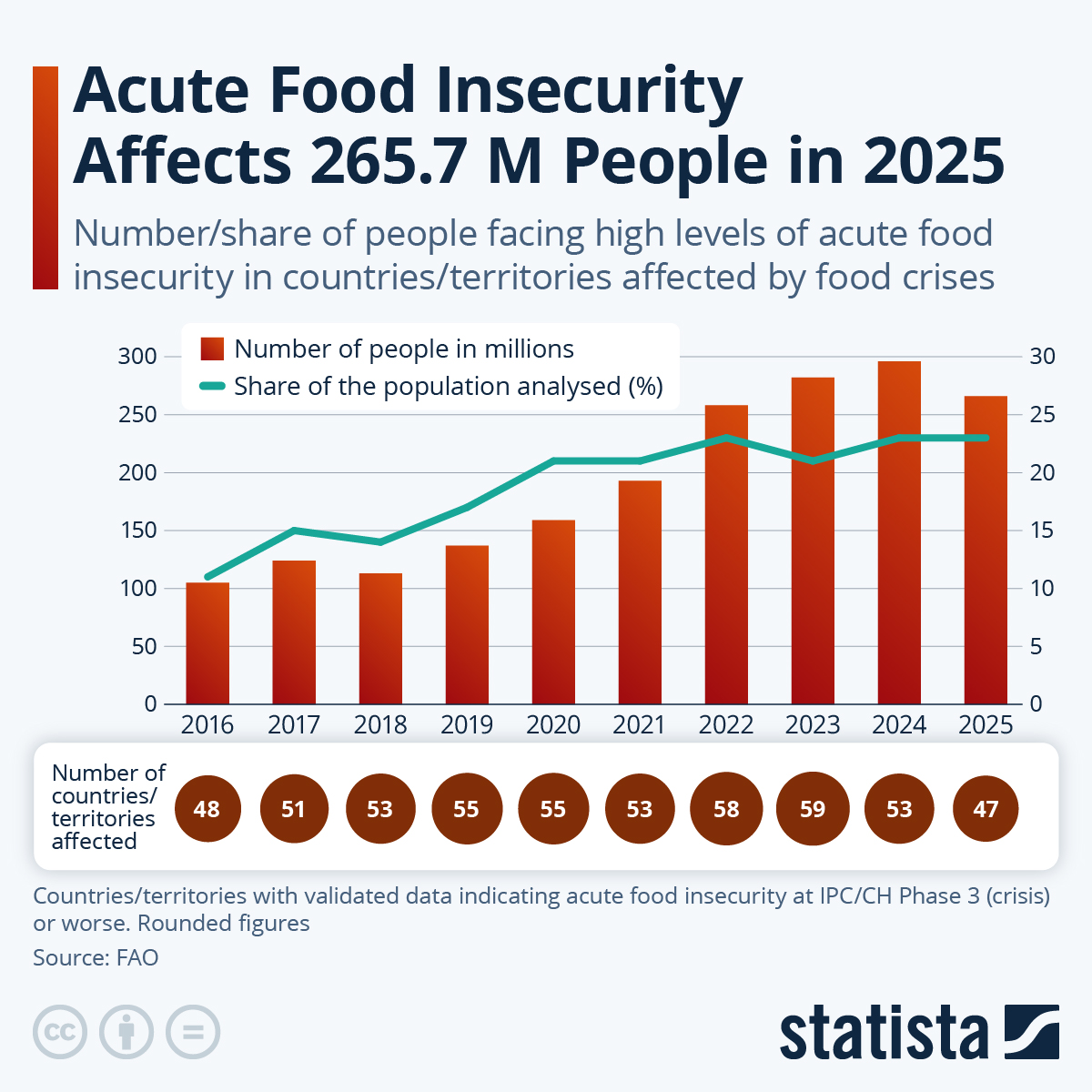
The number of people facing catastrophic levels of acute food insecurity rose from around 155,000 in two countries in 2015 to 1.4 million people across six countries in 2025, according to the FAO’s 2026 Global Report on Food Crises. Last year, the three main drivers of acute food insecurity were conflict, economic shocks and climate extremes. While these phenomenon are interconnected, an assessment of the state of global food insecurity in 2025 found that the primary driver in 19 of the 47 countries and territories analyzed was conflict.
As the following chart shows, the share of the analyzed population facing high levels of acute food insecurity nearly doubled in the past decade. Between 2016 and 2025, the total number of people facing high levels of acute food insecurity rose from 105.3 million to 265.7 million. This increase reflects both worsening food security and increases in country and population coverage.
Between 2019 and 2020, the major increases in the number of people facing high levels of acute food insecurity were driven largely by socioeconomic impacts of the Covid-19 pandemic and the outbreak of war in Ukraine, which impacted commodity prices. Over the next few years, between 2022 and 2024, the increase was partly due to expanded analysis coverage. Meanwhile, deteriorations in conflict-driven crises such as in Myanmar, Nigeria, Palestine and Sudan, outweighed improvements in Afghanistan, Kenya and Ukraine.
 You will find more infographics at Statista





