
Global democracy perception of US collapses, behind Russia and China for first time


A survey of nearly 100,000 people across 98 countries has found that global perception of the US has collapsed to its lowest recorded level — placing it among the five most negatively perceived countries in the world, behind both Russia and China in international favourability, and on the losing side of three of the five major geopolitical conflicts the survey tested.
The 2026 Democracy Perception Index, published by the Alliance of Democracies Foundation and research firm Nira Data ahead of the Copenhagen Democracy Summit on May 12-14, is based on 94,146 respondents across 98 countries surveyed between March 19 and April 21 — making it the world's largest annual study of its kind, representative of more than 90% of the global population.
"The fast decline of the US' perception around the world is saddening but not shocking," said Anders Fogh Rasmussen, former Nato Secretary General and founder of the Alliance of Democracies Foundation. "Far more concerning to me is that many Europeans still do not recognise the threats facing them and the urgent need to build our own deterrence. Democracy is still in demand around the world but our leaders must step up to show that our democratic systems can still offer a vision of optimism and hope for voters."
Dr Nico Jaspers, chief executive of Nira Data, said: "The 2026 Democracy Perception Index highlights how quickly global perceptions can shift in response to geopolitical tensions, conflict, and economic uncertainty. The declining image of the US and its increasingly widespread perception as the world's biggest threat — combined with widespread pessimism in parts of Europe — is deeply concerning. What we see is not declining demand, but rising expectations: citizens are looking for systems that deliver security, stability, and economic progress."
The country perception ranking
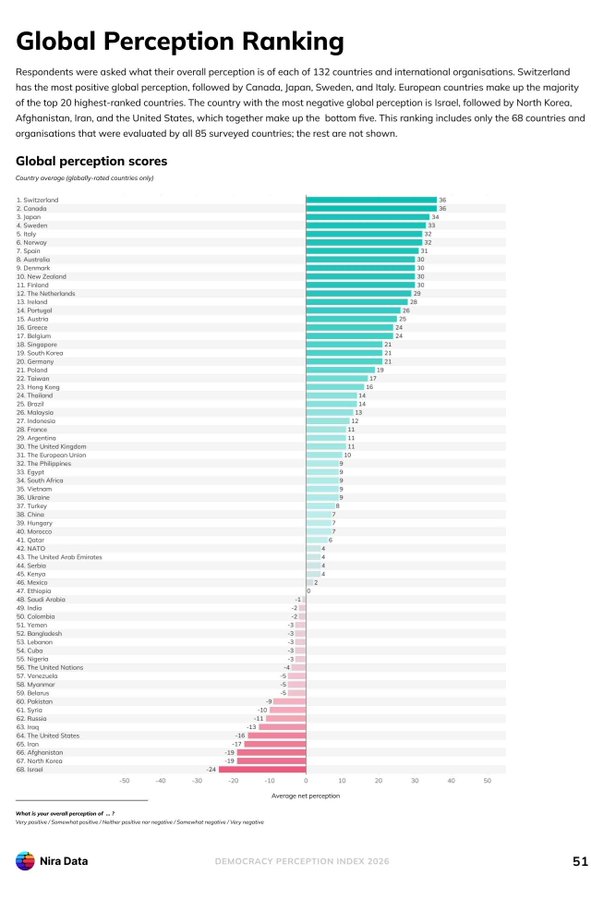
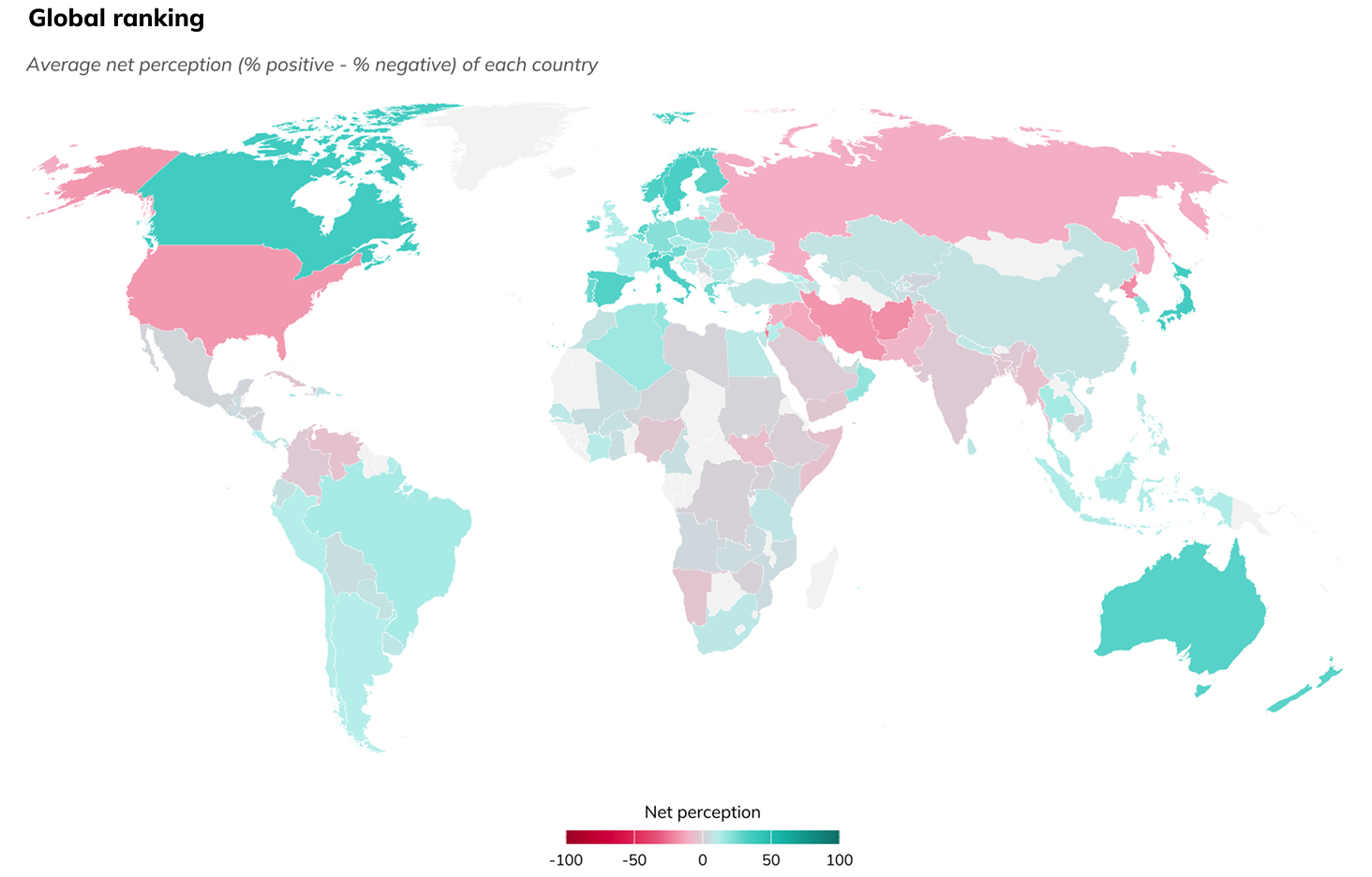
The US now sits in the bottom five most negatively perceived countries in the world. The most negatively perceived country globally is Israel, followed by North Korea, Afghanistan, Iran and the US — in that order. The five most positively perceived countries are Switzerland, Canada, Japan, Sweden and Italy.
The US net perception score has swung from 22% in 2024 to -16% in 2026 — a decline of 38 percentage points in two years, and a further drop of 11 points in the past year alone from -5 in 2025. The countries with the sharpest declines in their perception of the US since 2025 include Ivory Coast, Senegal, Serbia, Vietnam, Ghana, Cameroon and Algeria — countries that previously viewed Washington favourably or neutrally.
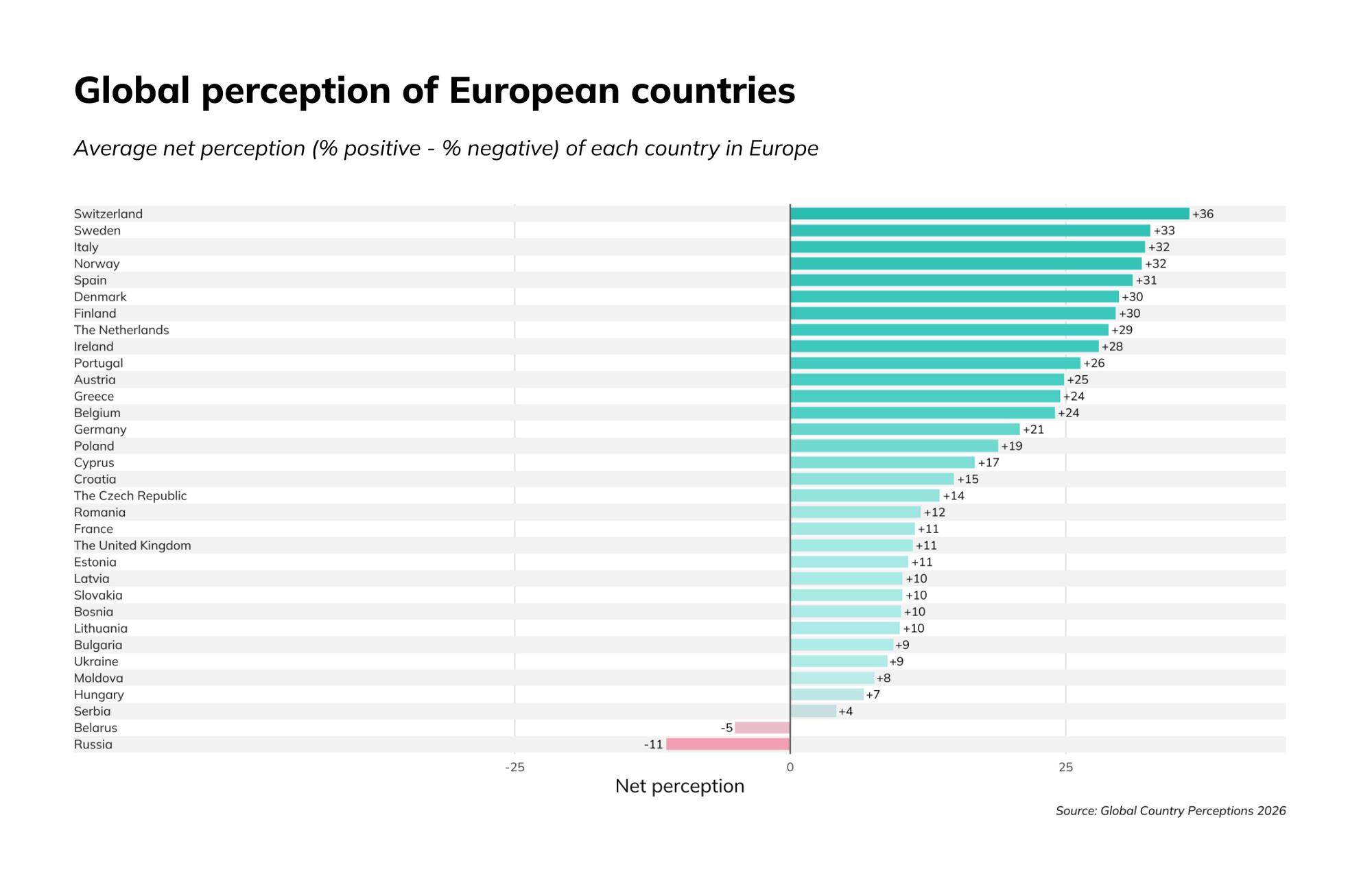
China, by contrast, has improved its global perception since 2022. It now scores 7% — the only one of the three major powers with a net positive global image. Russia scores -11. The US is now perceived more negatively than Russia for the first time in the survey's history.
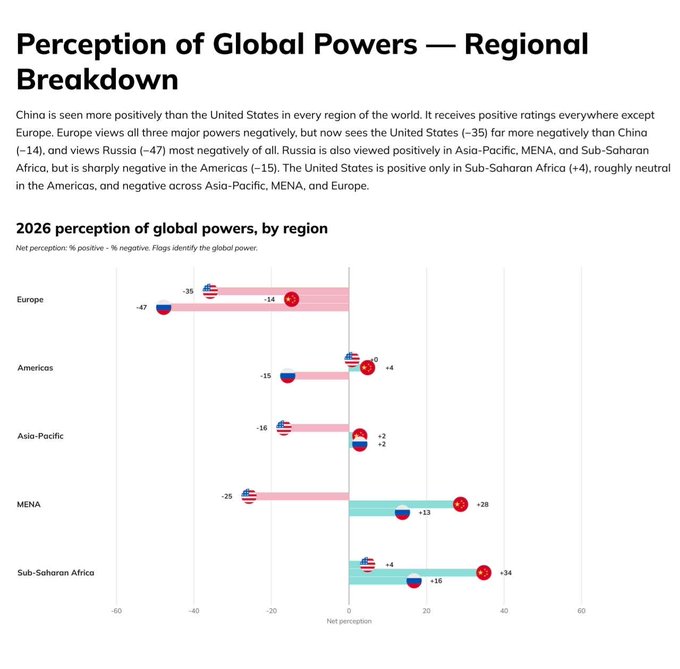
The regional breakdown is particularly striking. Europe now views the US at -35 — far more negatively than China at -14 — and Russia at -47. China is viewed positively in Asia-Pacific, MENA and Sub-Saharan Africa. The US is positive only in Sub-Saharan Africa at 4, roughly neutral in the Americas, and sharply negative in Asia-Pacific, MENA and Europe.
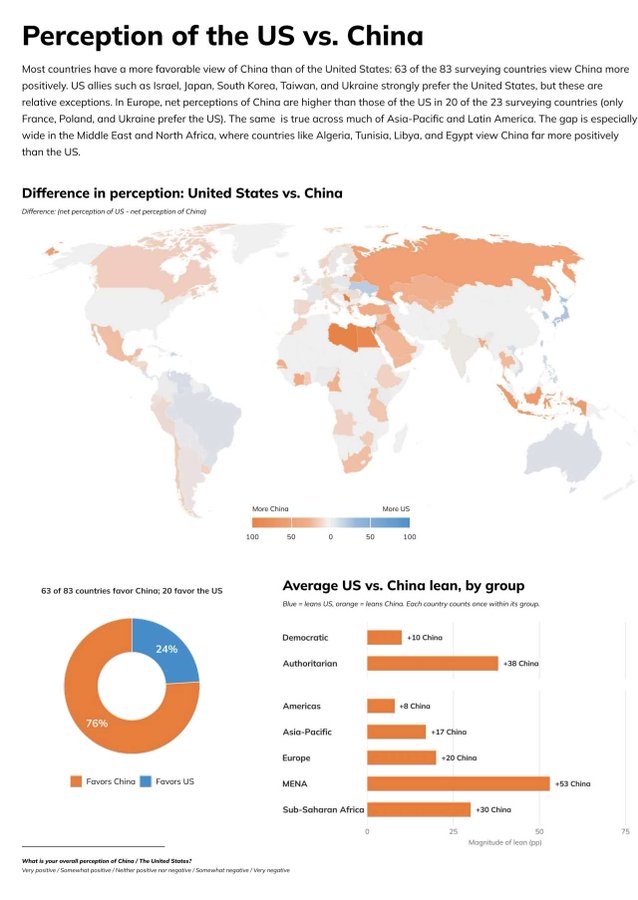
In 63 of the 83 surveying countries, respondents view China more favourably than the US. In Europe, China is rated more positively than the US in 20 of 23 surveying countries — with only France, Poland and Ukraine preferring Washington.
The five conflicts
The report asked respondents in all 98 countries which side they agreed with more in five active or potential conflicts. The US is on the less popular side of three of them.
On Russia versus Ukraine: 55 of 98 countries agree more with Ukraine, 30 with Russia. Europe agrees overwhelmingly with Ukraine; MENA leans toward Russia. Asia-Pacific is split, with pro-Ukraine views in Australia, New Zealand, Japan and South Korea, and pro-Russia leans in Indonesia, India, China and Pakistan.
On Israel versus Palestine: 51 countries agree more with Palestine, 17 with Israel. The Americas are the only region that leans, slightly, toward Israel.
On the US versus Iran: 41 countries agree more with Iran, only 28 with the US. Sub-Saharan Africa, Asia-Pacific and MENA all agree more with Iran. Europe is roughly even.
On China versus Taiwan: the closest split of the five conflicts — 41 countries agree more with Taiwan, 38 with China. This question also has the highest share of "don't know" responses, at 38% globally.
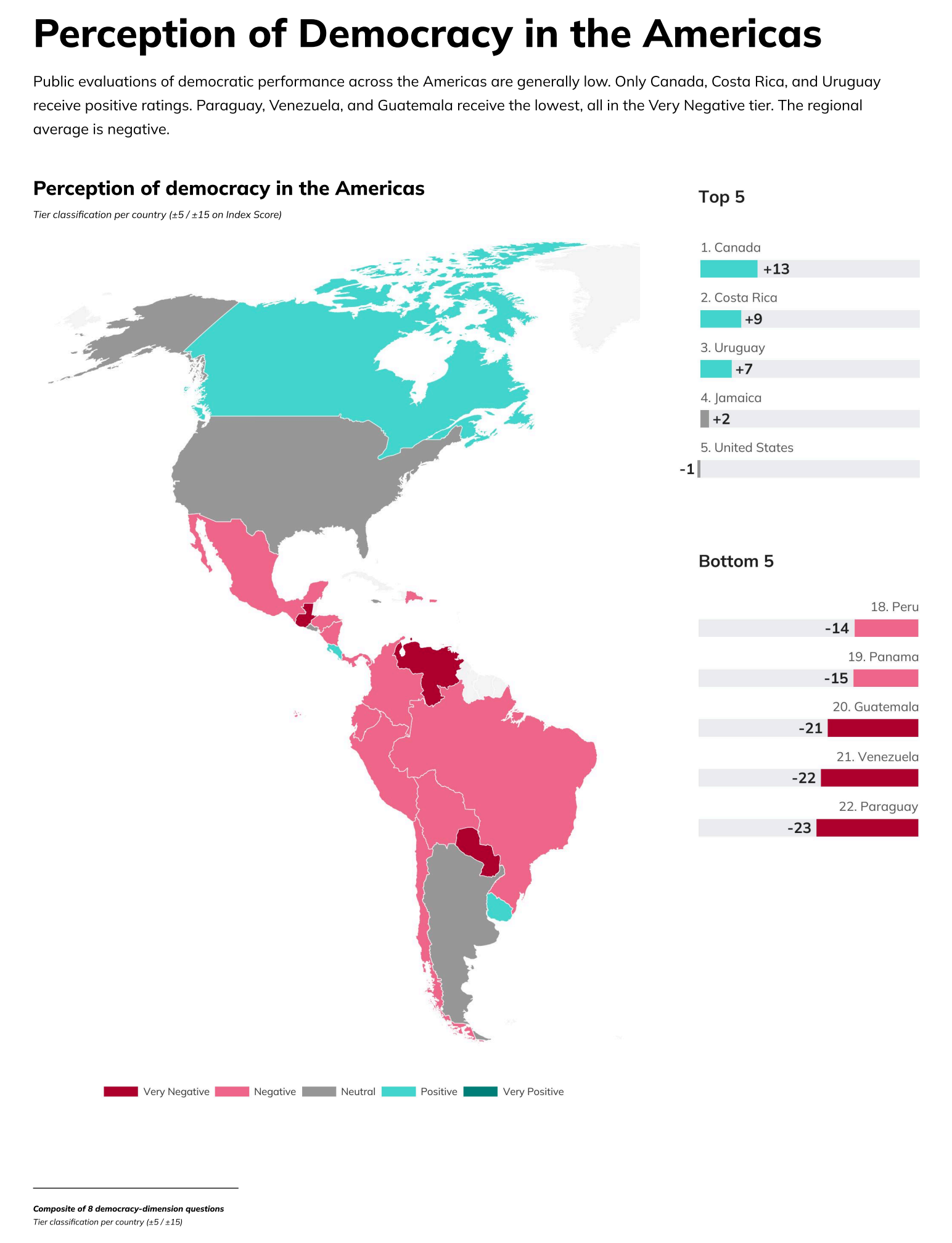
On the US versus Greenland and Denmark: the most one-sided result in the survey. Of 98 countries, 85 agree more with Greenland and Denmark; only 2 agree more with the US. Average agreement leans 26 points toward Greenland and Denmark. Notably, even the American public itself leans 12 points toward Greenland and Denmark over its own government's position.
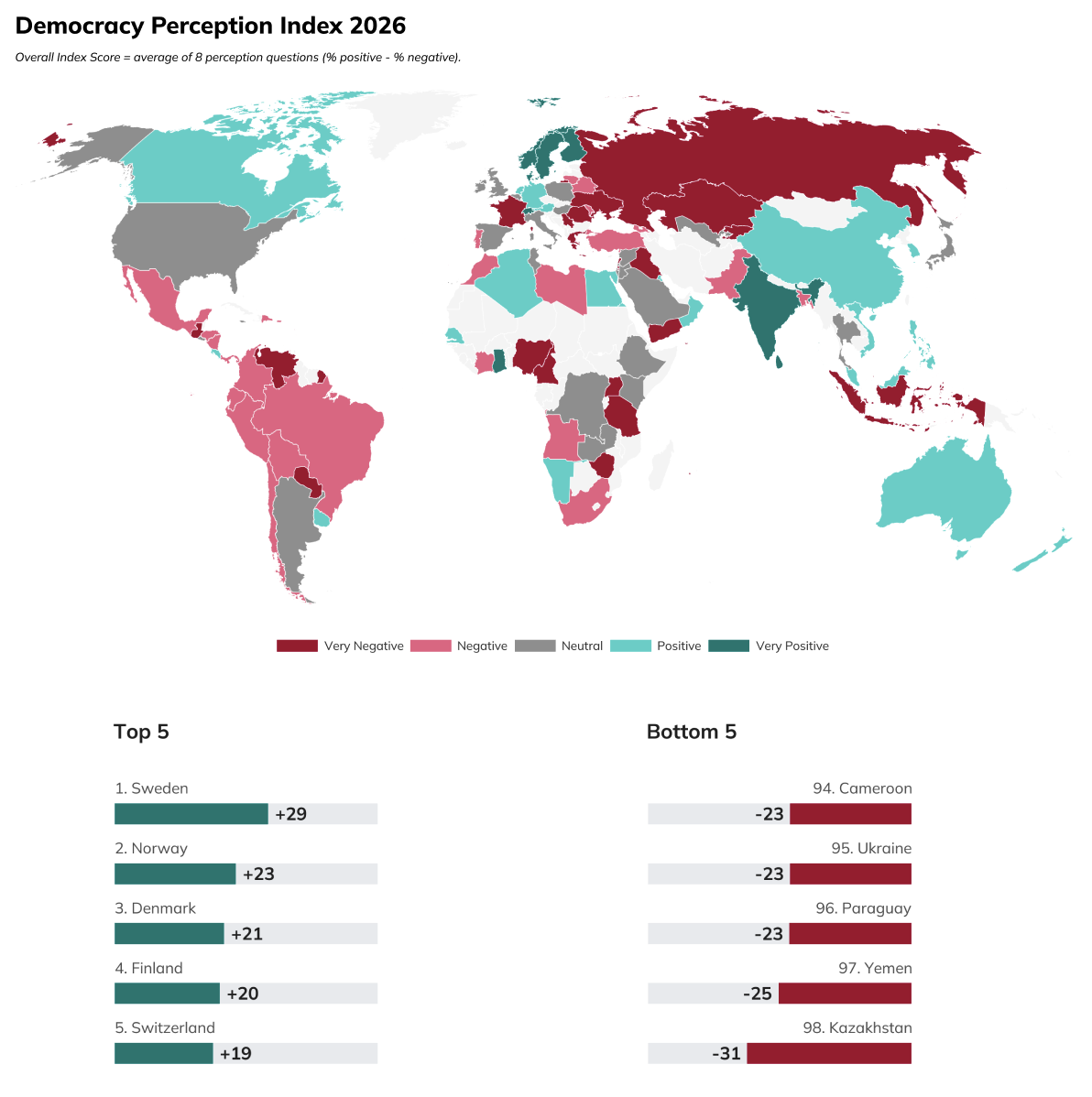
Democracy perception: France joins Kazakhstan in the lowest tier
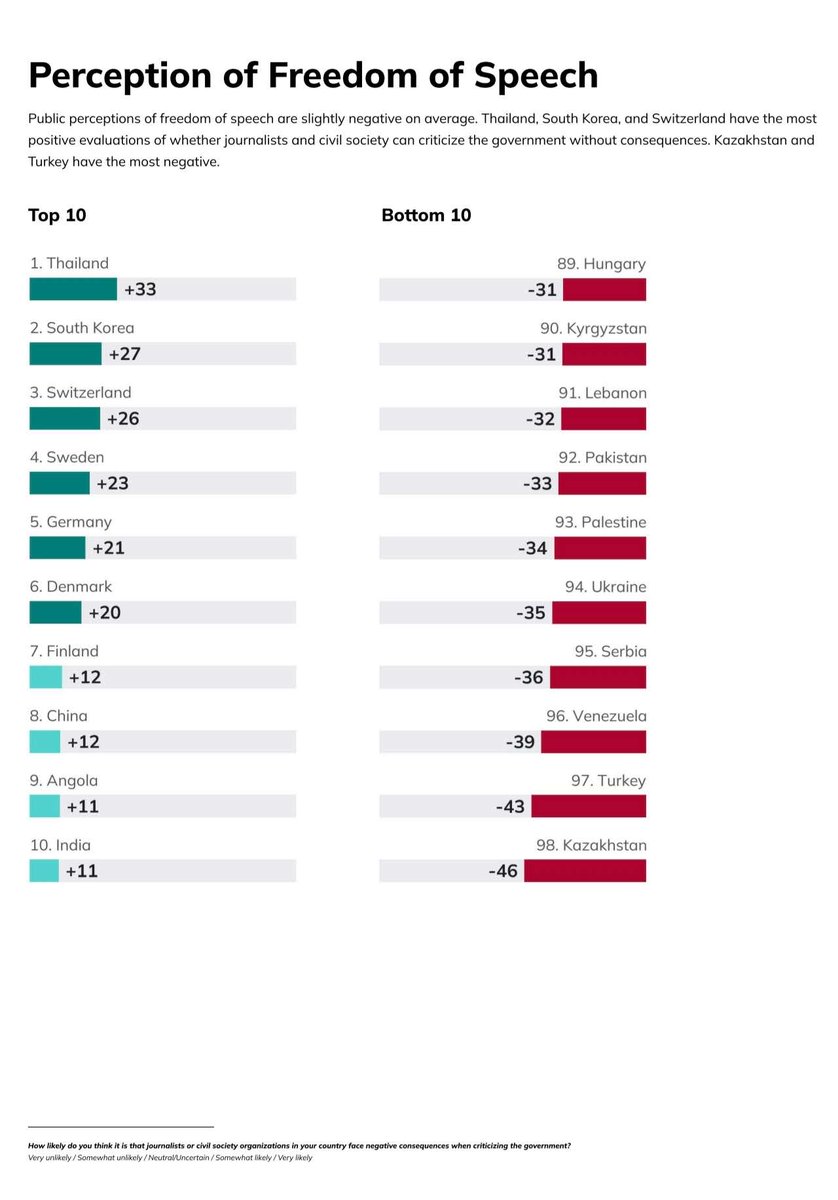
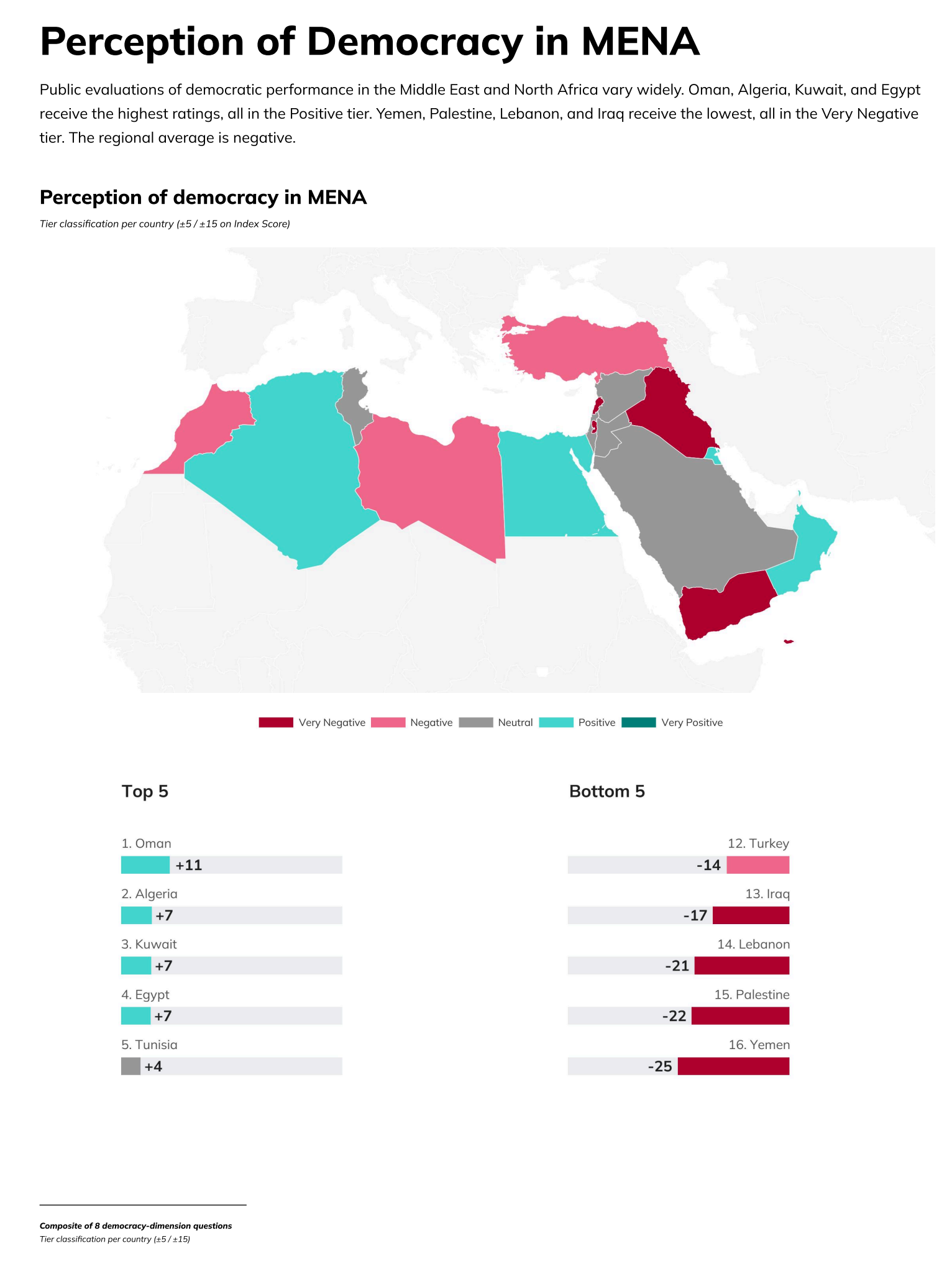
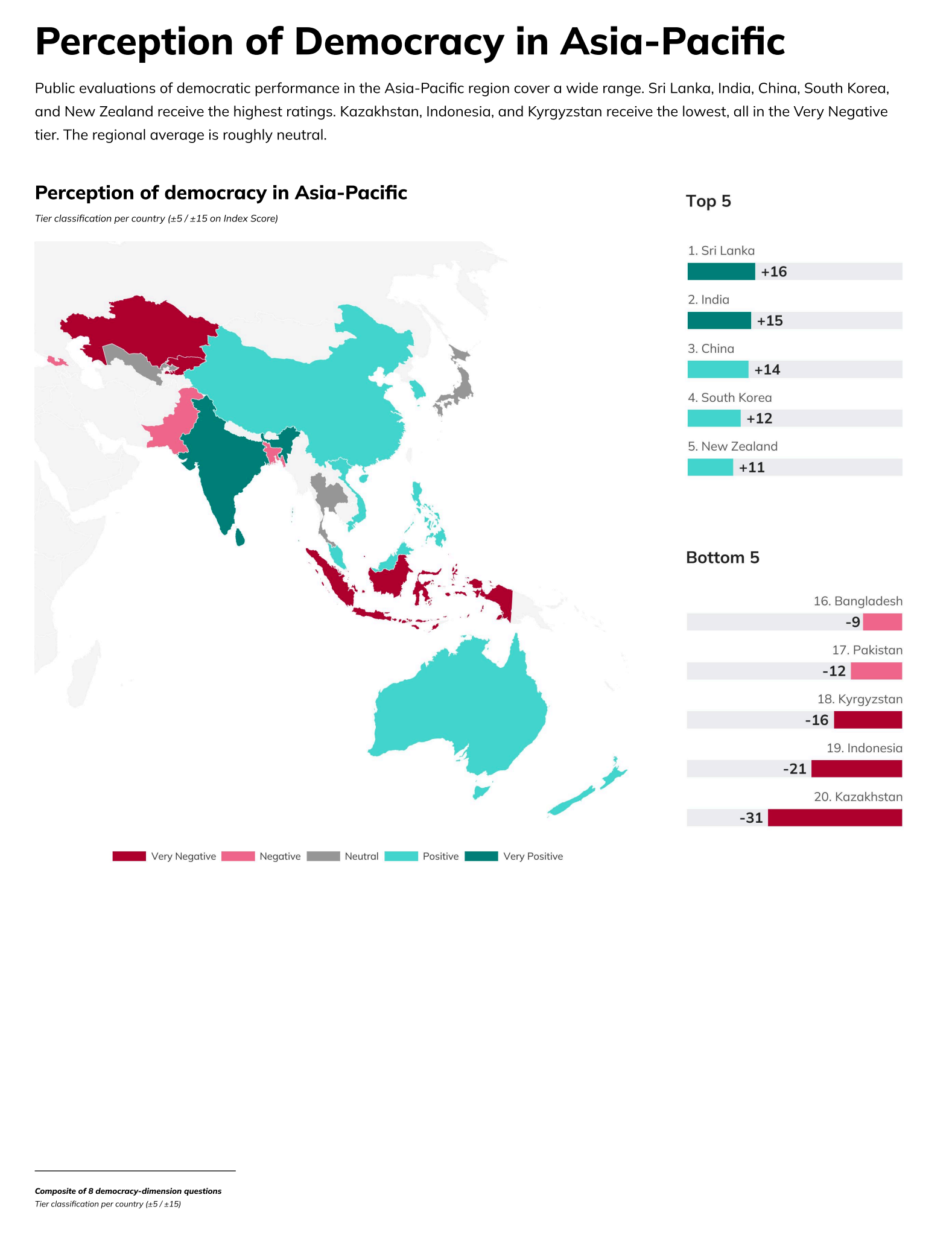
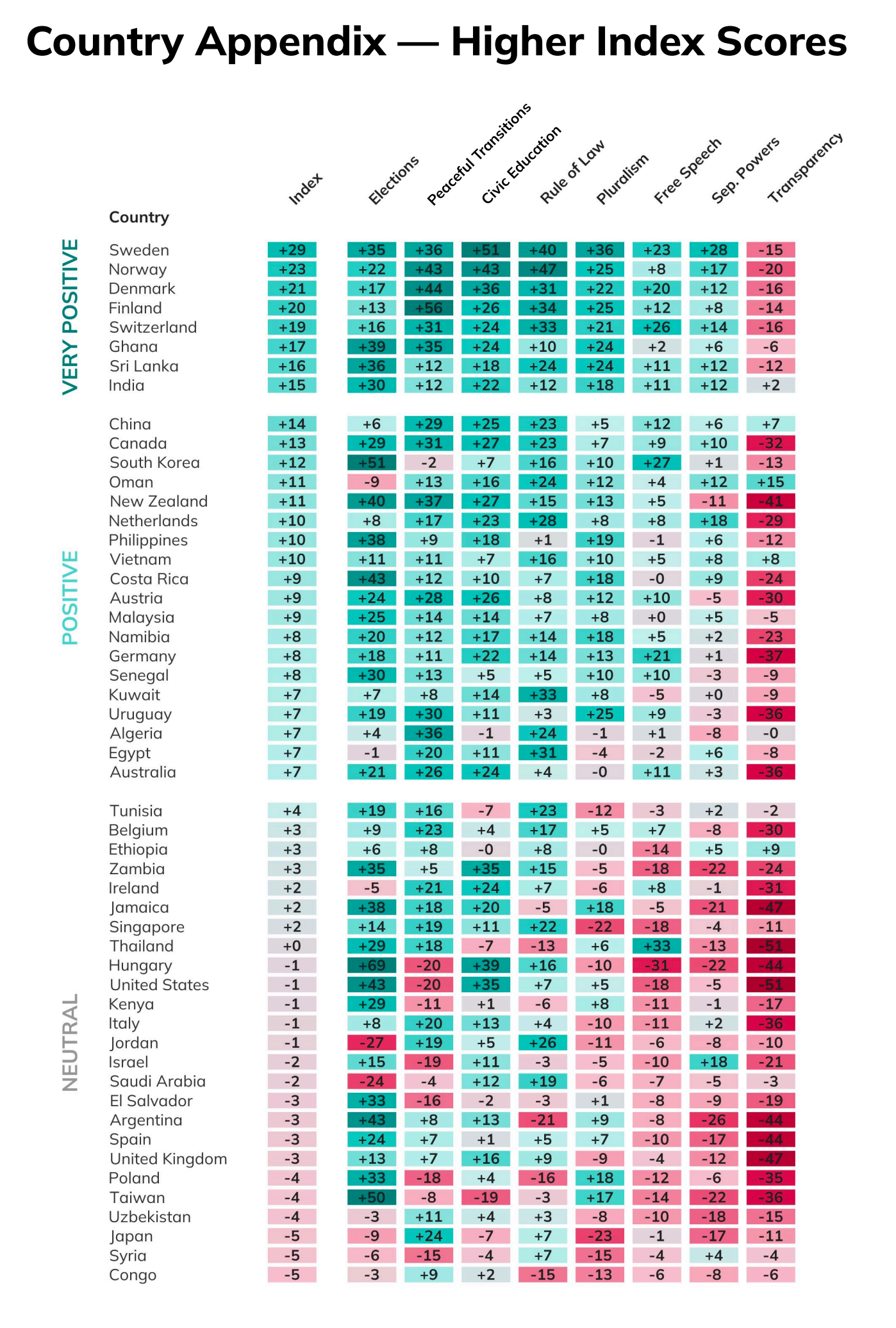
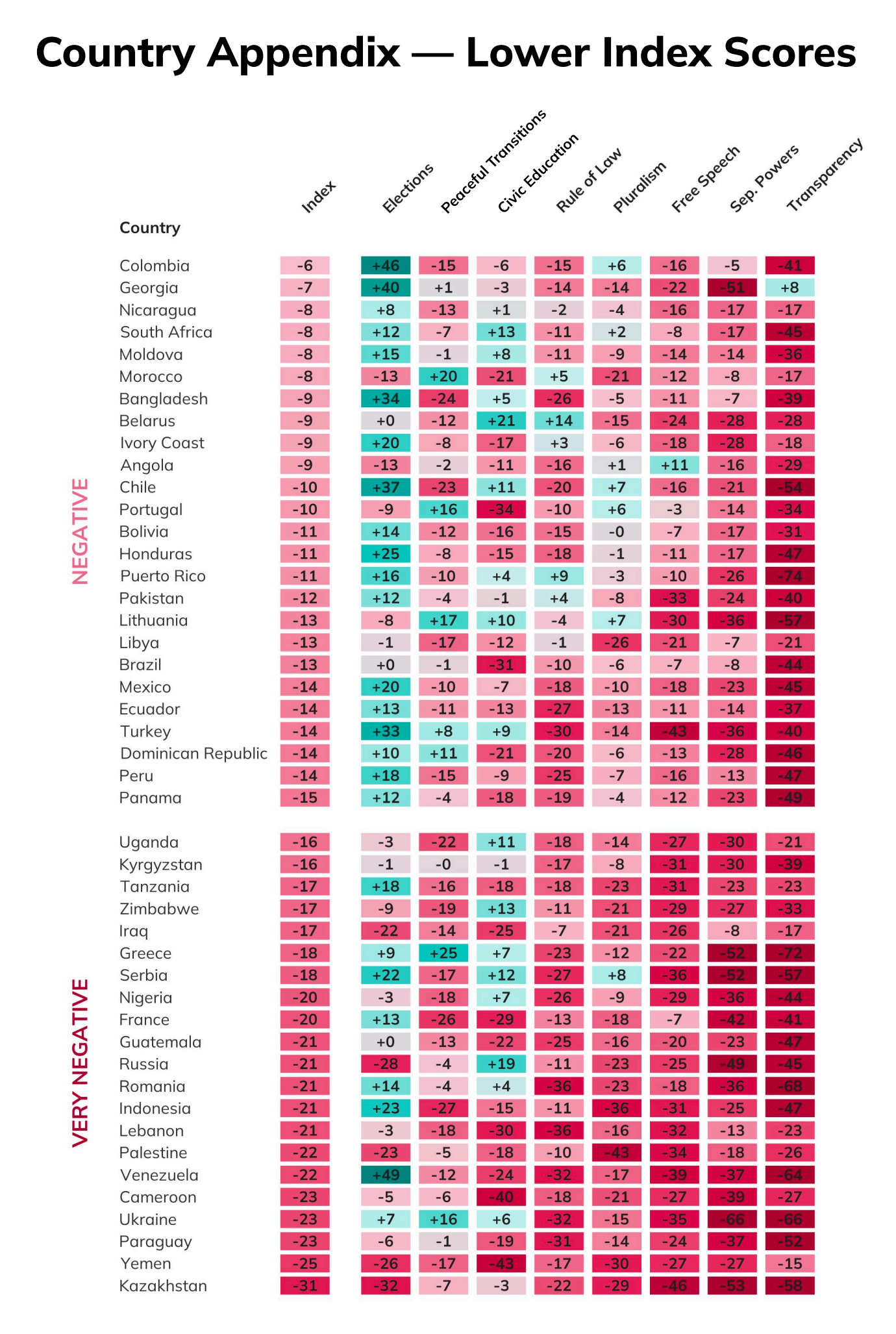
The Democracy Perception Index itself measures not institutional quality but citizens' direct experience of democratic life, across eight dimensions: elections, freedom of speech, political pluralism, civic education, separation of powers, rule of law, government transparency and peaceful transitions. Countries are ranked by how their own citizens rate these dimensions, not by external experts.
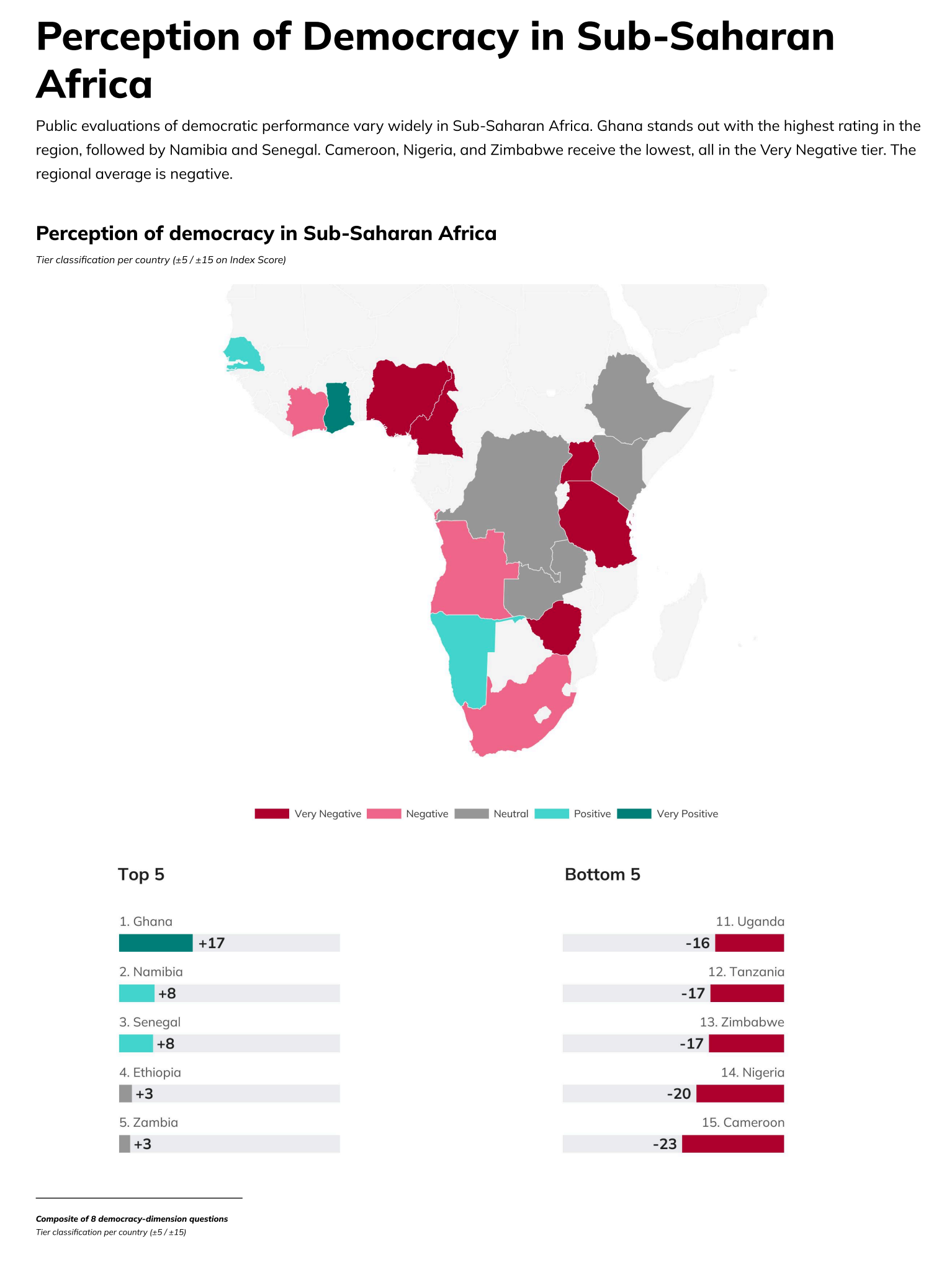
“France is now, according to the French people themselves, one of the least democratic countries in the world, alongside countries like Kazakhstan, Yemen or Zimbabwe,” says political commentator and IntelliNews contributor Arnaud Bertrand. “It's insane but sadly unsurprising given the fact that Macron made a complete mockery of the results of the previous elections, and altogether only has utter contempt for his people.”
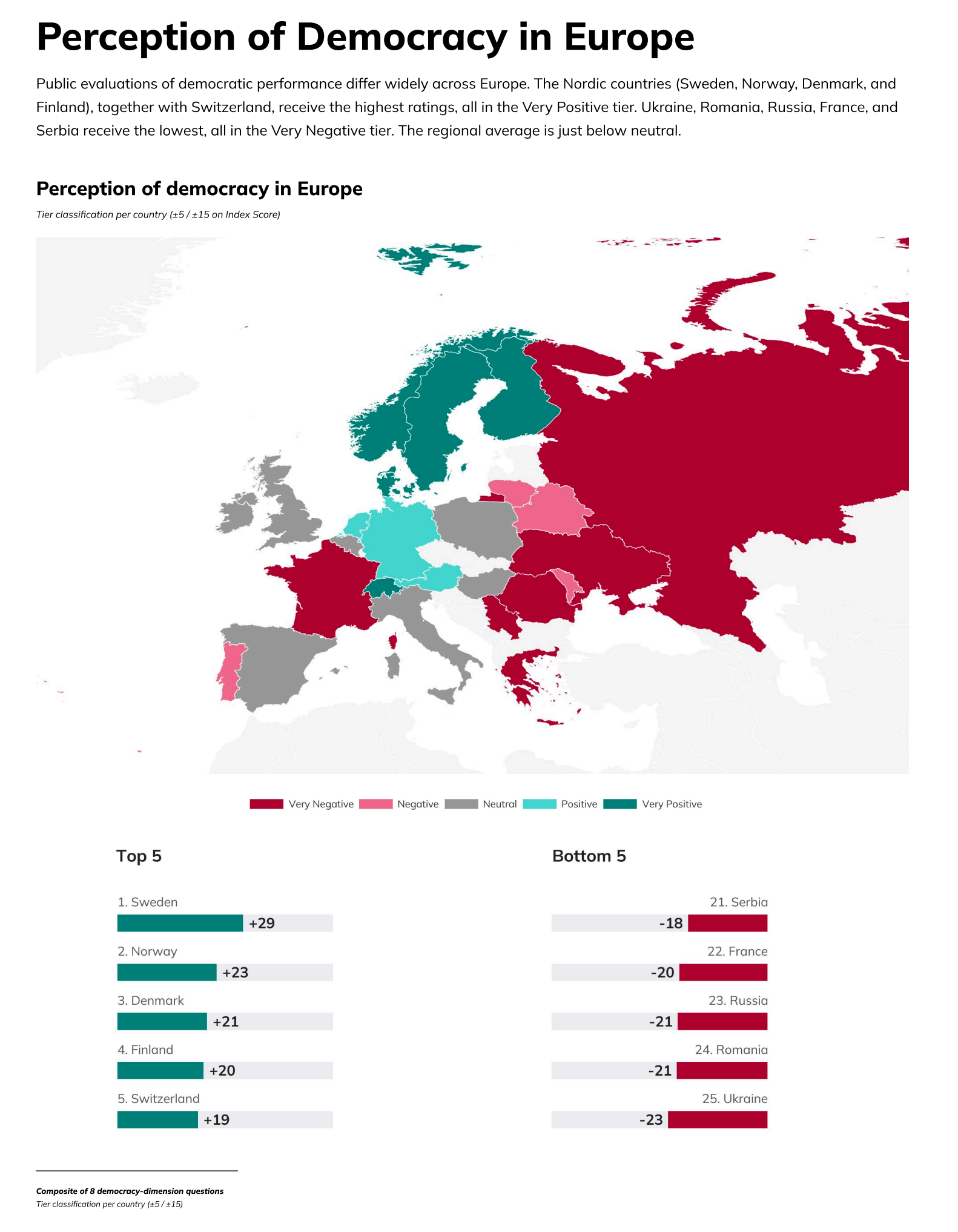
The highest-rated countries are Sweden, Norway, Denmark, Finland and Switzerland. Russia, Ukraine, France and Serbia are all placed in the Very Negative tier — the lowest category, meaning their own citizens rate their democratic experience most critically.
France's placement alongside Russia in the lowest tier is the most striking finding for a Western European audience, reflecting deep public disillusionment with political institutions and, the report notes, widespread pessimism: France and Germany are among the least optimistic countries about where their country is heading.
China, Oman and Vietnam score in the higher tiers — driven by positive citizen perceptions of the rule of law, civic education and peaceful transitions.
“Every year I get the same argument back so let me preempt it: no it's not because the Chinese people would be "afraid" to express their opinion,” says Bertrand. “If that were the case you'd see the same dynamic in other presumed "authoritarian" countries. But Russia scores -21, Belarus -9, Kazakhstan -31. If "fear of the regime" explained China's +14, why aren't Russians and Belarusians equally "afraid"?... The verdict: across every methodology tested, Chinese people mean what they say.”
The report is explicit that high DPI scores "do not necessarily mean that a country would be rated as democratic by outside experts," noting that in countries with restricted media environments "citizens may still report positive views of political participation or institutional performance. The DPI should therefore be read as a measure of public perception, not as a substitute for expert assessments of democratic rights and freedoms."
Across all regions, government transparency is the single most negatively rated democratic dimension — citizens worldwide overwhelmingly believe their governments withhold important information from the public. The most positive evaluations on government transparency come from Oman, Ethiopia, Vietnam and China. Puerto Rico and Greece have the most negative.
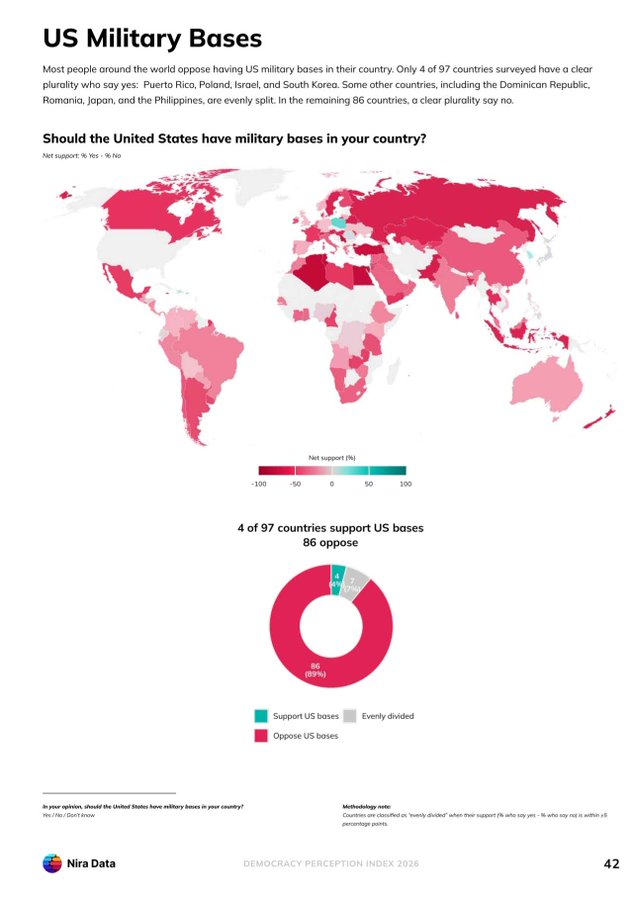
US military bases: rejected by 86 countries
The survey asked respondents whether the US should have military bases in their country. Of 97 countries surveyed, only four have a clear plurality in favour: Puerto Rico, Poland, Israel and South Korea. A further four — the Dominican Republic, Romania, Japan and the Philippines — are evenly divided. In the remaining 86 countries, a clear plurality say no.
Security: alliances over militarisation
On defence priorities, most people globally choose strengthening alliances as the primary means of national protection — the top answer in 80 of 98 countries. Military investment is the leading priority in only 18 countries, mostly in MENA and parts of Asia-Pacific. No country chose mandatory military service or nuclear deterrence as the primary approach.
However, willingness to fight personally has fallen sharply worldwide — from 53% in 2025 to 45% in 2026, a decline of 8 percentage points in a single year. In Europe, the share willing to fight is only 37% — half the MENA average of 62% — with particularly low figures in France, Italy, Germany, the Netherlands and Switzerland, where fewer than one in three say they would be willing to defend their country.
Europe is divided on whether to increase defence spending even if it means higher taxes or spending cuts. Support is highest in Nordic countries and on the eastern frontier — Sweden, Norway, Denmark, Finland, Ukraine and Poland. Opposition is clearest in Southern Europe — Italy, Greece and Spain — and France.
Faith in democracy remains high — but not in governments
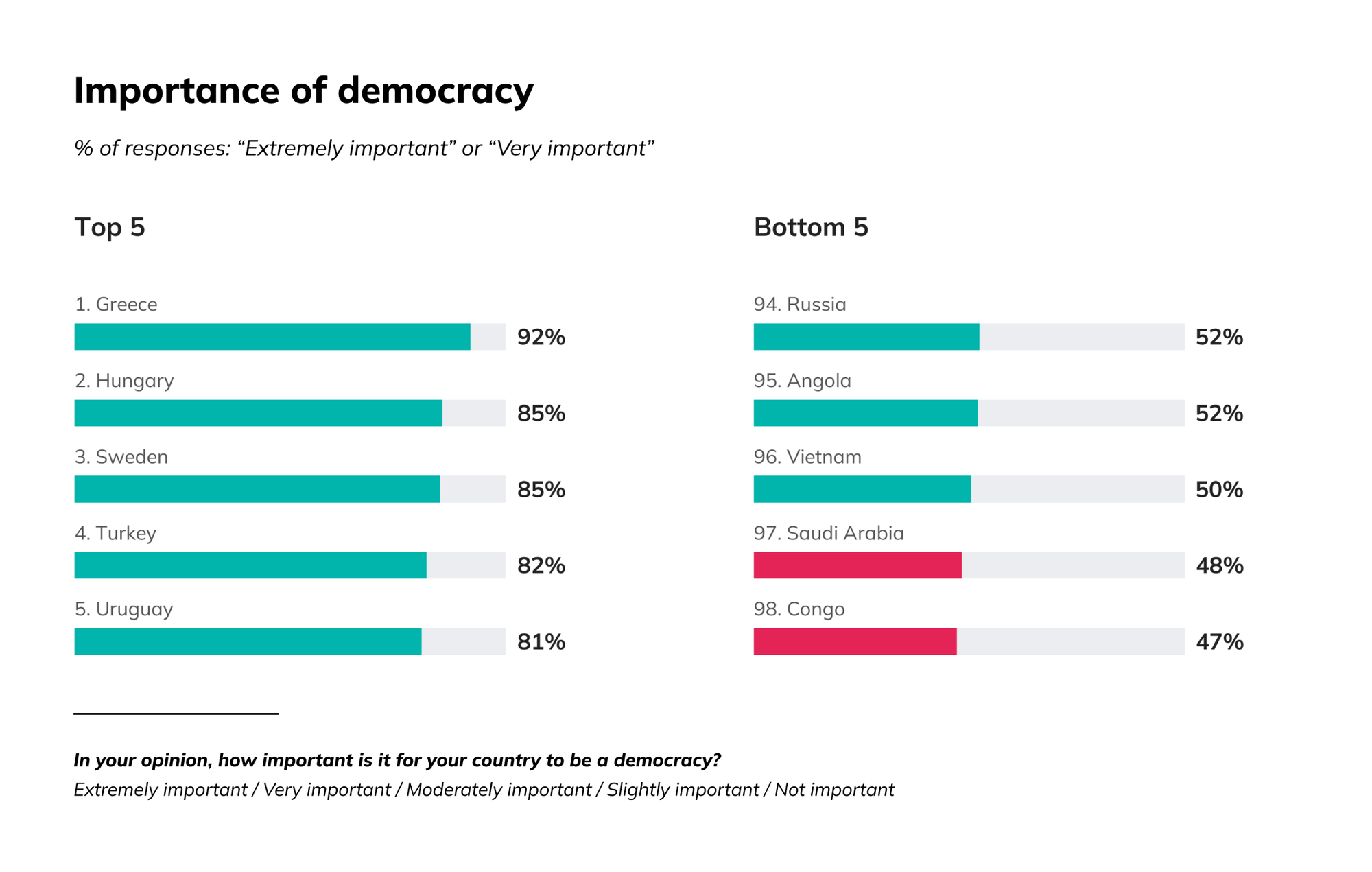
Despite the bleak picture on institutional trust, global faith in the idea of democracy itself remains remarkably strong. Over two-thirds of people worldwide say it is very important to have democracy in their country. When asked what democracy's main purpose is, most people — across 62% of countries — say it is to improve living standards and well-being, above freely choosing the government or protecting individual rights.
The gap between the idea and the reality is the report's defining tension. "What we see is not declining demand, but rising expectations," as Jaspers put it. Citizens believe in democracy as a concept. They are increasingly unconvinced their own system is delivering it.
Unlock premium news, Start your free trial today.


