
Far-right dashboard claims Swiss and Germans will be minorities by mid-2040s


People of migrant origin will outnumber everyone else in Switzerland by 2038 and Germany by 2045, a far-right dashboard on social media claims that is going viral.
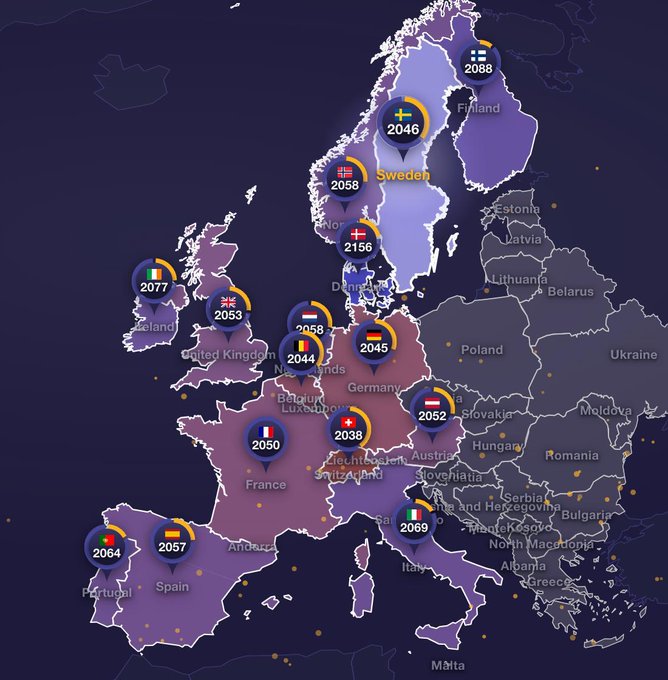
Projected year in which the "migrant" population passes 50% in each country under the Institute for Remigration's status-quo scenario. The institute's definitions of "migrant" differ from country to country. Source: IFR demography dashboard, via NEXTA.
The institute, founded by Austrian Identitarian activist Martin Sellner and registered in Germany's Saxony-Anhalt that has just voted in a far right Alternative for Germany (AfD) regional government, launched the dashboard on October 5. Assuming current trends hold, its map puts Belgium's "tipping point" in 2044 and Sweden's in 2046, followed by France in 2050, Austria in 2052 and the UK in 2053. Spain, the Netherlands, Norway, Portugal and Italy cross the line between 2057 and 2069, Ireland in 2077 and Finland in 2088, while Denmark holds out until 2156.
As IntelliNews reported, the changing make up of populations is a result of a growing demographic crisis, where no country in Europe has a replacement rate above 2.1 to keep its population stable. Immigrant communities have much higher fertility rates and a simply growing their numbers within the EU member states.
Sellner popularised "remigration", the idea of sending large numbers of immigrants and their descendants out of Europe, and the institute describes its aim as "demographic sovereignty and the preservation of ethnocultural continuity". German Chancellor Friedrich Merz has called the term "nothing more than a synonym for ethnic cleansing based on origin and skin colour". The dashboard's own alternative scenario cuts immigration by 90% and removes 1% of the starting migrant population every year.
The dashboard's methodology holds fertility and mortality constant at today's levels for decades, and assumes immigration and emigration continue every year at their 2015-2024 averages, a period that includes the 2015-16 asylum peak and the arrival of millions of Ukrainian refugees after 2022. Nothing in the status-quo model allows for policy changes, falling migrant fertility or return migration.
It also uses "the broadest available national definition" of the migrant population, which varies from country to country: foreign-born residents only in Portugal, census ethnic categories in Ireland and the UK, and the foreign-born plus their descendants in Germany - a definition that implicitly targets second-generation Turks, born in Germany and holding German citizenship. That makes the cross-country ranking an exercise in comparing apples with oranges, and in Germany's case it counts people with only one immigrant parent as migrants.
The dashboard puts the country's migrant share at 32.0% in 2026. Germany's statistics office Destatis counted 21.8mn people with an immigration history in 2025, or 26.3% of the population in private households, of whom 19.8% had immigrated themselves and 6.5% were children of two immigrant parents. A further 5.0% have one immigrant parent, and only by adding them does the total approach the dashboard's starting figure.
About 46.7mn people living in the EU at the start of 2025 were born outside it, around 10% of the population, according to Eurostat figures reported by The Local in March. Switzerland's foreign-born share was 31.7%, against the dashboard's 41.2% migrant share for 2026, while Germany and Sweden were just over 20%.
The map reached a wide audience through Belarusian opposition outlet NEXTA, which told its followers on October 7 that native Europeans "could become minorities in their own countries within the next 30 years". The institute's own page carries a narrower caveat: its figures are "population shares only - not a forecast of future total population."
Unlock premium news, Start your free trial today.
_Cropped.jpg)

