
Central and Southeast Europe outstrip EU's post-pandemic growth


Most eastern EU members outgrew the bloc as a whole between 2019 and 2024, led by Croatia, Bulgaria and Poland, while Romania's capital region recorded the fastest growth outside Ireland, Eurostat data showed on October 22.
GDP across the EU rose by 5.6% in real terms over the period, compared with increases of 19.3% in Croatia, 14.3% in Bulgaria, 13.8% in Poland and 13.2% in Lithuania. Growth was unevenly distributed within several countries, with capital regions often outperforming the rest of the economy.
The Romanian capital region of Bucuresti-Ilfov expanded by 33.0%, faster than any EU region outside Ireland. At the other end of the table, three of the five regions where economic activity fell most were in Romania and Bulgaria. GDP in Bulgaria's southeastern Yugoiztochen region contracted by 20.5%, the largest decline in the bloc, while Romania's Sud-Muntenia and Sud-Vest Oltenia shrank by 13.5% and 11.3%, respectively.
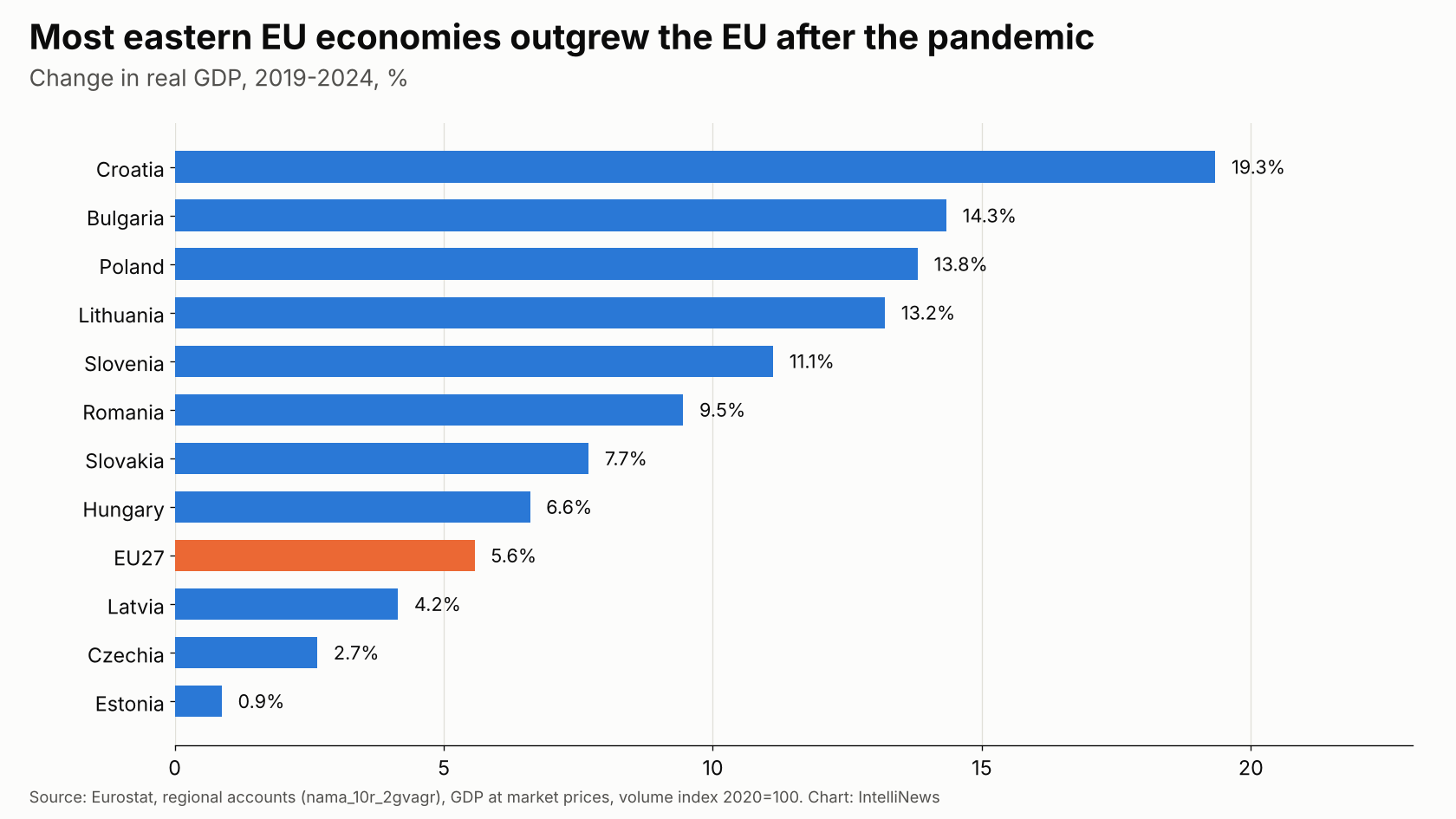
Change in real GDP of the eastern EU member states and the EU27, 2019-2024. Source: Eurostat regional accounts.
Romania provides the starkest example of regional divergence. Bucuresti-Ilfov's 33.0% expansion compared with growth of 9.5% for the country as a whole. The western regions of Nord-Vest and Vest grew by 15.8% and 14.3%, but GDP in Sud-Est was 5.1% lower in 2024 than in 2019, while Nord-Est barely grew, at 0.4%. Romania's productivity has been catching up quickly, with GDP per employee reaching 87.2% of the EU average, but the gains remain concentrated around the capital.
Bulgaria showed a similar split. Its southern central Yuzhen tsentralen region grew by 25.3%, Severen tsentralen in the north by 22.9% and the Sofia region, Yugozapaden, by 21.8%, while Yugoiztochen, home to the Black Sea port of Burgas, recorded the steepest contraction in the EU.
Hungary's Pest region, which surrounds the capital, grew by 19.1% and Budapest by 11.9%, but GDP in four other regions was lower in 2024 than in 2019. The biggest decline was in Eszak-Magyarorszag in the northeast, down 4.3%. Hungary's economy as a whole grew by 6.6%, barely above the EU average, after years in which household consumption lagged the rest of the bloc.
Czechia, the second-weakest performer among the eastern members, recorded growth of just 2.7%. Its northwestern Severozapad region, a coal-mining area, saw GDP fall by 6.9%, while Moravskoslezsko, the industrial region around Ostrava, contracted by 1.2%. Prague grew by 4.4%. Estonia, classified by Eurostat as a single region, expanded by just 0.9% over the five years, while Latvia grew by 4.2%.
Poland's growth was more evenly distributed. Every region expanded, with increases ranging from 9.2% in Lodzkie to 17.7% in Pomorskie on the Baltic coast. The Warsaw capital region grew by 15.9%.
Croatia also recorded broad-based growth, led by Sjeverna Hrvatska in the north, up 25.9%, and the Adriatic region, which expanded by 19.7%. In Lithuania, the capital region around Vilnius grew by 19.0%, more than twice the 8.9% increase in the rest of the country. In Slovakia, the gap between the capital and the east was narrower, with Vychodne Slovensko growing by 9.4%, slightly faster than the Bratislava region at 9.0%.
Across the EU as a whole, 197 of the 244 regions with available data recorded higher economic activity in 2024 than in 2019, while GDP fell in 46. Almost all capital regions expanded, with Helsinki-Uusimaa in Finland the only exception. Ireland's three regions led the bloc, with Eastern and Midland recording growth of 38.0%.
Unlock premium news, Start your free trial today.


