
COMMENT: Win or lose, Orban has broken Hungary’s democracy


Hungary’s parliamentary elections on April 12 would, under normal democratic conditions, point towards a change of government, but the country’s political system no longer operates on conventional terms, Zsuzsanna Szelényi, a Research Fellow at Central European University’s Democracy Institute.
“If Hungary were a normal European democracy, the conclusion would be straightforward,” Szelényi said in a note for Carnegie Endowment for International Peace. “A government that has trailed its main challenger in the polls for months would be heading toward defeat.”
The insurgent Tisza party, led by Péter Magyar, has maintained a consistent lead over Prime Minister Viktor Orban’s ruling Fidesz.
“The largest gap so far has also been measured by the 21 Research Centre, in favour of TISZA. The tipping point has been reached. The Hungarian countryside has turned against Orbán and his allies’ corrupt and inhumane rule,” Magyar said in a social media post on April 2. Now comes the most important phase of the campaign. There are 11 days left until this decisive election. Onwards to victory!”
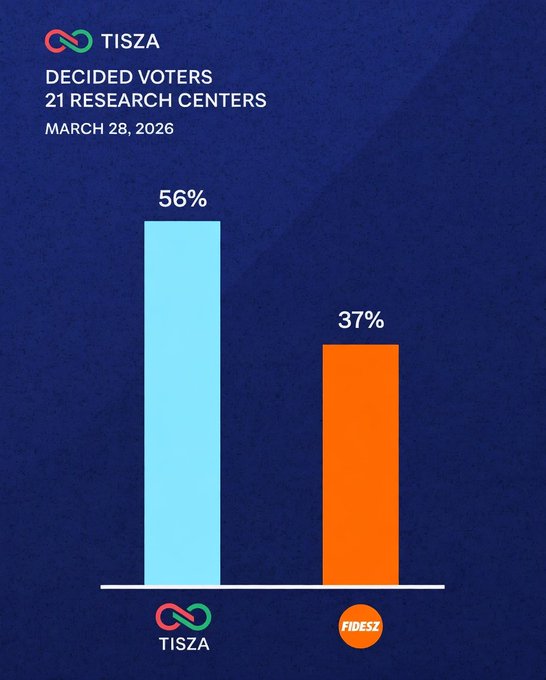
“In a democratic political system, such a gap would ordinarily suggest an imminent transfer of power,” she said, adding that Hungary’s institutional landscape has been fundamentally altered by what she described as “total state capture”.
Despite leading the only credible challenge to Orbán in years, Magyar has been denied even a token appearance on public television. The state media has worked tirelessly to amplify government messaging and Orban personally. A massive AI-powered campaign has flooded social media with anti-Tisza messaging and pro-government propaganda.
“The separation of powers has been hollowed out, institutional neutrality has disappeared, and the machinery of the state is deployed to partisan ends,” she said. As a result, “polling alone cannot tell the full story” in an electoral environment where “the battlefield is structurally tilted”.
“State institutions, public money, regulatory authority, and government-affiliated media now function as political tools,” she said.
However, a broader shift is under way. “A social and psychological barrier seems to have broken,” she said, citing growing opposition support beyond Budapest and the emergence of whistleblowers alleging corruption and intelligence service misuse.
Regardless of the outcome, “Hungarian politics will not return to business as usual,” she said, arguing that even a Fidesz victory would reflect weakened public consent.
The abuse of the “administrative resources” has poisoned the campaign which increasingly relies on fearmongering and external “enemy at the gate” narratives, with Ukraine cast as the main villain and EU leaders turned into symbolic adversaries. “The point is not coherence but fear,” she said. This is not a democratic debate on the pros and cons of each candidate’s policy platforms.
“The election is no longer a fair contest,” Szelényi added. “It is a domain of information warfare, institutional sabotage, and managed disorder.”
On paper Magyar and Tisza should win. What actually happens will only be known after April 12.
Unlock premium news, Start your free trial today.


