
Chevrolet cars still rule road in Uzbekistan. But for how much longer?


For almost 30 years, UzAuto Motor’s near total dominance on Uzbekistan’s car market went unchallenged. Complaints about a de facto monopoly and inordinate waits for a vehicle became commonplace. But things are starting to shift. A transformation is under way.
When in October 2011, then US secretary of state Hillary Clinton visited a joint-venture auto plant in Uzbekistan created by UzAuto, South Korea’s Daewoo Motors and American giant General Motors, UzAuto’s supremacy was still just a fact of life that it was, in the minds of many, futile to question, but take a look at the current Uzbek auto market landscape and the evolving change is unmissable – car imports are growing (the Islam Karimov era of steep tariffs is long gone), consumer preferences are switching to electric and hybrid vehicles (increasingly so, given the jolt of higher fuel prices linked to the involvement of oil-producing countries in wars) and production at foreign-invested rival car plants that have sprouted in Central Asia’s second largest economy is on the rise.
UzAuto Motors – a producer of Chevrolet models under licence from General Motors, which started its manufacturing life in 1996 as Uz-DaewooAuto, a joint venture between the Uzbek government and Daewoo Motors – is losing customers and has stepped up its offering of discounts and financing programmes to retain market share.
Market share heads south
With 2026 fast heading to a close, available figures on the year’s first quarter from the Automobile Business Association of Uzbekistan, cited by kun.uz, show the nowadays state-owned UzAuto’s market share fell to 79.3% from 82.6% in 1Q25 (with preliminary information in circulation indicating the share could well drop to below 70% by the end of the year).
Importantly, while UzAuto’s 1Q26 sales moved up 12% y/y, the growth recorded by competitors was much stronger. For instance, the sales expansion reported by the world’s leading maker of electric vehicles (EVs), China’s BYD (figure attributable to manufacturing subsidiary BYD Uzbekistan), was 93% y/y, while that of Korea’s Kia was 65% y/y.
Overall, vehicle sales in Uzbekistan in the first quarter amounted to 91,088, higher by 20.9% y/y.
Uzbekistan, meanwhile, imported 89,331 passenger cars worth approximately $1.23bn in the first nine months of 2026, up 58.9% in volume and 52.5% in value from the same period a year earlier, according to customs data.
EVs accounted for 62,789 of the imported vehicles, or 70.3% of the total, while hybrid imports increased from 2,261 to 11,752.
The growing presence of Chinese electric and hybrid models in particular is giving consumers alternatives in a market long characterised by the dominance of UzAuto’s locally-assembled Chevrolets.
Average import prices in the first nine months of 2026 also declined. The average price of an imported electric car fell 5.7% y/y to about $11,047, while hybrids became 9.6% cheaper y/y at approximately $22,005. Petrol-powered cars declined 8.6% y/y to an average of $18,618.
Discounts on the Cobalt
The accelerating change is particularly visible in the market for the Chevrolet Cobalt, the most popular car in Uzbekistan in recent years. Until recently, buyers could face lengthy waits for the car and securing a purchase contract could itself be difficult.
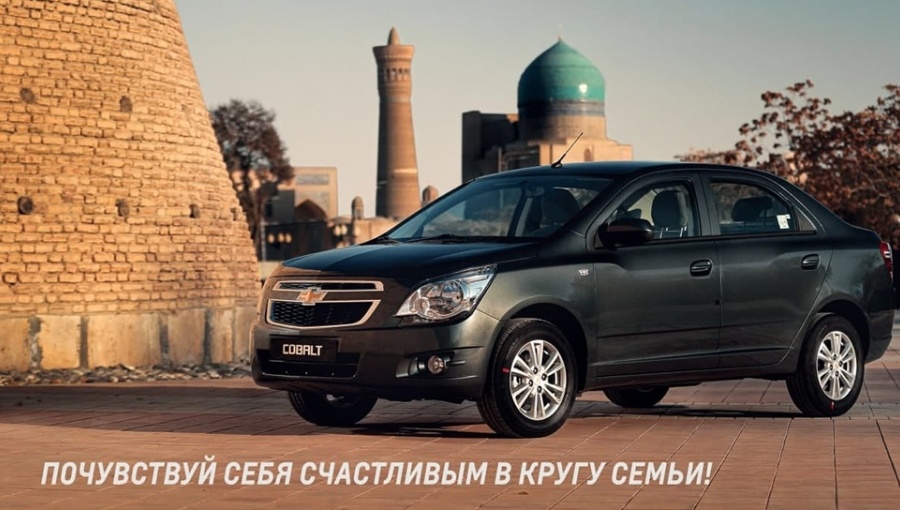
Not too long ago the idea that UzAuto would offer you a special discount on the Cobalt was unthinkable (Credit: UzAuto, Facebook).
In August, UzAuto Motors announced a special discount on the Cobalt. The company also introduced financing programmes for the Onix and Tracker, with down payments on these Chevrolets starting at 25% and zero interest.
Some automotive bloggers have claimed that the Cobalt’s market value has fallen by as much as 65% from its peak. The estimate is based on individual social media reports and does not establish a comparable decline across all versions of the model.
Nevertheless, the move towards discounts marks a contrast with the conditions that previously characterised the market, when limited availability of popular models could give sellers greater pricing power.
Buyers have also been boosted in that competition has moved beyond imports. China’s BYD established a local production base, BYD Uzbekistan Factory, which is in fact a joint venture with UzAuto, that began producing electric and hybrid vehicles in Jizzakh in June 2024. The plant launched with an annual production capacity of 50,000 vehicles, with plans to increase it to 200,000 and eventually 500,000. The facility is intended to support local production of components and create opportunities to export vehicles to other Central Asian markets.
Struggle to sell old cars
In Uzbekistan’s second-hand car market, some sellers say they are struggling to attract buyers for older cars.
According to Azattyq, videos circulating on social media show a 1998 Daewoo Tico advertised for about $420, a 2010 Nexia for $700 and a 1997 Damas for $400. One Damas owner says he initially asked $500 but eventually sold the vehicle for $400.
"Prices have dropped. There are a lot of cars, but no buyers. There are too many cars," says a seller in a video filmed at Fergana car market.
A seller in Samarkand estimated that only 10-15 domestically assembled Tico cars remained available locally, yet buyers were showing little interest even at $600.
The videos prompted automotive bloggers to joke that some older vehicles were approaching the value of scrap metal.
"Look, the Nexia 1 is already at the price of metal. We came to the market because of the internet hype," says one blogger.
In social media discussions of fuel prices, reported by Azattyk, motorists say filling a petrol tank can cost about $80. One driver estimated that refuelling a petrol-powered car cost UZS 850,000-950,000 ($71-$79), compared with approximately UZS 250,000 ($20) to charge an EV.
"I won't be driving this car anymore. It's better to take a taxi – it's cheaper. The BYD is a different story. I just plug it in and go," he says.
For years, limited supply and difficulties securing popular models meant that some car owners in Uzbekistan could treat their vehicles as a way to preserve or increase wealth. Stories of bought cars being sold several years later for more than the original purchase cost were widespread. They will soon be a distant memory.
Unlock premium news, Start your free trial today.


