
Ceasefire: Iran, US agree to two-week Gulf War pause and 10-point plan


In a last-minute deal, US President Donald Trump pulled the world back from the brink of a massive escalation in the Gulf War and announced he had agreed to a two week suspension of military operations against Iran after he agreed to a 10-point plan proposed by Iran that contains most of their maximalist demands.
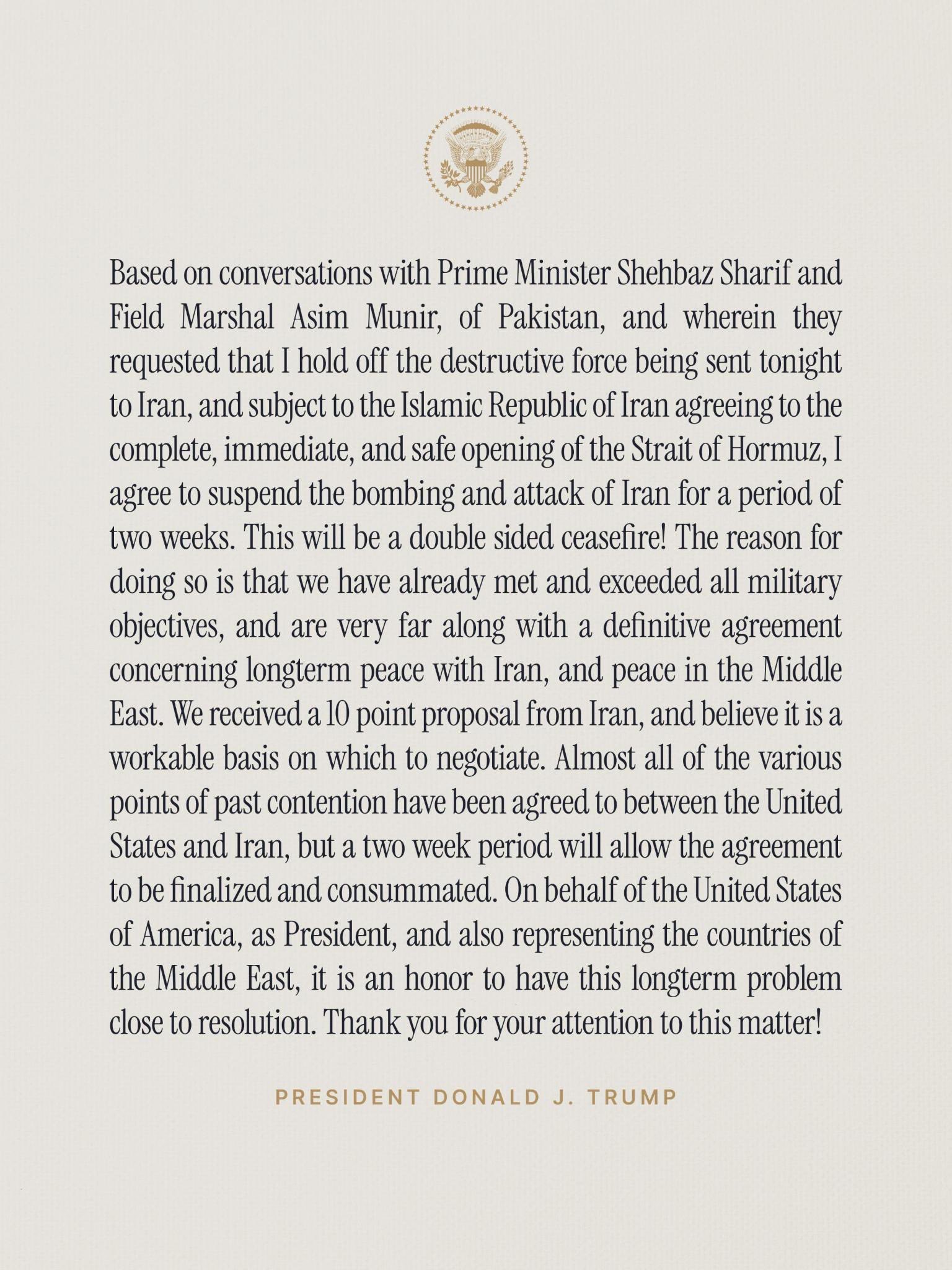
The White House released a statement where Trump said:
“Based on conversations with Prime Minister Shehbaz Sharif and Field Marshal Asim Munir, of Pakistan, and wherein they requested that I hold off the destructive force being sent tonight to Iran, and subject to the Islamic Republic of Iran agreeing to the complete, immediate, and safe opening of the Strait of Hormuz, I agree to suspend the bombing and attack of Iran for a period of two weeks. This will be a double sided ceasefire! The reason for doing so is that we have already met and exceeded all military objectives, and are very far along with a definitive agreement concerning long-term peace with Iran, and peace in the Middle East. We received a 10 point proposal from Iran, and believe it is a workable basis on which to negotiate. Almost all of the various points of past contention have been agreed to between the United States and Iran, but a two week period will allow the agreement to be finalized and consummated. On behalf of the United States of America, as President, and also representing the countries of the Middle East, it is an honor to have this long-term problem close to resolution. Thank you for your attention to this matter!”
According to reports, direct talks between Iranian Speaker of Parliament Mohammad-Bagher Ghalibaf, who is de facto in charge of Iran, and US Vice President JD Vance in the small hours of April 7 made the ceasefire agreement possible, in negotiations brokered by Pakistan.
In the last few days US Special Envoy Steve Witkoff has reportedly been negotiating with Iranian Foreign Minister Abbas Araghchi by text messages, through Pakistani intermediators.
Iran’s 10-point peace plan at the G20 summit in November 2022 includes:
Guarantee that Iran will not be attacked again
Permanent end to the war, not just a ceasefire
End to Israeli strikes in Lebanon
Lifting of all US sanctions on Iran
Unfreezing all frozen assets
End to all regional fighting against Iran's so-called Axis of Resistance regional partners, including Hamas, Hezbollah and the Houthis.
Iran would reopen the Strait of Hormuz but remain under Iranian military management
Iran would impose a $2m fee per ship transiting Hormuz
Iran would split these fees with Oman
Iran would establish rules for safe passage through Hormuz
Iran would use Hormuz fees for reconstruction instead of reparations
The deal to be enshrined in a UN security Council resolution to give it the power of an international treaty
It was not immediately clear if the US had agreed to any of those demands, even in principle.
In the version released in Farsi, Iran also included the phrase “acceptance of enrichment” for its nuclear program. But for reasons that remain unclear, that phrase was missing in English versions shared by Iranian diplomats to journalists.
Accaording to earlier reports, Araghchi was willing to dilute Iran’s stockpile of highly enriched uranium, but insisted on continuing a civil nuclear power prgramme. The status of Iran’s nuclear programme remains unclear in the new 10-point deal.
Talks on what has been dubbed the Islamabad Accords, are due to start in Islamabad on April 10 to work out the details. Tehran said that they were prepared to extend the two week ceasefire if the talks in Islamabad go well.
One of the key issues on the list is the question of continuing uranium enrichment, which was not in the English language version of the plan released to journalists.
It appears that the 10-point plan is only a draft document and that it will be subject to change in the upcoming talks. There is also Trump’s 15-point plan on the table that will be on the table floated last week.
US oil prices immediately tumbled by a quarter (23%) from their high of the day after the agreement between Iran, Israel, and the US was announced. As of the morning of April 8, Brent was trading at $96 per barrel, Russia’s Urals blend was still at an elevated $121, its highest level in years, and Dutch TTG gas was also still at an elevated €53.2/MWh, some €20 more than its pre-war level, but down from recent highs of €70/MWh.
Back from the brink
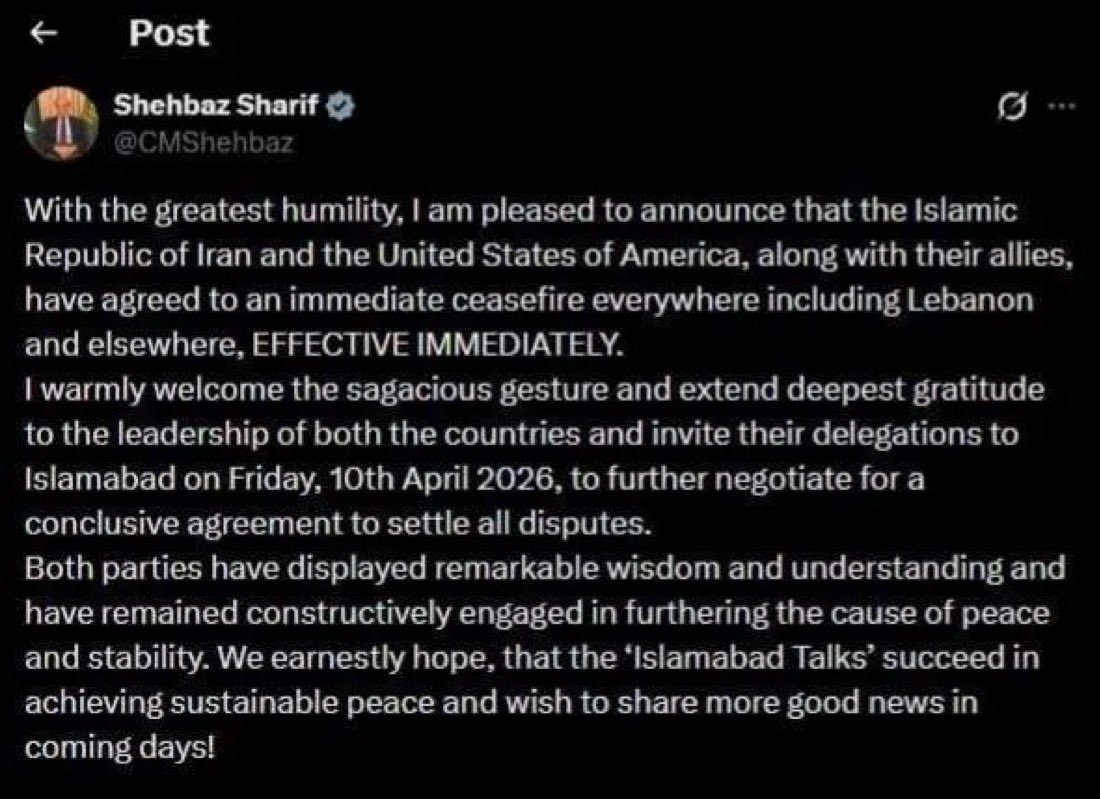
Pakistan’s Prime Minister Shehbaz Sharif, who played a key role in brokering the deal, announced with “the greatest humility” — Iran and the United States have agreed to an immediate ceasefire, effective immediately, everywhere, including Lebanon.
“I warmly welcome the sagacious gesture and extend deepest gratitude to the leadership of both the countries and invite their delegations to Islamabad on Friday, 10th April 2026, to further negotiate for a conclusive agreement to settle all disputes,” Sharif said in a statement published on social media. “Both parties have displayed remarkable wisdom and understanding and have remained constructively engaged in furthering the cause of peace and stability. We earnestly hope that the ‘Islamabad Talks’ succeed in achieving sustainable peace and wish to share more good news in coming days!”
Iran’s statement, released through the IRGC-affiliated Tasnim News Agency, said the agreement included “continued Iranian control over the Strait of Hormuz.”
The new Supreme Leader, Mojtaba Khamenei, reportedly personally approved the negotiations. The message from Tehran was unambiguous and said the IRGC delegation would start the talks with “fingers still on the trigger” and were prepared to restart the conflict no progress is made at the talks.
Iran’s Consulate in Mumbai said it plainly: “Iran will end the war at a time of its own choosing and only if the conditions it has set are fulfilled.”
Trump warned a day earlier that "a whole civilisation will die tonight" as his deadline for Iran to reopen the Strait of Hormuz approached. The US struck 50+ targets on Kharg Island as oil topped $115 a barrel on day 39 of the war. The IRGC promised to respond in kind and rain down widespread destruction on the entire Gulf region if Trump carries through on his threat to do “irreversible damage” to Iran’s power sector and civilian infrastructure.
Attacks on industrial assets were rising in a tit-for-tat round of airstrikes on oil, gas and petrochemical facilities over the weekend ahead of the deadline.
Trump’s climb down represents a strategic defeat for the US which arrived in the Gulf with overwhelming force, but was unable to reopen the Strait of Hormuz by military force, in what some have dubbed “mission impossible.” The US-Israeli coalition underestimated the effectiveness of Iran’s asymmetrical war tactics, capitalising on its superior cost-to-kill ratio, using cheap but plentiful drones and missiles against multi-billion dollar warships and simply overwhelming their defences.
The Trump administration has achieved none of its goals. As part of the deal the Strait of Hormuz will remain under the control of Iran in partnership with Oman. Iran is insisting on keeping its uranium enrichment programme and its missile development programme. While the US did not agree to pay reparations, it has agreed to allow Tehran to charge shipping a $2mn transit fee to pass through the strait and use that money to pay for reconstruction. Tehran is expected to earn $96bn a year from this fee that will increase the size of its economy by 20% to $571bn pa, according to preliminary estimates.
Israel opts out
Fox News admits that Israel is extremely upset about this double-sided ceasefire with Iran but has conceded that this decision was President Trump’s to make.
Israeli Prime Minister Benjamin Netanyahu was reportedly unhappy with the White House deal and has vowed to continue Israeli’s military campaign to occupy the whole of southern Lebanon and set up a buffer zone.
Israeli forces reportedly shelled Baraachit in south Lebanon after PM Netanyahu’s office said the US‑Iran two‑week ceasefire “does not include Lebanon,” despite Pakistan’s PM saying it does.
Netanyahu’s office released a statement: “The United States has told Israel that it is committed to achieving these goals, shared by the US, Israel and Israel’s regional allies, in the upcoming negotiations. The two-week ceasefire does not include Lebanon.”
Netanyahu’s announcement was made only in English and issued four-hours after the ceasefire announcement that has led some commentators to suggest the message was directed primarily at the English-language media, and Trump in particular.
Israel White House briefing
The New York Times (NYT) released a damning report that claims Netanyahu visited the White House shortly before the attacks on Iran began in February, where he told Trump that Iran was weak and would collapse quickly, promising that “victory is almost certain.”
“In the Situation Room on Feb. 11, Mr. Netanyahu made a hard sell, suggesting that Iran was ripe for regime change and expressing the belief that a joint U.S.-Israeli mission could finally bring an end to the Islamic Republic,” the NYT reported.
“At one point, the Israelis played for Mr. Trump a brief video that included a montage of potential new leaders who could take over the country if the hard-line government fell. Among those featured was Reza Pahlavi, the exiled son of Iran’s last shah, now a Washington-based dissident who had tried to position himself as a secular leader who could shepherd Iran toward a post-theocratic government,” the NYT wrote.
“Mr. Netanyahu and his team outlined conditions they portrayed as pointing to near-certain victory: Iran’s ballistic missile program could be destroyed in a few weeks. The regime would be so weakened that it could not choke off the Strait of Hormuz, and the likelihood that Iran would land blows against U.S. interests in neighboring countries was assessed as minimal,” the NYT concluded.
Peace plans
Iran’s 10-point plan is one of several proposals that have been put forward in the last two weeks. The current version is a cut down plan from a version suggested last week by Iranian President Pezeshkian's close ally former Foreign Minister Mohammad Javad Zarif in an article published by Foreign Affairs with a framework deal:
- IRAN STEPS:
Commit never to seek nuclear weapons
Down-blend enriched uranium to below 3.67%
Ratify the IAEA Additional Protocol for permanent monitoring
Ensure safe commercial passage through the Strait of Hormuz, with Oman
Sign a permanent non-aggression pact with the United States
Participate in a regional security framework
Transfer enriched uranium and related equipment to a regional enrichment consortium
Remove terrorism-related designations on the United States
Restore diplomatic/consular channels
Remove travel restrictions on US citizens
Invite oil companies, including American ones, to help facilitate exports
China, Russia, and possibly regional states may serve as guarantors of the agreement.
- THE US STEPS:
Remove unilateral US sanctions on Iran
Allow Iran to export oil freely and repatriate the proceeds
Accept that Iran will retain some non-weapons-level nuclear programme rather
than demand zero enrichment
Terminate UN Security Council resolutions against Iran
Allow Iran to participate normally in global supply chains
Sign a permanent non-aggression pact with Iran
Finance reconstruction in Iran
Compensate Iranian civilians for losses
Participate in a regional security framework
Help create the regional enrichment consortium
Remove terrorism-related designations on Iran
Restore diplomatic/consular channels with Iran
Remove travel restrictions on Iranian citizens
Cooperate on trade, energy, and technology projects
Trump also proposed a 15-point plan that was tantamount to a capitulation by Iran that included:
A 30-day ceasefire.
The dismantling of Iran’s nuclear facilities in Natanz, Isfahan and Fordow.
A permanent commitment from Iran to never develop nuclear weapons.
The handover of Iran’s stockpile of already enriched uranium to the International Atomic Energy Agency (IAEA), and a commitment from Iran to allow the IAEA to monitor all elements of the country’s remaining nuclear infrastructure. Iran must also no longer enrich uranium within the country.
Limits on the range and number of Iran’s missiles.
Ending Iran’s support for regional proxies.
Ending Iranian strikes on regional energy facilities.
Reopening of the Strait of Hormuz.
A removal of all sanctions imposed on Iran, alongside the ending of the UN mechanism that allows sanctions to be reimposed.
The provision of US support for electricity generation at Iran’s Bushehr civil nuclear plant.
Pakistan and China recently proposed a two-phase peace plan to halt the war for 45 days and then produce a lasting peace agreement. Trump told AFP on April 7 he believed China had helped get Iran to the negotiating table. The Pakistan-China proposal was rejected by Tehran, which had earlier started the process with a simple three-point list of demands on March 21. Iranian Speaker of Parliament Mohammad-Bagher Ghalibaf responded to the Pakistan-China proposal with an expanded but hardliner position, a list of maximalist demands Tehran expects, most of which are in the current 10-point plan:
Guarantee that Iran will not be attacked again
Permanent end to the war, not just a ceasefire
End to Israeli strikes in Lebanon
Lifting of all US sanctions on Iran
End to all regional fighting against Iranian allies
Iran would reopen the Strait of Hormuz
Iran would impose a $2m fee per ship transiting Hormuz
Iran would split these fees with Oman
Iran would establish rules for safe passage through Hormuz
Talks in Islamabad are expected to seek a compromise between all these positions.
Unlock premium news, Start your free trial today.


