
Analysts back Hungary's 2027 budget but doubt its 2030 deficit target


Hungary's 2027 budget, which cuts the deficit to 4.9% of GDP, surprised investors positively, but its 2030 goals look demanding, Capital Economics said in a note on October 23.
The government of Prime Minister Peter Magyar presented the draft on October 19 and Finance Minister Andras Karman laid out the medium-term plan a day later, targeting a deficit of 3.4% of GDP in 2029 and 2.8% in 2030, down from an estimated 7.5% this year. The plan relies on new taxes, the cancellation of Orban-era state contracts and HUF1.45 trillion (€4.0bn) of spending cuts, while public debt is set to edge down from 77.5% of GDP to 77.2% next year and 74.9% by 2030.
The budget is the first full fiscal plan of the Tisza government that ousted Viktor Orban's Fidesz in the April election, and it is the main test of whether Budapest can repair public finances that blew out ahead of the vote while keeping the euro adoption pledge alive. Fitch Ratings has Hungary at 'BBB' with a negative outlook, and warned of a downgrade without a credible consolidation ahead of its next review on December 4. The 2030 target would put Hungary back inside the Maastricht deficit criterion for the first time since 2019, but only just.
"This puts it on course to meet the fiscal criteria for euro adoption by the end of this decade, albeit by a whisker and with very little room for slippage," wrote Liam Peach, senior emerging markets economist at Capital Economics.
Where the money comes from
Raiffeisen Research analyst Gergely Palffy broke the consolidation down in a note on October 21. The government counts on savings of 1.5% of GDP from unwinding unfavourable contracts, including motorway concessions, and another 1.9% from one-off, mainly election-related, 2026 spending that will not be repeated. New revenue measures add 0.9% and lower interest costs 0.2%, partly offset by energy-related costs of 0.5% of GDP.
That frees up about 4% of GDP. Some 1.4% goes on election pledges and tax cuts, leaving 2.6% for deficit reduction, Palffy calculated, adding that the details the ministry presented on October 20 "suggest a credible adjustment path".
Tax changes are expected to raise HUF929bn (€2.5bn) next year. Large companies with annual revenue of HUF180bn (€491mn) or more will pay a 15% corporate tax rate, loopholes in corporate and Robin Hood taxes will be closed, and a two-tier wealth tax on fortunes above HUF1bn is meant to pay for cutting personal income tax on the minimum wage to 9%, a measure costing HUF250bn (€682mn). More than 600,000 public-sector employees are due double-digit pay rises.
| Indicator | 2025 actual | 2026 est. | 2027 plan | 2028 target | 2029 target | 2030 target |
| Budget balance (% of GDP) | -4.7 | -7.5 | -4.9 | -4.0 | -3.4 | -2.8 |
| Gross public debt (% of GDP) | 74.6 | 77.5 | 77.2 | n/a | 76.2 | 74.9 |
| Expenditure (% of GDP) | 47.3 | 51.2 | 47.3 | n/a | n/a | n/a |
| Revenue (% of GDP) | 42.6 | 43.7* | 42.4* | n/a | n/a | n/a |
| Interest payments (% of GDP) | n/a | 3.9 | 3.8 | n/a | n/a | n/a |
| Real GDP growth (%) | 0.5 | 1.7 | 2.4 | n/a | n/a | n/a |
| CPI inflation, average (%) | 4.4 | 1.8 | 3.0 | n/a | n/a | n/a |
Source: 2025 actuals IMF World Economic Outlook (October 2026) via IntelliNews Lambda; 2026 estimates and 2027-2030 targets Hungarian Finance Ministry, October 20. *Revenue for 2026-2027 is implied from the ministry's expenditure and deficit figures.
Growth is assumed to pick up to 2.4% next year from 1.7% in 2026, helped by cohesion funds that Karman said could add HUF900bn (€2.5bn). The minister named energy prices, especially gas, as the biggest risk to both the growth and deficit targets.
A better start than expected
Capital Economics had pencilled in a 2027 target of about 5.0-5.5% of GDP, so 4.9% came in slightly better than it expected. Tax hikes and the cancelled contracts more than offset added spending worth 1.4% of GDP, the note said.
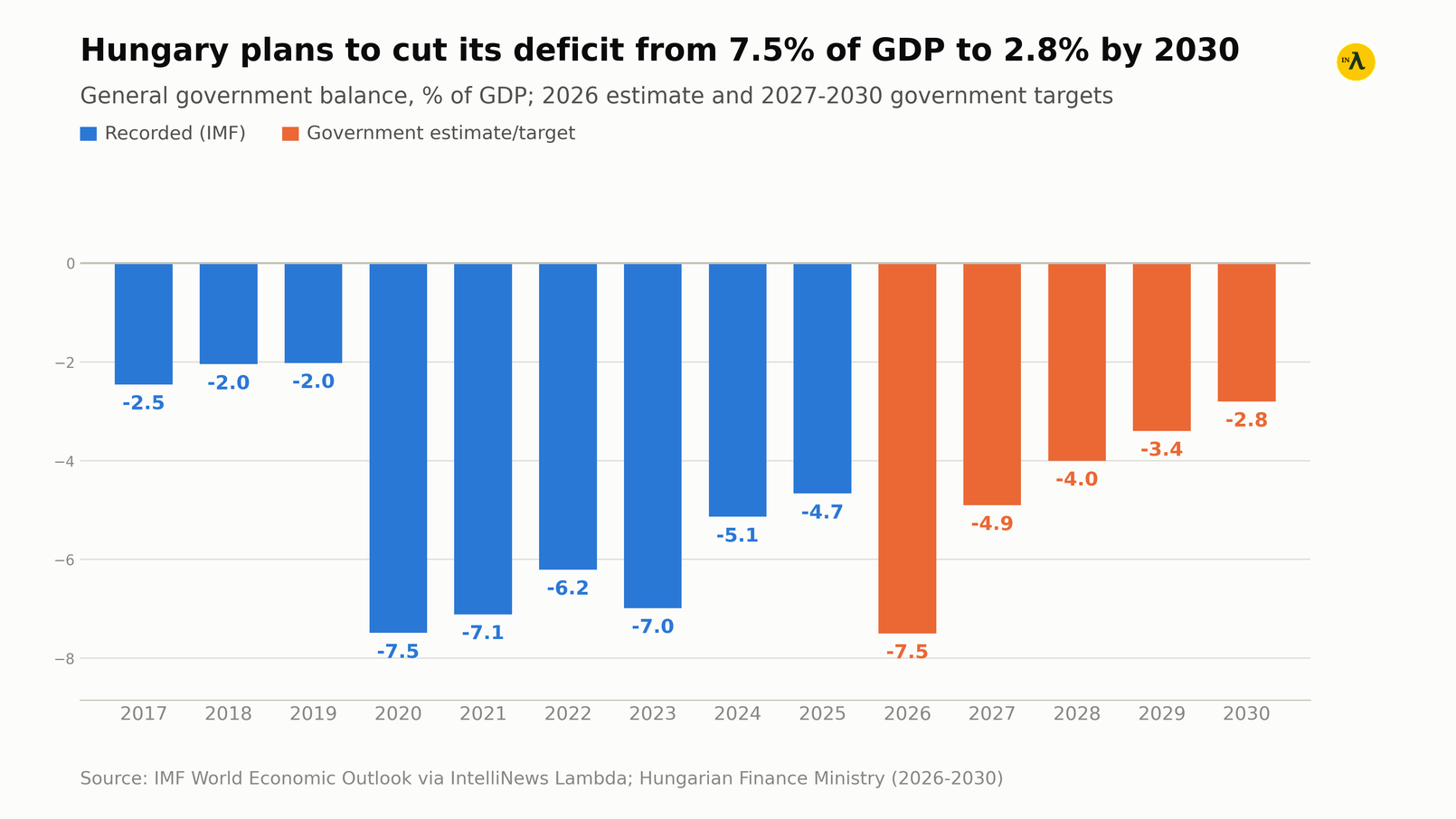
Hungary's general government balance, % of GDP: IMF-recorded history to 2025 and Finance Ministry estimate and targets for 2026-2030. Source: IMF World Economic Outlook via IntelliNews Lambda; Hungarian Finance Ministry.
ING saw the target as no surprise. "The 4.9% figure is in line with our expectations and roughly in line with market expectations," its strategists wrote on October 20, adding that consolidation would rely on cutting wasteful spending, lower interest costs, reversing pre-election spending and new taxes.
Local banks polled by state news agency MTI were cautiously optimistic. Erste Bank called the target more ambitious than the 5-5.5% it had expected and saw savings on interest and the end of one-off election spending as achievable, but said the HUF1.5 trillion of savings from tackling waste and corruption remained uncertain. MBH Bank kept its own 5.3% deficit forecast for 2027 unchanged for now.
A whisker from Maastricht
"The medium-term fiscal targets look demanding, and we are sceptical the government will bring the deficit below 3% of GDP in 2030, particularly as that coincides with the next election," Peach wrote. A miss "need not put the bond rally into reverse, but could limit further declines in yields and push euro adoption to the mid-2030s," he added.
Fitch, which forecast a 2026 deficit of 7.3% before the budget was published, had expected the gap to stay at 5.8% of GDP in 2028, against the government's new 4.0% target. The IMF, after its mission to Budapest earlier in October, said Hungary needs tax, spending and structural reforms to make the most of the opportunity.
Before the budget was released, Raiffeisen Bank Hungary's head of research Zoltan Torok wrote on October 20 that the government faced "a credibility test" but that consolidation should be viable with convergence-style growth and stability-oriented policy, "potentially making euro adoption feasible by 2031/2032, absent major external shocks." Palffy said market expectations of euro adoption in 2032 "appear increasingly resilient", adding that "the proposed fiscal path represents a tangible step towards the government's objective." ING sees adoption in 2032 at the earliest.
Bonds sell the fact
Hungary's 10-year yield rose by more than 25 basis points in the week of the budget, even as yields fell elsewhere, to 5.7% on October 23, Capital Economics said. The firm still expects improving fiscal credibility to push the 10-year yield down to 4-5% in the coming years and forecasts 5.0% by end-2027.
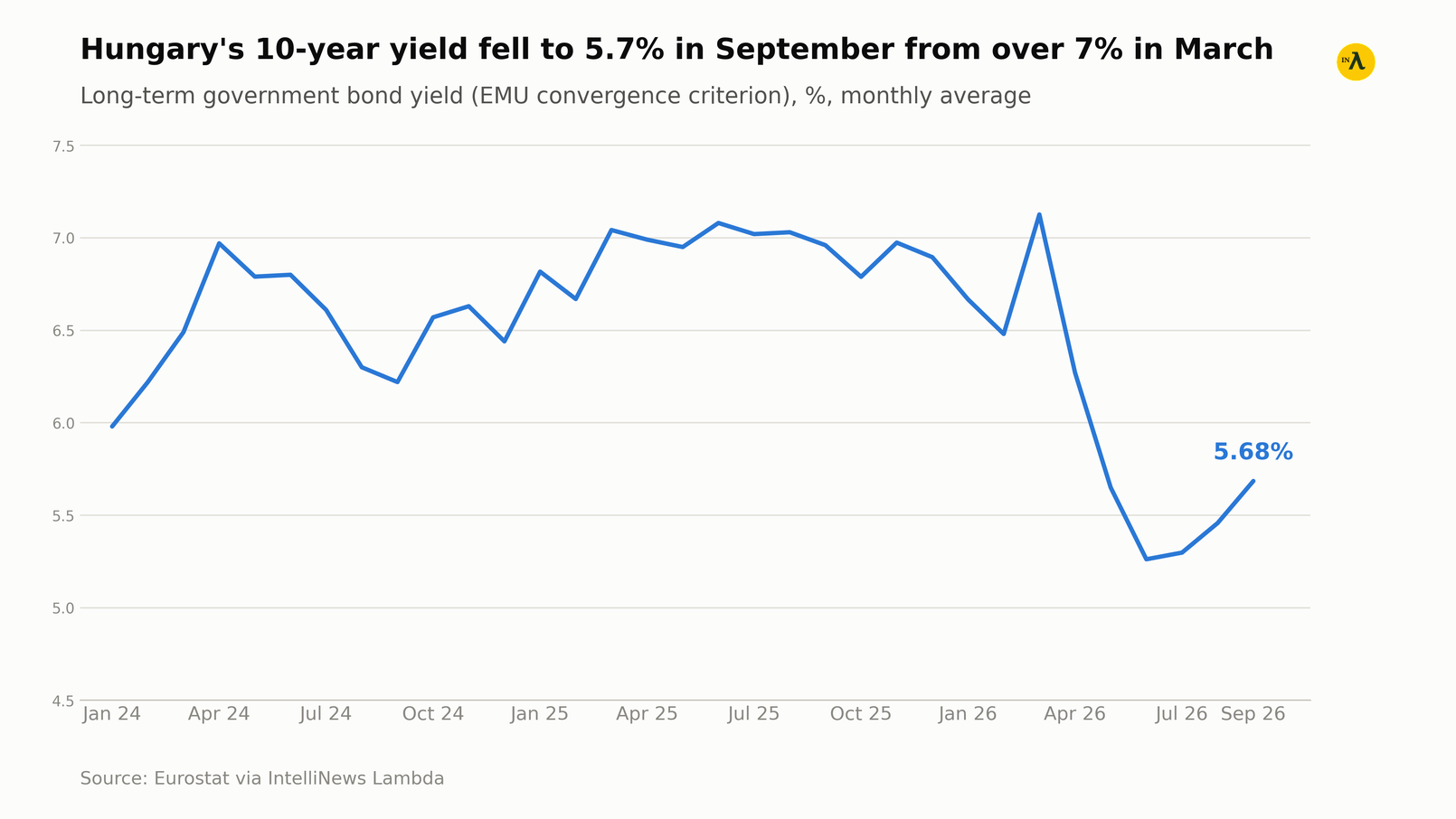
Hungary's long-term government bond yield, monthly average, %, January 2024 to September 2026. Source: Eurostat via IntelliNews Lambda.
ING blames positioning rather than the numbers. "Although the market may be satisfied with Hungary's direction, the trade has proven too heavy, and profit-taking has pushed yields higher," it wrote on October 20. A day later it said "the 'buy the rumour, sell the fact' scenario has fully played out", but that "the domestic story is moving in the right direction" and investors would soon use lower prices to rebuild positions.
The bank noted that the spread of Hungarian bonds over the euro area had already narrowed to about 200 basis points, against the 50-120bp range seen in earlier cases by the time countries entered ERM II. The forint has held in a tight 362-364 range against the euro, and ING expects any weakening to stall at 368-370.
Rate cuts wait on delivery
The National Bank of Hungary (MNB) left its base rate at 5.5% on October 20 and said it would study the budget in detail before deciding on further easing. Its emphasis on rising inflation "dampened hopes of an imminent rate cut" and may have added to the bond sell-off, Capital Economics said. Analysts had told Portfolio.hu before the meeting that rate cut prospects rested on budget credibility.
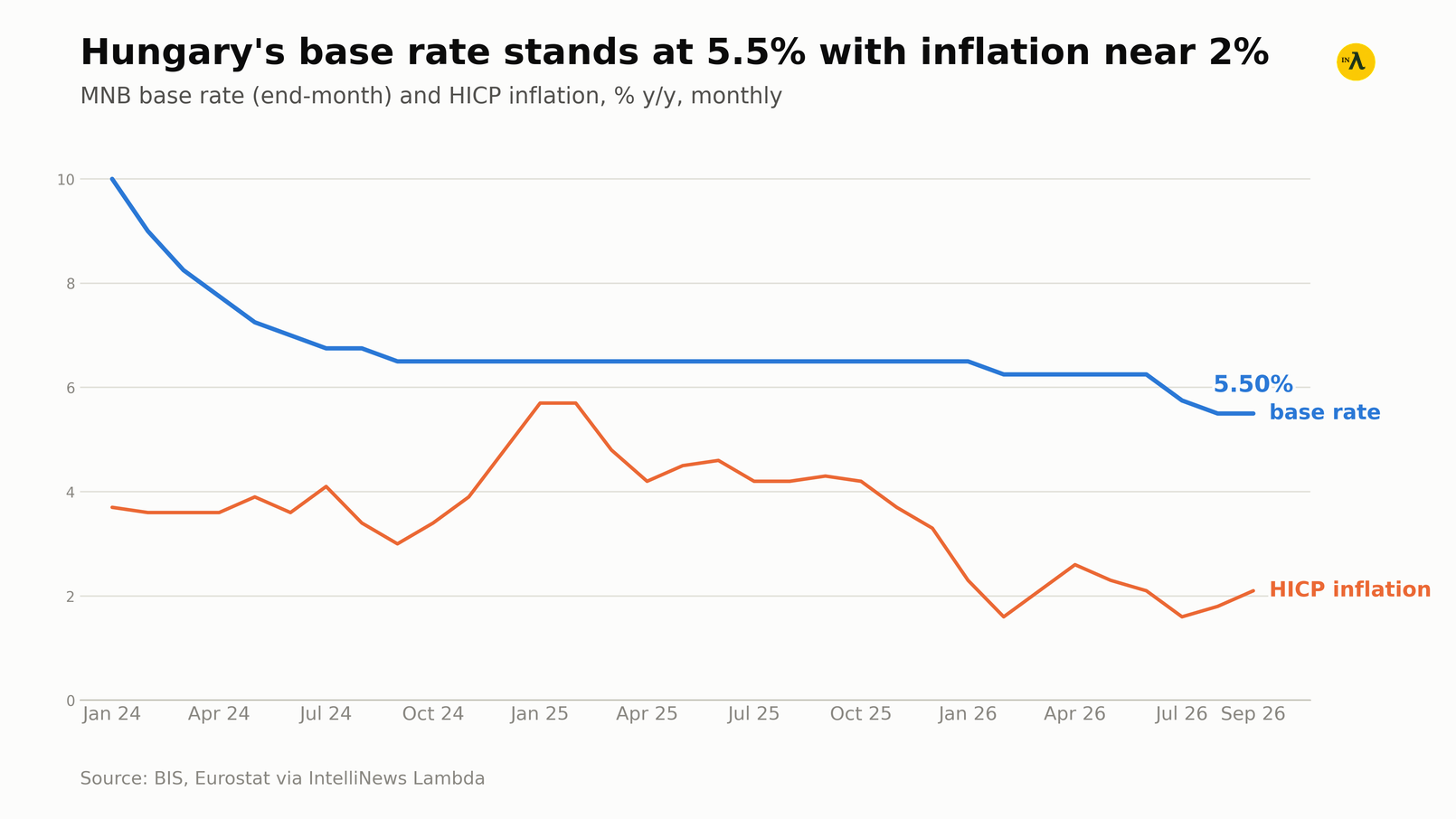
MNB base rate (end-month) and Hungary's HICP inflation, % y/y, January 2024 to September 2026. Source: BIS, Eurostat via IntelliNews Lambda.
Inflation is low for now, at 1.6% on the national measure in September, but the budget assumes it rises to 3% next year and Capital Economics expects 3.5%. The firm sees the base rate unchanged at 5.5% at the end of this year and at 5.0% by end-2027. ING is more dovish, seeing room for 125bp of cuts by the end of 2027 if Hungary lowers its inflation target and sticks to a credible fiscal framework.
Little contagion from France
The sharp rise in French bond yields has so far barely touched Central and Eastern Europe, Capital Economics said, with spreads over French bonds narrowing in Poland, Hungary and Czechia. French banks have a limited presence in the region and local banking systems depend far less on foreign parent funding than in the early 2010s. The bigger risk, the note said, is that trouble in France prompts investors to reassess other large-deficit countries, a list on which it put Poland, Romania and Slovakia rather than Hungary.
The 2027 plan follows an amended 2026 budget that raised this year's deficit target to 7.5% of GDP from the 3.7% legislated under Fidesz, and comes as the IMF presses for reform and Fitch weighs a downgrade. Analysts broadly accept that next year's cut is achievable; their doubts centre on 2030, when the deficit has to drop below 3% of GDP in an election year.
Unlock premium news, Start your free trial today.


