
AfD wins a second German state as Merz's CDU crashes out on 4.9%


The AfD has won its second German state in a fortnight, and Friedrich Merz's Christian Democrats have dropped out of a state parliament for the first time.
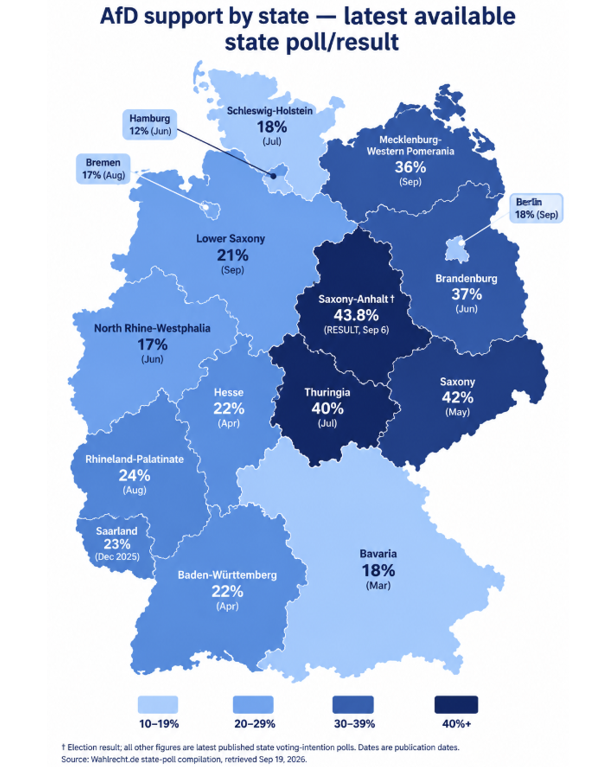
AfD support by state, latest poll or result. Saxony-Anhalt's 43.8% on September 6 is the only figure here that is an actual election result rather than a voting-intention poll.
The far right took 38.2% in Mecklenburg-Western Pomerania on September 20, a gain of 21.5 points on 2021, against 35.5% for the Social Democrats. The CDU finished fifth on 4.9%, down 8.4 points and below the 5% threshold, with the Sahra Wagenknecht alliance just behind it on 4.8% and the Free Democrats on 1.0%, on ARD's count of the preliminary result. Die Linke took 6.5% and the Greens 5.7%.
That produces a 71-seat Landtag holding 32 AfD members, 29 Social Democrats and five each from Die Linke and the Greens. A majority needs 36. The SPD, Die Linke and the Greens together have 39, so the party that won the election is on course to sit as the chamber's only opposition.
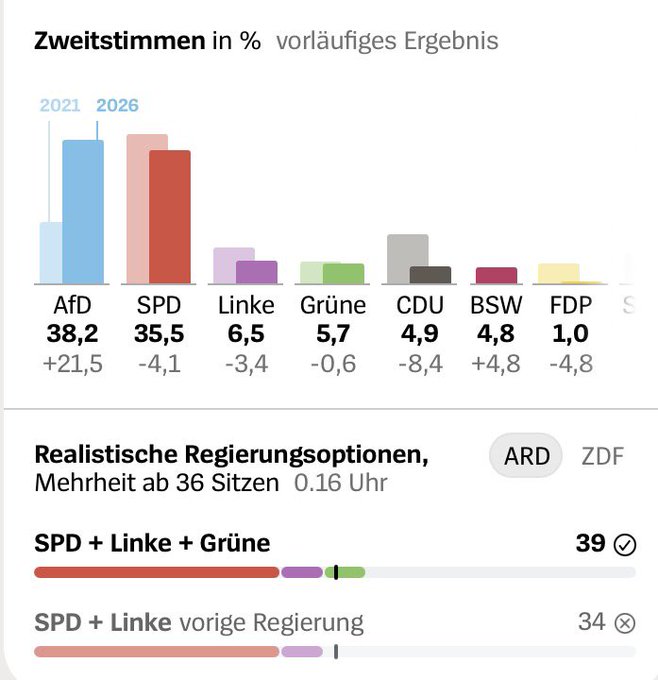
Mecklenburg-Western Pomerania's preliminary result and the two coalitions the arithmetic allows. Only the three-way bloc reaches the 36 seats needed.
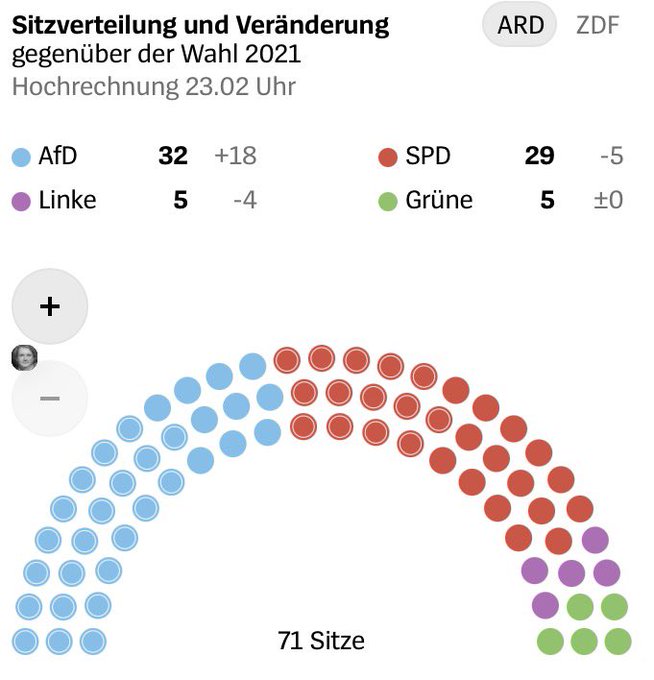
Seats in the 71-member Landtag: AfD 32, SPD 29, Die Linke and the Greens five each. The CDU has none.
“All in all, another reminder of an increasingly fragmented political landscape: a win for a right-wing populist party in one state, a win for a left-wing populist party in the other,” said Carsten Brzeski, global head of macro at ING, in a research note. “Years of economic stagnation helped produce that fragmentation. Now the fragmentation will make the stagnation harder to escape.”
In Berlin, voting the same day, Die Linke won 25.7%, a gain of 13.5 points, and 38 of the 130 seats in the House of Representatives. The CDU, which led the outgoing city government, fell 9.5 points to 18.8%. The AfD took 16.3%, the Greens 14.3% and the SPD 12.1%, while the Sahra Wagenknecht alliance missed representation on 4.7%. Turnout was 74.2%, up 11.3 points on 2023, The Berliner reported.
Die Linke's lead candidate, Elif Eralp, a 45-year-old lawyer who took her own seat in Friedrichshain-Kreuzberg, would be the first politician from her party to run the capital. “In our city, love and justice have triumphed over hatred,” she said, Al Jazeera reported.
Housing carried the vote. Eralp has promised to implement the 2021 referendum that voted to bring some 240,000 privately owned flats into public ownership, a result successive city governments have left on the shelf for five years.
“I've always said that if the Left Party joins the government, then socialisation will happen,” she said of the housing corporations.
Two coalitions are arithmetically available in Berlin: Die Linke with the Greens and the SPD, or the CDU with the same two. The CDU has said it will not work with Eralp's party.
Merz said he would stay. “We can't sugarcoat it, it was a disaster,” he told reporters in Berlin after the exit polls were published, breaking with the convention that chancellors wait until the following day, Bloomberg reported. He cancelled a trip to the UN General Assembly, gathered senior CDU officials at party headquarters and meets the parliamentary group on Tuesday.
Rank-and-file members are calling for him to go after 16 months in office, and polling makes him the least popular postwar German chancellor. Eight CDU state premiers signed a declaration of support last week; party officials quoted by the same report expect his departure sooner rather than later.
“He's dragging the CDU down with him,” AfD co-leader Alice Weidel told ARD, calling Merz the “wrong chancellor”.
“What needs to be done now requires backbone, steadfastness, and patience,” Merz said. “The reforms have to come. I am taking on this responsibility because I want to move our country forward.”
The result matters well beyond Germany. The AfD wants German aid to Ukraine cut and economic relations with Russia restored, and its Mecklenburg-Western Pomerania campaign ran on deporting migrants and opposing military support for Kyiv, the Kyiv Independent reported. Reuters reported on September 18 that the Kremlin's economic envoy Kirill Dmitriev and the AfD leadership were preparing to meet to discuss resuming Russian gas supplies to Germany.
The direction of travel is not new. Two years ago an Estonian security researcher was already describing Germany as moving to the right one state at a time, when the AfD's 29.2% in Brandenburg counted as a narrow defeat. On September 6 it won Saxony-Anhalt outright with 43.8%.
The AfD has now won two state elections and governs neither.
Unlock premium news, Start your free trial today.


