
ADB projects slower growth in all of Asia


For decades after globalisation and interconnected digitally enhanced international commerce, Asia has been the world's most reliable source of economic momentum.
According to an outlook forecast report by the Asian Development Bank(ADB), the broad Asia region including its many developing high growth economies are facing what can be best described as the most complex set of headwinds in years, knocking down previously much rosier forecasted growth estimates.
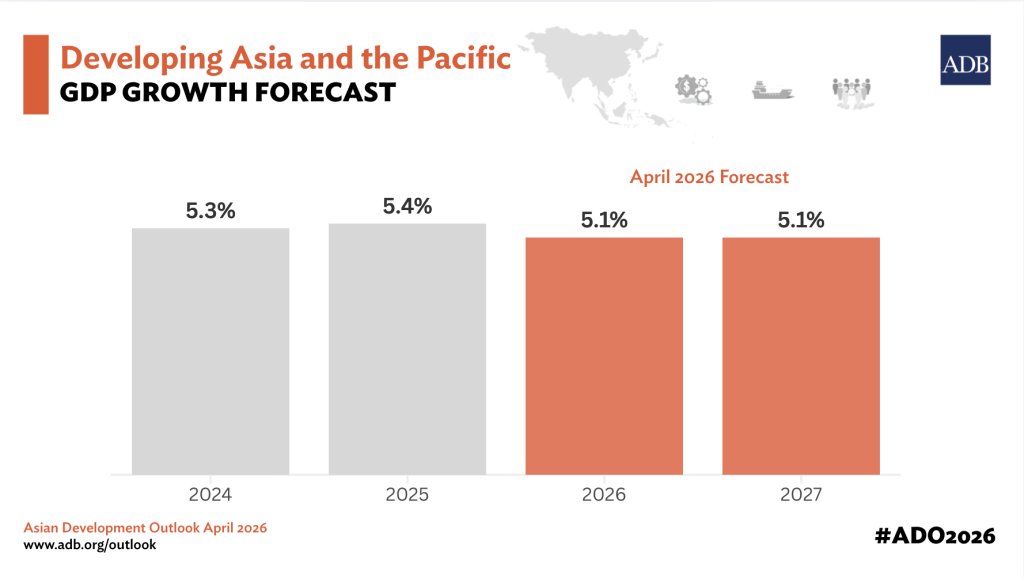
In its April 10 2026 report titled Asian Development Outlook, the ADB in aggregate estimates that growth across the broader Asia and Pacific region will slow to 5.1% in both 2026 and 2027, down from 5.4% in 2025.
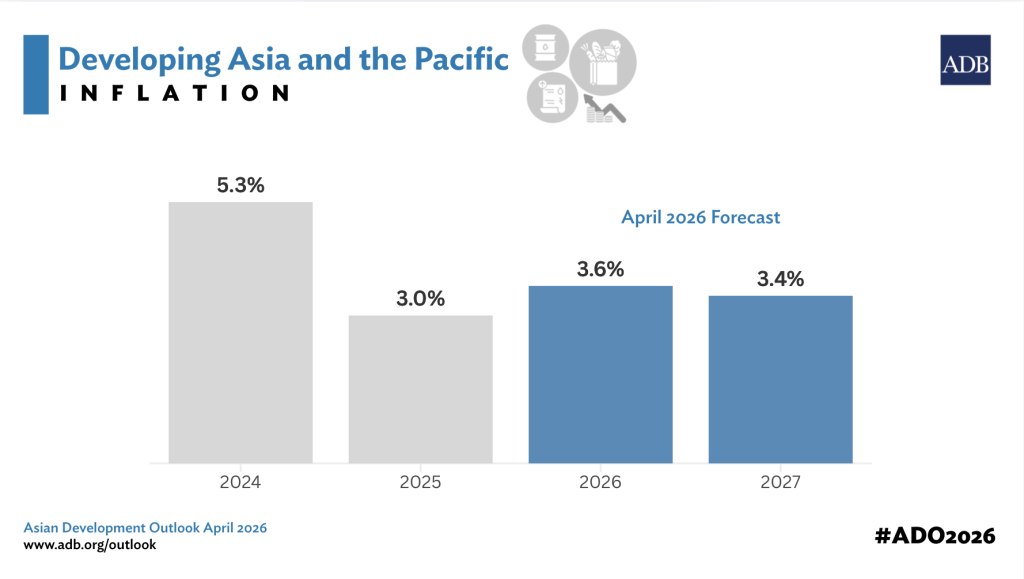
At the same time, regional inflation is expected to climb to 3.6% in 2026 before easing modestly to 3.4% in 2027, rising from 3.0% in 2025. Prima Facie, the numbers point to what can be interpreted as a regional economy under supply-side pressure, growing more slowly while paying more for the energy and food that sustains its growth.
The proximate cause as postulated by ADB is the ongoing conflict in the Middle East region between Iran on one side and the US and Israel on the other. The conflict and the various second and third order effects of it have disrupted global shipping lanes and sent seaborne hydrocarbon prices surging. This has introduced a degree of geopolitical uncertainty that policymakers and investors across the region are struggling to price in.
The ADB revealed in a press release that the forecasts were finalised on March 10, 2026, under what it describes as "exceptionally high uncertainty," with assumptions built around an early stabilisation scenario for the conflict.
Since then, the evidence has pointed toward a higher likelihood of more persistent disruption as the negotiations between Iran and the US in Pakistan have failed to deliver an agreement on April 12 2026, meaning the published figures may already be optimistic.
ADB’s Chief Economist Albert Park warned at the report's launch, that "a prolonged conflict in the Middle East is the single biggest risk to the region's outlook," noting that sustained hostilities could keep energy and food prices elevated while tightening financial conditions across the region. He urged governments to deploy sound macroeconomic policy alongside targeted measures to shield the most vulnerable households from price shocks.
The two largest economies in Asia, China and India, are both expected to decelerate, though from very different starting points and for different reasons. China's growth is projected to slip to 4.6% in 2026 and 4.5% in 2027, from 5.0% in 2025.
The drivers of that slowdown are structural as much as cyclical, a property sector that continues to drag on domestic demand, and an export engine that faces both slower global growth and renewed trade policy uncertainty from Washington.
Beijing has tools at its disposal such as fiscal stimulus, monetary easing, targeted industrial support, but deploying them in an inflationary global environment carries its own complications.
India presents a more nuanced picture. Growth is forecast to ease to 6.9% this year from 7.6% in 2025, before recovering to 7.3% in 2027. That trajectory, a dip followed by a rebound, reflects the ADB's view that India's domestic consumption base is resilient enough to absorb the near-term shock before reasserting itself.
India's challenge is the energy import bill, as one of the world's largest crude oil buyers, it is directly exposed to price surges that widen the current account deficit and complicate monetary policy. India's central bank, the Reserve Bank of India(RBI), has already held its benchmark rate steady in April 2026, watching the growth-inflation trade-off with evident caution.
Across South Asia more broadly, the picture is mixed as Bangladesh is forecast to grow at 4.0% in 2026 and 4.7% in 2027, a gradual recovery, but inflation remains a significant concern at a projected 9.0% in 2026.
Sri Lanka, still navigating the aftermath of its 2022 economic collapse and now facing the added pressure of Middle East disruption on its energy costs and tourism flows, is expected to grow at 4.0% in 2026 and 4.2% in 2027, a trajectory that looks reasonable on paper but leaves little margin for additional shocks.
Nepal and Pakistan both face elevated inflation alongside modest growth, while Bhutan stands out with a projected 6.9% expansion in 2026, supported by hydropower revenues and Indian economic linkages. Perhaps the most striking finding in the ADB's report is the severity of the projected slowdown in Pacific island economies.
As a group, they are expected to decelerate from 4.2% growth in 2025 to just 3.4% in 2026 and 3.2% in 2027, the sharpest regional deceleration in the entire report. These economies are acutely vulnerable to external shocks as they are highly dependent on tourism, remittances, and imported fuel, with limited fiscal buffers and minimal ability to substitute domestically for what they cannot import.
For countries like Fiji, Papua New Guinea, and the smaller island states, the combination of higher energy costs and disrupted travel routes will be felt immediately in household budgets and government revenues.
Unlock premium news, Start your free trial today.

