
US pilot shot down in Iran rescued in prelude to possible ground invasion

A dramatic game of cat and mouse played out in the mountains of Iran in the last few days following the Downing of an F15E Strike Eagle by an Iranian missile as US Special Forces searched for and eventually extracted one of its airmen lost in the mountains.
Both the pilots and the weapons system officer (WSO) ejected from the damaged plane. The pilot was quickly found but his co-pilot came down deeper into the mountains and spent 24 hours in the wilderness as the Iranian militia mounted a manhunt to try and capture him. The US then launched a successful and massive operation, sending in special forces and several aircraft in order to recover the missing aviator. He was extracted without a single US casualty.
The success of the mission will only bolster the White House's apparent determination to mount a ground assault on Iran in the coming weeks. Badly outnumbered by Iran’s very large army, the success of the US Special Forces-led rescue operation will only reinforce the Pentagon’s confidence in a plan that reportedly relies heavily on special forces operations.
Iranian local TV covered the story live as the authorities called on the Basij militia and villagers to scour the mountains and find the hiding American. Initially there was a shoot to kill order out on him but then, realising the PR value of capturing an American serviceman, that order was changed to bring him in alive in exchange for “a precious prize”.
The airman evaded capture for 24 hours, at one point hiking up a 7,000ft ridgeline, a senior US military official said. Like all American combat airmen, the WSO, who has not been named, used his SERE (Survival, Evasion, Resistance and Escape) training to evade capture. He hid on an elevated ridge after hiking away from the wreckage and putting out an emergency beacon, which the rescue team centred in on.
This was first time US servicemen have entered Iranian territory since the conflict began a month ago. US Special Operations rescue forces including US Air Force Pararescuemen (PJs) and many layers of elite rescue forces took part in the complex operation, including the legendary Navy SEAL Team Six that carried out the operation to kill Osama bin Laden, and dozens of fighter and strike aircraft, helicopters, and cyber, space and other intelligence capabilities, officials told The New York Times.
Multiple aircraft were dispatched to establish a temporary fire zone around Dehdasht, a no-entry perimeter enforced with precision strikes on a telecommunications tower and approaching vehicles.
Senior military officials described the mission to rescue the airman as “one of the most challenging and complex in the history of US Special Operations”, given the mountainous terrain, the airman’s injuries and Iranian forces rushing to the location in the mountains of Southern Iran. It was a big, layered mission.
Search and rescue
Black Hawk helicopters hunted for the WSO on the ground. US attack aircraft dropped bombs and opened fire on Iranian convoys to keep them away from the area where the airman was hiding. A-10 Warthog planes flew along the roads strafing Iranian army forces that were rushing into the region to carry out a manhunt for the lost airman.
In addition, there were C-130 transport planes carrying more equipment arms and supplies that landed in the mountains of Kohgiluyeh and Boyer-Ahmad Province in southwestern Iran to support the operation. However for unexplained reasons they got “stuck”. Commanders decided to fly in three new planes to extract all the US military personnel and the airman, and they blew up the two disabled planes in order not to leave them for the Iranians.
Eventually the WSO was recovered and loaded onto the helicopter to be flown out, but by that time Iranian forces had caught up and he was evacuated in the middle of a large firefight where several of the helicopter members were wounded. It's not clear what the status of the WSO is, however, according to some reports he was also badly wounded and is now in hospital recovering.
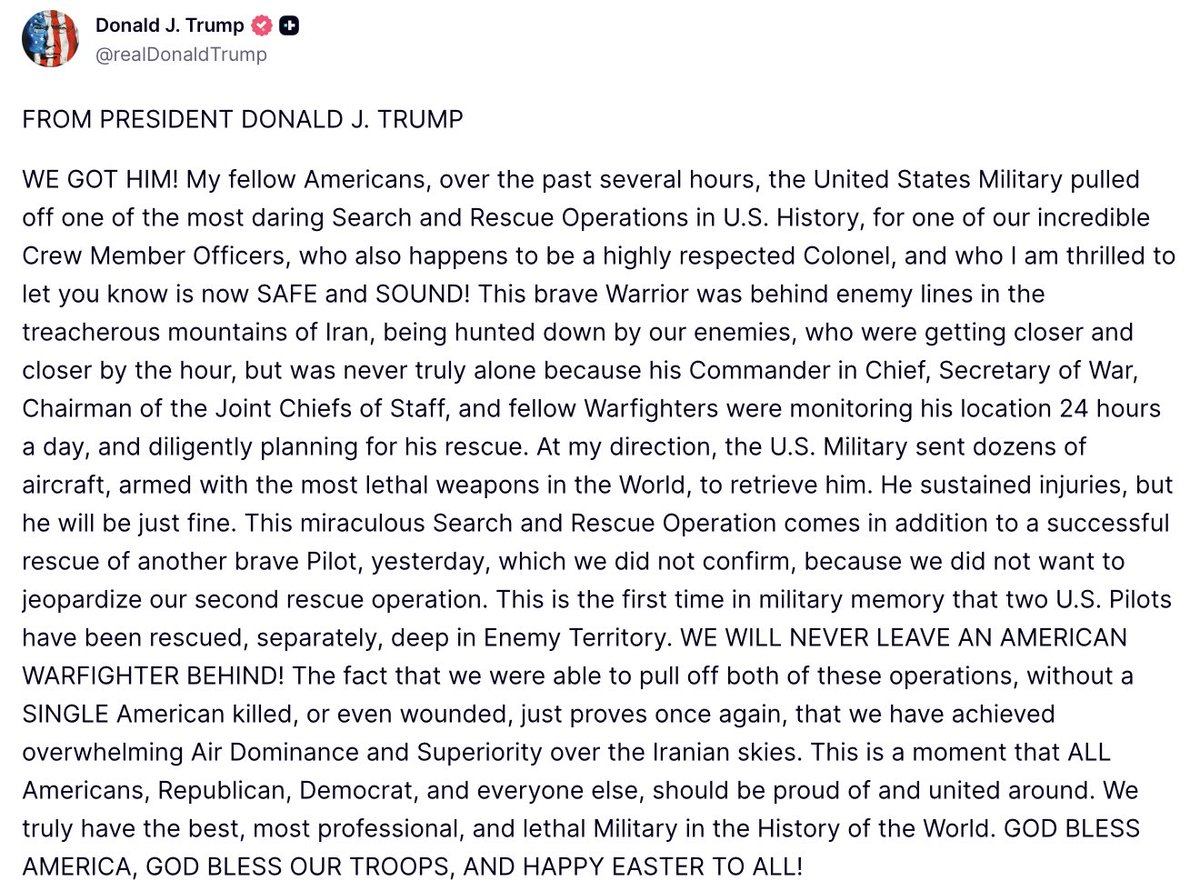
US President Donald Trump praised the operation, which highlights the American military principle of “no man left behind”.
“WE GOT HIM!” Trump exclaimed in a social media post. “The US military pulled off one of the most daring search and rescue operations in US history, one of our incredible Crew Member Offices, who also happens to be a highly respected Colonel, and who I am thrilled to let you know is now SAFE and SOUND!”
The whole episode has been a PR boon for Trump, who has been seen to rescue a military man in distress. However it's also a PR disaster after Iran shot down one of America's most sophisticated jet fighters with a surface to air missile invading its many defensive systems and putting America's air superiority in Iran into question.
The Iranians made as much hay from the incident as the Americans. As the saga unfolded it was watched live by Iranians on local TV, where the authorities took maximum advantage to highlight their ability to strike back at the invader.
Prelude to invasion
The incident is a prelude to a possible ground invasion that seems to be being prepared. Rumours are swirling of a buildup of US-Israeli coalition forces ahead of what will likely be a series of special operations to secure key assets.
While US forces would be outnumbered in Iran by 13 to one, the excellence of the special forces could give America the edge. The rescue of the downed airman is the second highly successful special forces operation of Trump’s second term in office. Operation Absolute Resolve on January 3 used US special forces to snatch the sitting president of Venezuela Nicolas Maduro from the capital Caracas and whisk him back to the US to stand trial on narco-terrorism charges without a single casualty as well.
As IntelliNews reported, some 17,000 US infantry troops already arrived in the region last week, But according to reports a joint US Israeli fighting force of up to 45,000 men could be being prepared to invade Iran in the coming week or two.
Various targets are being discussed. One option is to hit the Kharg Island, which is responsible for 90% of Iran's oil exports. However military experts say the heavily defended island would be extremely difficult to take and even harder to hold.
Iran has deployed troops to the islands and has likely mined the shores and water on the approach. Moreover, the island is reportedly full of underground tunnels which both house the Iranian troops and protect them from missile strikes. Conversely the island is only about 90 from the shore, putting it in easy range of Iran's missiles and drones. Any US occupying troops would be exposed to intense bombardment with little shelter, and at the same time vulnerable to surprise attacks by Iranian forces coming out of their subterranean refuge.
As an isolated strike on Kharg Island is believed to be suicidal, the current plan involves a full-scale ground offensive into Khuzestan on the facing shore, supported by Kurdish militias, along with the seizure of key Iranian ports, according to speculation on the possible details.
Another option is to take the four islands in the Strait of Hormuz – Abu Musa, Greater Tunb, Lesser Tunb and Qeshm – as part of the effort for the US to take control of the straits. However military analysts say this plan is also vulnerable to missile and drone strikes from Iranian positions on the shore and the same challenges exist. There are also discussions of capturing coastal cities in Baluchistan to encircle the Strait of Hormuz and neutralise Iran as a regional power.
A third option is to seize Iran’s uranium stockpiles, even though the material has reportedly been moved to undisclosed new facilities. The last IAEA inspection confirmed this shift, yet American troops may still be sent on a high-risk mission without precise intelligence on the target. As the uranium is believed to be stored in a mountain cave, the US invading forces would have to bring with them excavating equipment in order to dig into the mountain defences and capture the approximately 400 kilos of enriched uranium believed to still be there.
The Iranian army numbers up to 600,000 men including 190,000 elite IRGC troops.
Last week US Secretary of War Pete Hegseth sacked joint chief of staff commander Gen. Randy George last week along with a dozen other generals, and appointed two of his close associates to head up the military. Observers say this is a preemptive move to head off military objections to a ground invasion operation that the White House has already decided it wants to carry out.
Amongst the many objections to the plan are Iran's highly accurate and powerful missile systems, capable of striking ships air bases and staging areas, coupled with large scale draw drone swarms. There is also the lack of an exit strategy. What happens if things go wrong? Extraction under fire is extremely difficult in modern warfare. Air evacuation would be restricted by Iran's missile and drone arsenal, while a ground withdrawal across hostile territory would be extremely dangerous, and naval extraction is also vulnerable to Iran’s fleet of deadly mini-subs, among many other asymmetric weapons.
The IRGC say they are well prepared for any potential invasion and released a propaganda video called “Welcome to Hell” for invaders, promising to annulate any troops that set foot on Iranian soil.
.jpg)