
Ukraine strikes Ryazan refinery as Zelenskiy ends three-day pause


Ukraine has resumed its strikes on Russian oil refineries, with a drone attack starting a fire at a plant in the Ryazan region, regional governor Pavel Malkov said on October 15.
Material damage was being assessed and emergency services were at the scene, Malkov said on Telegram, Reuters reported. The strike came hours after President Volodymyr Zelenskiy told the Financial Times that Kyiv's three-day halt was over. "The block [on attacking refineries] is out. We're done," he said in an interview in London, Meduza reported.
The pause was the entire substance of the energy ceasefire President Donald Trump announced on October 11, which raised more questions than answers at the time and which neither army ever confirmed. Its collapse inside four days returns the war to the total war footing it has been sliding towards since July, in which each side goes after the other's civilian economy rather than its front line. That exchange is not symmetrical: Russia's missile and drone arsenals are several times the size of Ukraine's, and Ukraine's answer to them is a drone fleet that depends on satellite links Washington controls.
Zelenskiy said he had stopped the energy strikes for three days to comply with US wishes while Russia went on hitting Ukrainian energy infrastructure and killing civilians, more than 100 of them in the past week. In return, he said, Ukrainian military officials were told by their US counterparts that "if you will not stop [the energy strikes], we will block intelligence", a message later presented to Kyiv as a technical glitch.
US intelligence agencies warned Ukraine's embassy in Washington on October 12 that sharing would stop immediately if strikes on Russian energy facilities continued, The Washington Post reported, as carried by Censor.NET. Trump has denied cutting intelligence off, saying "we are helping them, and we are sharing intel". Ukraine says it received no warning of the first ballistic wave of the October 13-14 attack on Kyiv.
The second squeeze was Starlink. The military version, Starshield, was capped at 100 miles per hour for terminals in motion on the night of October 13-14 without notice, disrupting frontline operations and medium-range strike drones. Elon Musk said the systems are "owned and controlled by the US government" and that "any limits on speed or usage are decided by the US military and ultimately POTUS". A White House official told Axios the administration had nothing to do with it and planned to ask SpaceX what had happened, Meduza reported. Service at speed was restored on October 15, a Ukrainian defence ministry source told the Kyiv Independent.
Zelenskiy rejected the technical explanation. "It was not a technical problem, it was the will," he said. The timing could hardly have been worse: "From midnight yesterday through 9 a.m. today, there had already been more than 850 'shaheds' - and this comes precisely at a time when the speed of our defensive capabilities is being artificially restricted," he said of the overnight attack.
Kyiv spent the week in the dark. The CHP-4 combined heat and power plant in Darnytsia took a direct ballistic hit in the October 13-14 attack, 600,000 consumers lost power across Kyiv, the Kyiv region and Kharkiv, and hot water was suspended on October 15 for homes served by the Darnytsia plant. The campaign to freeze Ukraine into submission is running against a defence whose interceptor stocks were already short before Starshield slowed down.
Trump called at the weekend for Ukraine to replace Zelenskiy, and Musk posted "And so the slaughter continues ... Time for Zelensky to go" on X. Zelenskiy told Piers Morgan Uncensored he would not resign and that a wartime election was close to impossible because "each hour we have attacks". "Not Trump, not Musk, not anybody in the world can choose the president or elect in other countries," he said, Ukrainska Pravda reported. He called Trump's demand "rhetoric" that would only encourage Putin.
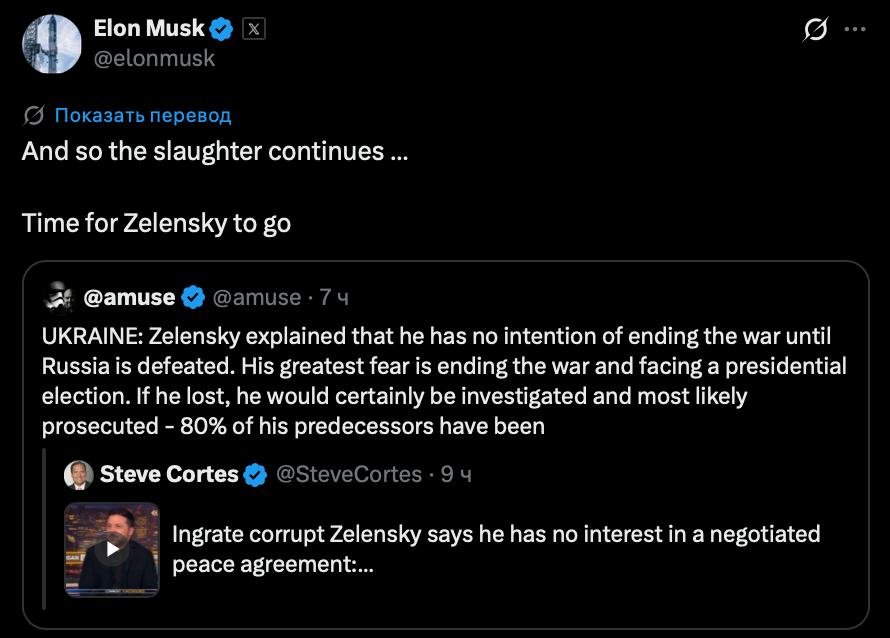
Elon Musk's post on X on October 14 calling for Zelenskiy to go, shared with a third-party account's claims about the Ukrainian president's motives, which are not reported here. Source: Elon Musk (@elonmusk) on X.
Asked whether he would halt energy strikes anyway to repair relations with the White House, Zelenskiy said he could agree only in exchange for more US-made Patriot interceptors, which he called the "minimum" he had asked for. When he asked for air defences, he said, the American answer was to weaken Starlink. He also expects the deal-making to continue: "The question will be when will the next deal be? Maybe it will be gas. Definitely it will be gas."
Behind the pressure is the US midterm vote on November 3 and a pump price that reached $6.53 a gallon. Trump's diesel deal with Putin, struck on October 9, is meant to bring Russian diesel to American drivers within weeks, and Washington has also asked Europe to unfreeze part of Russia's immobilised central bank reserves, an idea European delegates rejected. Kyiv was refused any reward for the pause it did observe.
Not everyone in Kyiv thinks the refinery campaign earns its cost. Russia made about $46bn from refined petroleum exports in 2024 and roughly $40bn in 2025, against crude exports of about $124bn and $101bn, former presidential spokeswoman Iuliia Mendel wrote, arguing that two and a half years of strikes have not cut Russian defence spending, which she put at about $190bn in 2025. The counter-argument, which Zelenskiy made in the same interview, is that stopping the strikes buys nothing: Russia kept hitting Ukrainian energy throughout the pause.
Unlock premium news, Start your free trial today.


