UAE advances alternative trade route to bypass Strait of Hormuz

The United Arab Emirates is accelerating efforts to establish a new trade corridor linking its eastern seaboard to Saudi Arabia, to bypass the Strait of Hormuz bottleneck.
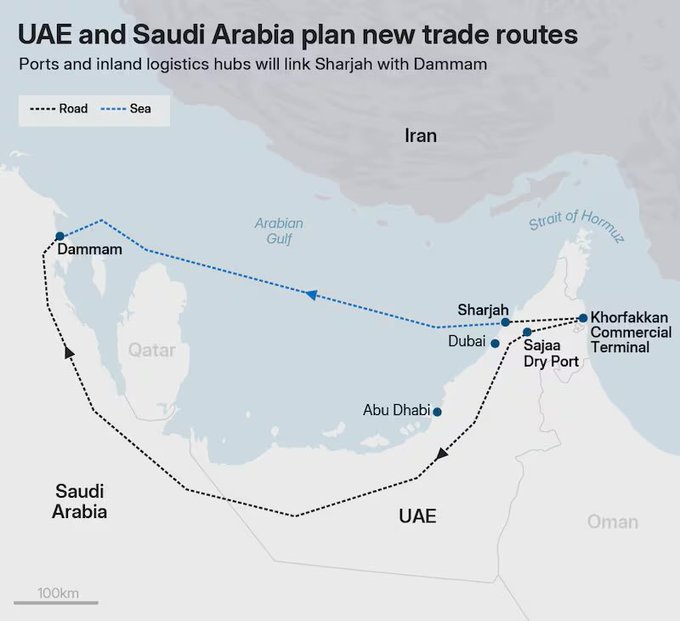
Officials and regional observers say the initiative centres on Khorfakkan Port in the emirate of Sharjah, which sits on the Gulf of Oman outside the Strait. The UAE is the only Gulf state with shores on both the Persian Gulf, behind the Strait of Hormuz, and the Gulf of Oman, on the open side of the Strait thanks to land spur that cuts under Oman.
The route is designed to connect the UAE directly to Saudi Arabia’s eastern city of Dammam through a combination of maritime and overland links, reducing reliance on one of the world’s most strategically sensitive chokepoints.
Instead of sitting around waiting for sea mines in the Strait of Hormuz planted by the Iranian regime to be cleared, the UAE is setting up a new land trade route in Sharjah in partnership with Saudi Arabia.
The Strait of Hormuz handles roughly a fifth of global oil trade. Khorfakkan Port, already a significant container hub on the Indian Ocean side of the UAE, has been expanded in recent years to accommodate larger vessels and increased cargo volumes. Its location allows ships to avoid entering the Gulf entirely, offering a strategic alternative for trade flows. Iran’s blocking of the Strait has prevented oil and gas getting out, but it has also prevented food getting in. Most of the Gulf states are heavily dependent on imports of essentials.
The proposed corridor would see goods arrive at Khorfakkan before being transported across the UAE and into Saudi Arabia, linking with logistics networks that extend to Dammam and beyond. Analysts say such infrastructure could strengthen economic integration between Gulf states while mitigating exposure to maritime disruption.
The development aligns with broader regional efforts to diversify supply chains and reinforce economic resilience amid persistent security concerns. It also reflects deepening co-ordination between Abu Dhabi and Riyadh on trade and infrastructure.
While no official timeline has been announced, the project highlights the extent to which Gulf states are preparing contingency routes to ensure continuity of trade in the event of escalation in the Strait of Hormuz.