
Trump warns Iranian civilisation could 'die tonight' as US signals major escalation


US President Donald Trump warned that "a whole civilisation will die tonight" in a social media post on April 7, hours before a self-imposed deadline for Iran to reopen the Strait of Hormuz or face strikes on its civilian infrastructure.
"I don't want that to happen, but it probably will," Trump wrote on Truth Social. He said the night would mark "one of the most important moments in the long and complex history of the World" and that "47 years of extortion, corruption, and death, will finally end."
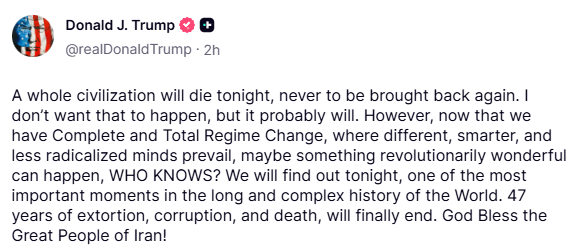
Trump has given Iran until 8pm Eastern Time (midnight GMT) on April 7 to agree to a deal that includes reopening the strait, threatening the "complete demolition" of Iran's power plants and bridges if Tehran does not comply, US media reported.
The threat came as US forces struck more than 50 military targets on Iran's Kharg Island overnight, the country's main oil export hub handling roughly 90% of crude shipments. Crude oil surged past $115 a barrel following the strikes.
Israel acknowledged attacks on Iranian railways and bridges, with Prime Minister Benjamin Netanyahu saying the strikes hit infrastructure "used by" the Islamic Revolutionary Guard Corps.
Iran's IRGC dismissed Trump's threats as "baseless" and vowed to continue fighting, warning it would "deprive the US and its allies of the region's oil and gas for many years" if Washington crossed "red lines" by attacking civilian infrastructure.
Iranian authorities called on young people to form human chains around the country's power plants ahead of the threatened strikes. Iranian President Masoud Pezeshkian claimed more than 14mn Iranians had vowed to "sacrifice their lives" in defence of the country.
UN Secretary-General Antonio Guterres warned the Trump administration that attacking civilian infrastructure in Iran is prohibited under international law.
Former Human Rights Watch Executive Director Kenneth Roth said Trump was "openly threatening collective punishment" in violation of the Fourth Geneva Convention, NBC previously reported.
The war, now in its 39th day since Trump announced "major combat operations" on February 28, has sent oil prices above $111 a barrel.
The head of the International Energy Agency, Fatih Birol, said the world has "never experienced a disruption to energy supply of such magnitude”.
US petrol prices have risen to a national average of $4.14 a gallon, up nearly 39% since the war began.
Unlock premium news, Start your free trial today.


