
Sub-Saharan Africa faces the world's steepest climate adaptation bill at 3% of exposed GDP


Protecting areas of Sub-Saharan Africa exposed to extreme heat, drought and flooding against hazards in a world 2°C warmer than pre-industrial levels would cost the equivalent of 3% of their projected annual GDP, the highest share of any region, according to the McKinsey Global Institute.
The estimate comes from the consultancy’s research arm in its report, Advancing adaptation: Mapping costs from cooling to coastal defenses, published in December 2025. The study examines the costs of 20 established adaptation measures, from air conditioners and white roofs to levees and sea dikes, combining climate models with population and economic data mapped to approximately one-square-kilometre grid cells.
McKinsey compared Sub-Saharan Africa’s projected adaptation burden with the 2% of regional GDP spent servicing external debt in 2024. The two figures are not directly comparable, as they use different GDP bases and refer to different periods. The Middle East and North Africa ranks second in the regional adaptation-cost comparison, followed by India.
The regional breakdown shows that protection would impose the heaviest relative costs on lower-income areas, with heat rather than coastal flooding accounting for most of the projected spending. Across regions encompassing much of the developing world, approximately 70% of adaptation costs would go towards protecting against heat, largely through air conditioning.
The global cost of providing protection to standards commonly found in developed economies could reach $1.2 trillion annually through 2050 under a 2°C warming scenario, more than six times estimated baseline expenditure.
The figure represents an annualised cost, including operating expenses and capital expenditure spread over the lifetimes of assets, rather than a forecast of actual spending. It also excludes some climate risks and adaptation measures.
A bill six times today’s
McKinsey estimates that annual spending on the 20 adaptation measures stood at approximately $190bn in its baseline, providing some form of protection to 1.2bn people.
Some 4.1bn people lived in places exposed to at least one of the climate hazards examined, and extending protection to all of them at developed-economy standards would have cost approximately $540bn annually under baseline conditions.
The resulting $350bn gap was concentrated in lower-income areas, where approximately $200bn in additional annual spending would be required. About 85% of people in low-income locations lacked protection, compared with roughly a quarter in high-income areas.
Under McKinsey’s 2°C warming scenario around 2050, taking account of projected population growth, an additional 2.2bn people would live in areas exposed to heat stress and 1.1bn more in areas exposed to drought. The additional population exposed to serious coastal flooding would be about 40mn.
The annualised cost of protecting exposed populations to developed-economy standards would rise to $1.2 trillion, approximately 6.2 times baseline spending and equivalent to about 0.8% of projected GDP in exposed areas.
About 60% of the cost would consist of recurring expenses, including electricity for cooling and water for irrigation, rather than capital expenditure.
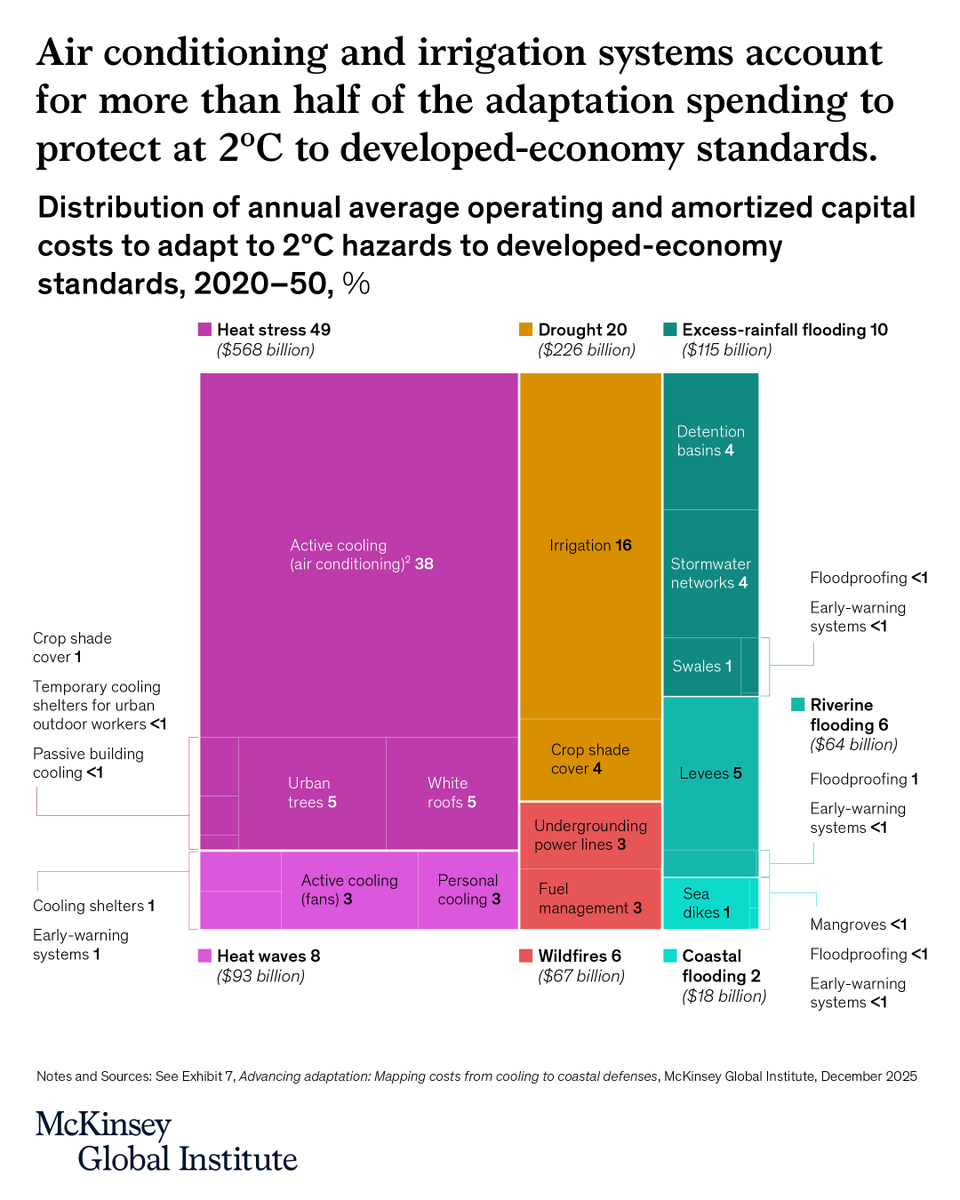
Air conditioning and irrigation together account for more than half the modelled annual adaptation cost at 2°C warming. Source: McKinsey Global Institute.
Heat stress alone accounts for 49% of the projected bill, or $568bn annually, with active cooling through air conditioning representing 38% of total adaptation costs. Including heat waves, heat protection accounts for more than half of the total.
Drought accounts for 20%, or $226bn, mostly for irrigation, followed by flooding from excess rainfall at 10% ($115bn), heat waves at 8% ($93bn), wildfires at 6% ($67bn) and river flooding at 6% ($64bn).
Coastal flooding accounts for just 2%, or $18bn, of modelled annual adaptation costs through approximately 2050. More than 40% of the world’s population would live in areas exposed to heat stress at 2°C warming, compared with fewer than 1% exposed to serious coastal flooding under the study’s definitions.
However, the relatively small coastal-flooding allocation does not capture all the longer-term consequences of rising sea levels, including risks beyond 2050 and some impacts on small-island states.
The heat season would also lengthen, from less than 12 weeks on average to approximately 16 weeks annually at 2°C, increasing pressure on electricity grids as cooling systems operate for longer periods.
Roughly three-quarters of heat-protection costs would be recurring operating expenses. As IntelliNews has argued, in large parts of the world air conditioning is becoming existential rather than a luxury.
Poorer regions pay most
In absolute terms, Greater China and India would face the largest adaptation costs, each exceeding $200bn annually under the 2°C scenario.
In India, the estimated cost would be approximately $125 per person, more than a third of the amount allocated per capita in the central government’s 2025 budget.
About 60% of India’s population and 30% of Nigeria’s already live in places experiencing annual heat stress under McKinsey’s definition, yet air-conditioning coverage is approximately 10% in India and 3% in Nigeria.
In the United States, where only 4% of the population faces heat stress under the same definition, air-conditioning coverage exceeds 90%.
India’s summer heat is already a drag on economic growth, and the McKinsey report highlights one example of a relatively low-cost response.
Ahmedabad, a city of about 7mn people in western India, recorded more than 1,300 deaths during a heat wave in May 2010. In 2013, it introduced South Asia’s first city heat-health action plan, incorporating colour-coded warnings, additional cooling spaces and painted “cool roofs” for low-income homes.
Across Greater China, emerging Asia, India and Sub-Saharan Africa, more than half the population could live in places exposed to heat stress under a 2°C warming scenario.
Protecting low-income locations would cost an average of 1.7% of their GDP, rising to 2.5% in low-income rural areas, compared with 0.8% in middle-income locations and 0.5% in high-income ones.
Emerging Asia currently spends approximately 0.6% of GDP in exposed locations on adaptation measures but would need 1.4% under the 2°C scenario.
The average estimated cost of protection across exposed populations is approximately $130 per person annually, compared with baseline spending of about $45.
In the United States, the $130 benchmark is equivalent to less than four hours of average wages. In Bangladesh, it amounts to about half a household’s average monthly income, illustrating the sharply different affordability of adaptation measures across income levels.
If Sub-Saharan Africa, India and other lower-income regions maintained their existing protection levels as the planet warmed, their spending would cover only about 15% of the cost of providing developed-economy standards of protection. Even if spending increased in line with economic growth, coverage would reach only about 25% of the estimated requirement.
North America already spends approximately 0.4% of GDP in exposed areas on adaptation, enough to meet its projected 2°C requirements if expenditure keeps pace with economic growth. Similar growth-linked spending could deliver full coverage in Advanced Asia.
Europe’s problem is drought
Europe and the former Soviet space face a different distribution of climate risks.
Fewer than 10% of people in the EU30, North America and McKinsey’s “Other Europe and Central Asia” region would live in places exposed to heat stress at 2°C warming, with drought accounting for a larger share of adaptation requirements.
If existing levels of protection were maintained, more than 40% of adaptation spending in those regions would go towards drought measures, compared with slightly more than a third allocated to heat stress.
Warsaw, Toronto and Kyoto are among the cities identified by McKinsey as having no exposure to the four broad hazard groups under its baseline definitions but facing exposure at 2°C.
European cities could consequently experience heat waves as part of a recurring annual disaster season, alongside the growing costs of managing water shortages.
A good buy nobody is paying for
McKinsey estimates that the benefits of adaptation, measured as avoided economic damages, are approximately three times its costs under baseline climate conditions, rising to four times at 1.5°C warming and seven times at 2°C.
These are modelled benefit-cost ratios rather than guaranteed financial returns.
Air conditioning delivers estimated benefits equivalent to three to five times its costs, while cheaper measures such as fans and white roofs can offer higher benefit-cost ratios but provide less comprehensive protection.
Urban sea dikes generate estimated benefits exceeding 10 times their costs, while rural sea dikes deliver benefits of less than 1.5 times costs, reflecting differences in the value and concentration of assets protected.
“If adaptation spending decisions were based only on cost-benefit economics, there would be no resiliency gap today,” the report says.
McKinsey outlines two potential spending paths as the world approaches 2°C warming.
Maintaining today’s levels of protection would require annual spending to rise to approximately $470bn, or 2.5 times the baseline, but would cover only about 40% of the full projected adaptation requirement.
If expenditure increased in line with incomes, annual spending would reach approximately $670bn, covering about 60% of the estimated requirement.
Maintaining existing protection levels would require around $6 trillion in cumulative capital investment by 2050, while extending developed-economy standards of protection to all exposed populations would require approximately $15 trillion.
The estimates distinguish the cost of maintaining protection as climate hazards intensify from the considerably larger investment needed to close existing protection gaps.
As of October 2025, 141 countries had a formal adaptation plan, up from 84 five years earlier, but McKinsey found that only a fraction established clear priorities or included cost estimates.
Where adequate protection is absent, the costs of climate-related losses ultimately fall on households, businesses, insurers and governments.
“Ultimately, someone will have to pay for risks,” the authors conclude.
Unlock premium news, Start your free trial today.


