
Russia's war financing could run short by early 2028, KSE Institute says


Under its market-based scenario, Russia would run out of sufficient budget financing by early 2028, and each ruble raised would become more expensive, the KSE Institute said in a September report.
The federal budget deficit reached RUB5.8 trillion ($68.7bn) in January-August, 48% more than a year earlier, 3% more than the whole of 2025 and 20% above the already-revised 2026 target of RUB4.8 trillion ($56.9bn), according to the Kyiv School of Economics think tank. Oil and gas revenue fell 17% year on year over the eight months while spending rose 15%, and non-oil and gas revenue grew 18%, more slowly than in previous years as the economy stalls.
With effectively no access to foreign money, Moscow has three places to find rubles - the National Wealth Fund (NWF), the Treasury's cash balances and domestic OFZ treasury bonds sold overwhelmingly to banks - and KSE finds all three are being stretched at once, leaving an increasingly strained banking system to carry the load. "Russia has so far been able to finance its war against Ukraine without triggering acute fiscal or financial instability, but doing so is becoming increasingly difficult and costly as key financing channels become less dependable," the authors wrote.
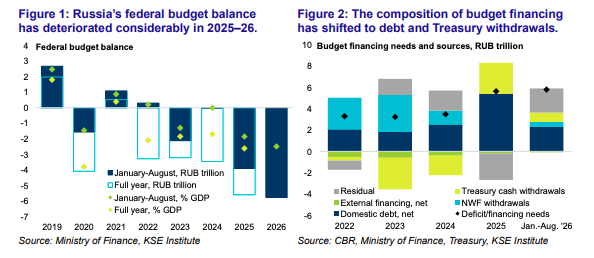
Russia's federal budget balance (left) and the composition of budget financing (right). Source: KSE Institute
The think tank projects the full-year deficit at RUB8.1 trillion ($95.9bn), or around 3.7% of GDP, if the January-August trends hold, and calls that closer to a lower-bound estimate, as Russia typically spends 35-37% of its annual budget in the fourth quarter. Even the conservative figure would put the deficit RUB3.3 trillion ($39.1bn) over the revised target and leave RUB2.4 trillion ($28.4bn) to be financed in the last four months of the year. The eight-month shortfall is equal to 2.5% of GDP, marginally higher than in 2025, but KSE argues that ratio flatters Russia because it borrows in absolute rubles from a narrow domestic pool rather than in percent of GDP.
High oil prices caused by the war in the Middle East have helped. KSE reckons Russia earned an extra RUB1.7 trillion ($20.1bn) compared with a scenario in which revenue had stayed at January-February levels, but much of that was eaten by fuel and energy-industry subsidies, wider discounts on Russian crude and a stronger ruble. "Altogether, Russia has not been able to fully capitalize on extremely supportive external conditions, with Ukraine's long-range strike campaign on Russia's oil industry and logistics hubs contributing materially to this outcome," the report said.
The NWF stood at RUB13.2 trillion ($156.3bn) in July, but only RUB4.0 trillion ($47.4bn) of that was liquid, a fall of more than RUB5.7 trillion ($67.5bn), or 59%, since February 2022. All the hard currency has been sold, leaving only yuan assets worth RUB2.4 trillion and 131.5 tonnes of gold worth RUB1.5 trillion, and the gold's value is being propped up by the 2024-2025 price rally: at earlier prices it would be worth under $10bn rather than close to $18bn. The illiquid remainder is tied up in VEB.RF deposits, long-dated corporate bonds, bank support deposits and a bare 50%-plus-one-share stake in Sberbank (MOEX: SBER) that the state cannot sell without losing control of the country's biggest lender.
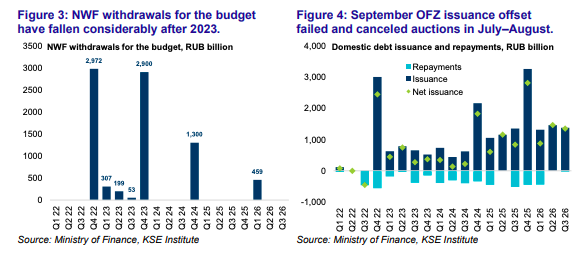
NWF withdrawals for the budget (left) and domestic debt issuance and repayments (right). Source: KSE Institute
NWF withdrawals for the budget came to only RUB460bn ($5.4bn) this year, all in the first quarter when oil prices were low, and the fund was not tapped at all in 2025. KSE estimates that at most RUB4.6 trillion ($54.5bn) could realistically be mobilised, including fiscal-rule FX purchases yet to be transferred, which would wipe out the buffer entirely. Treasury cash balances have fallen by RUB1.1 trillion since the end of 2025 to RUB8.6 trillion at the end of August and are nearing the level needed to smooth ordinary mismatches between revenue and spending; the think tank assumes only another RUB1 trillion can safely be drawn.
That leaves domestic borrowing, which ground to a halt over the summer. After strong issuance in February-May, the Finance Ministry cancelled the June 24 and July 8 auctions, sold just RUB9bn on July 1, rejected all bids on July 17 and suspended auctions indefinitely on July 20, the first such suspension since 2022. All four August auction days were lost.
On September 2 the ministry resumed issuance and placed RUB1.0 trillion ($11.8bn) of a new floating-rate OFZ at a 7.5% discount to par, a deal that coincided with RUB940bn ($11.1bn) of repo liquidity from the Central Bank of Russia (CBR), and banks then pledged almost the whole amount as collateral for CBR repos. Fixed-coupon auctions followed, with the longer bond sold on September 9 yielding 15.97%, up from 14.79% in May despite a lower key rate, and the September 23 auction clearing at weighted-average yields of 16.14-16.44%.
"Altogether, we see a mechanism of indirect monetary financing of the budget: CBR refinancing increases banks' capacity to absorb OFZ issuance, while government securities themselves provide collateral for repo borrowing," KSE wrote.
Banks hold RUB20.4 trillion ($241.6bn), or around 62%, of outstanding OFZs, with systemically important banks alone taking 55% of primary purchases since 2023. Non-residents' share has fallen from 19% in January 2022 to 3.1%, and households have absorbed only 1.4% of issuance since 2023. The banking system itself has swung from a liquidity surplus of about RUB1.6 trillion in May 2025 to a structural deficit of RUB3.0 trillion ($35.5bn) by mid-September, its largest since the post-invasion shock, as around RUB7.8 trillion has been withdrawn as cash since the start of the full-scale war. Bank borrowing from the CBR reached RUB7.4 trillion ($87.6bn) in late September, up 185% year on year, and the entire repo book now rolls over weekly.
Behind the healthy headline ratios, KSE sees mounting credit stress hidden by regulatory forbearance, including rules exempting defence-procurement borrowers from normal loss recognition. On the CBR's own measure, problem corporate loans reached 11.8% of the portfolio, or RUB11.5 trillion ($136.2bn), at the end of June, with RUB5.8 trillion uncovered by provisions or quality collateral. VTB (MOEX: VTBR) has estimated it needs RUB1.7 trillion ($20.1bn) of extra capital over five years, and its group capital adequacy stood at 10.7% on July 1 against a 10% minimum that rises to 10.75% in January. State defence bank PSB has had its charter capital nearly doubled to RUB427bn since June 2024.
The state is still pulling capital out of the sector: banks declared RUB912bn ($10.8bn) of dividends in July alone, and RUB425.1bn of Sberbank's record RUB850.2bn payout reached the budget on August 24. "The state needs banks to absorb more OFZ and more defense credit risk, yet it simultaneously extracts their capital as budget revenue," the report said.
KSE runs three scenarios. In a stress case with another prolonged halt to OFZ sales and a monthly deficit of RUB600bn ($7.1bn), buffers would be exhausted by June 2027. "Clearly, Russia cannot afford another prolonged interruption in domestic borrowing without jeopardizing its ability to fund the state," the authors wrote. Under Scenario 1, in which the ministry accepts higher yields, the CBR steps up repo support and net OFZ issuance runs at RUB300bn a month, Russia would run out of sufficient budget financing by early 2028, even after draining the NWF's liquid assets and cutting Treasury cash to potentially problematic levels.
Tax rises and spending cuts (Scenario 2) or coercive measures to force demand for OFZs (Scenario 3) could stretch the horizon considerably further, but at a cost. Spending cuts "would bring the war home to Russian society in a way that the government has gone to great lengths to avoid," KSE said, while coercion risks distorting the debt market and triggering a crisis of confidence. The tax hikes on passive income, windfall taxes on metals producers and higher dividend taxes for "unfriendly" investors in the 2027-2029 draft budget are "clearly insufficient but send a signal of what is to come", it added. The biggest downside risk is a reopening of the Strait of Hormuz that would knock down energy prices and accelerate the timeline.
The think tank urges Ukraine's allies to cut Russia's oil and gas revenue further, keep foreign investors out of the OFZ market - with the US using secondary sanctions against third-country institutions that buy Russian debt - and target the banks that absorb the most OFZs. It also calls for keeping CBR reserves immobilised, hindering sales of sovereign gold, setting a deadline for remaining foreign banks to exit Russia, easing legitimate private capital outflows and using strategic communications to challenge confidence in the Russian financial system.
The report builds on KSE's monthly digest earlier in September, which showed oil export revenue sliding to $13.8bn in July, and its June assessment that Russia's war economy was grinding towards a halt despite the oil windfall. Finance Minister Anton Siluanov has since conceded the 2026 deficit will exceed its initial target of RUB3.786 trillion but stay within 3% of GDP, a ceiling KSE's own lower-bound projection already comes close to.
Unlock premium news, Start your free trial today.

.jpg)
