
Russia leans on glide bombs to grind out gains at Kostyantynivka


Russia has increased its use of its powerful FAB glide bombs to enable infantry advances in and around the key Donbas “fortress city” of Kostiantynivka, the Institute for the Study of War (ISW) said in its July 29 campaign assessment. Russian forces are making slow but steady progress in Ukraine's Donetsk oblast Fortress Belt, which Russian President Vladimir Putin is fixated on taking as his military goals harden in the last few months.
Russian forces are using glide bombs to turn Kostyantynivka and other fortress-belt cities into rubble, say the milbloggers, destroying Ukrainian strongpoints and ground-control stations to let small infiltration groups enter and consolidate positions - a shift from the larger mechanised assaults Russia relied on earlier in the war toward small-group infiltration backed by airpower it cannot yet be denied. "Russian guided glide bomb strikes against Kostyantynivka are the main form of Russian successes in the area," the commander of a Ukrainian drone unit told ISW, calling them a major challenge for Ukrainian defenders.
The pattern is not new but is intensifying: Russia debuted glide-bomb-enabled assaults at scale to take Avdiivka in February 2024, then repeated the approach at Vuhledar in October 2024, Kurakhove in December 2024 and Toretsk in August 2025. Kostyantynivka, where Russian troops first infiltrated the city in June, is the latest fortress-belt settlement to face the same playbook. The playbook is identical to the capture of Pokrovsk in December, another key logistics hub supplying the Armed Forces of Ukraine (AFU) in the Donbas frontline.
ISW's own assessed control map, geolocated to July 29, shows Russian forces have infiltrated southeastern Oleksiievo-Druzhkivka along the H-20 highway and continue to hold infiltration areas across central and northern Kostyantynivka, even as Ukrainian forces maintain positions in the city centre and have not lost it outright despite Russian claims.
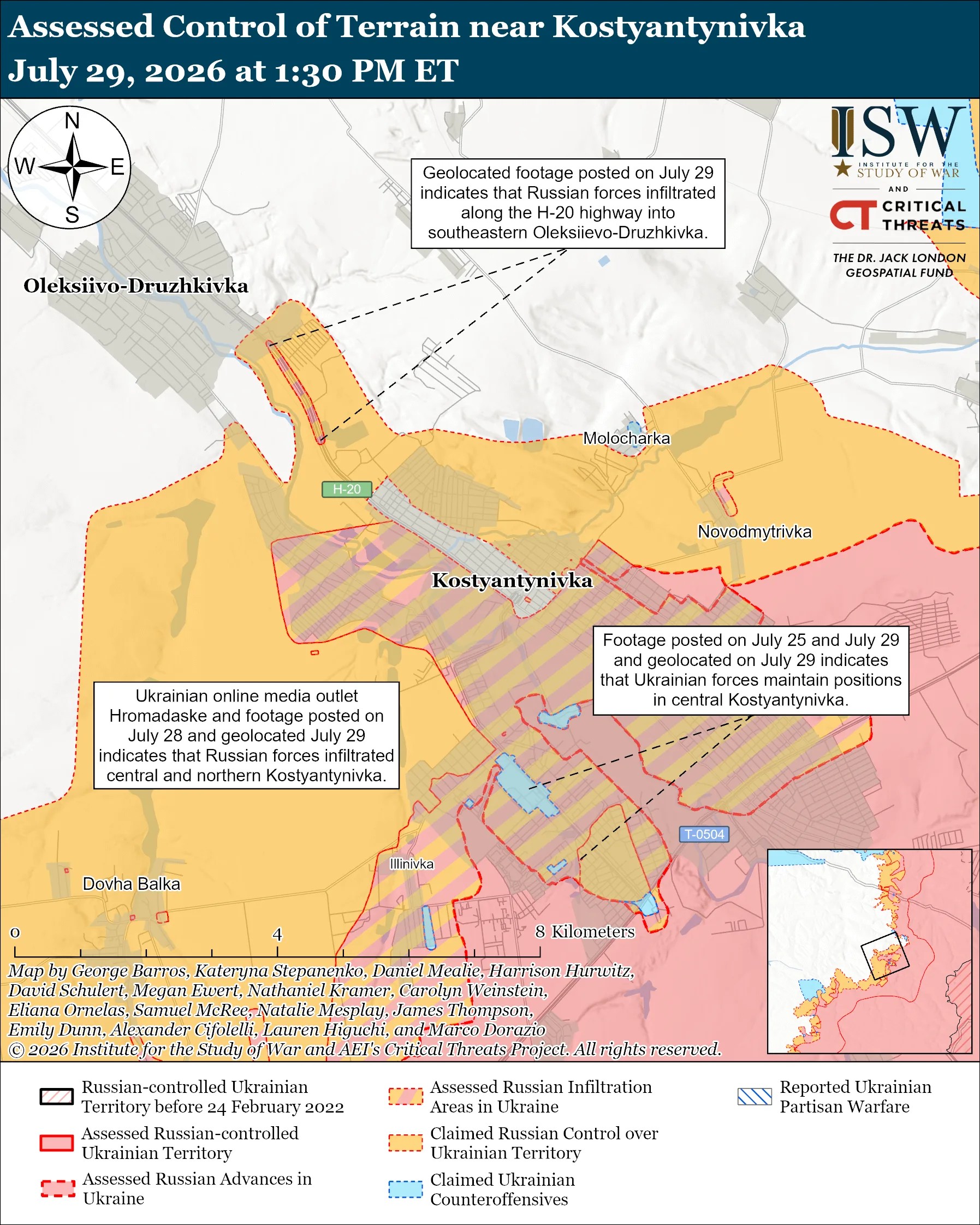
Assessed control of terrain near Kostiantynivka, July 29, 2026. Source: ISW/Critical Threats Project.
ISW frames Russia's reliance on glide bombs as a vulnerability as much as a strength: Ukraine has already degraded parts of Russia's ground-based air-defence network through a sustained suppression campaign since late 2025, and further attrition of Russian aviation would strip away the tactical advantage now driving the slow grind toward Kostyantynivka's fall. Fighting is expected to continue for several weeks as Russian forces try to consolidate the ground already taken through infiltration rather than a decisive breakthrough.
Unlock premium news, Start your free trial today.


