
Romania's rate cuts delayed until August 2027 - Raiffeisen


Romania's central bank will not cut interest rates before August 2027, Raiffeisen Research forecasts, as a fresh energy shock keeps inflation high and the economy shrinks this year.
In its Romania Economic Insights report published on October 28, the Vienna-based research arm of Raiffeisen Bank International pushed its call for the first cut back from May 2027. It expects the National Bank of Romania (NBR) to keep its policy rate at 6.5%, where it has been since August 2024, and to lower it to 5.75% by the end of 2027.
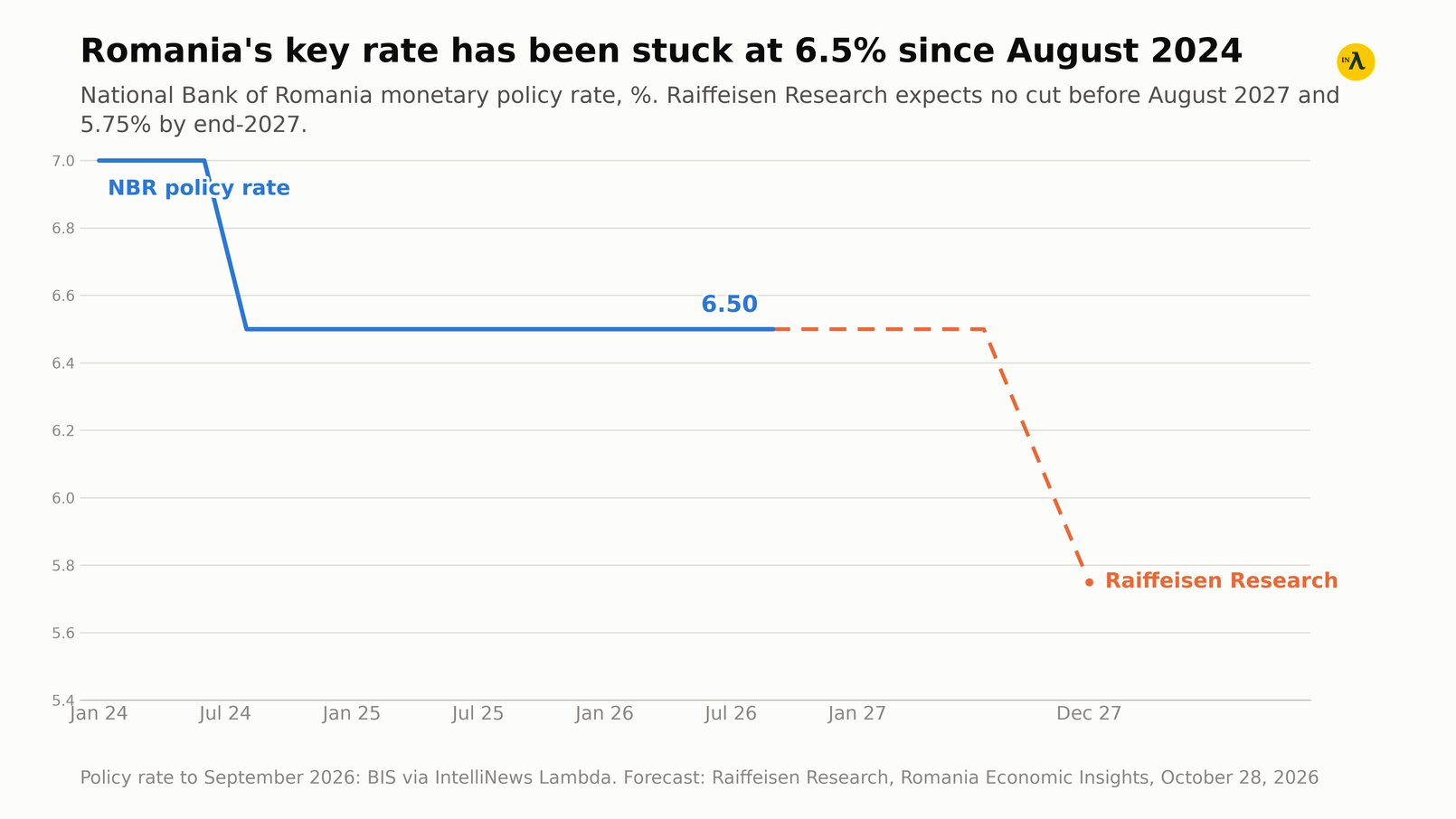
NBR monetary policy rate, %, January 2024 to September 2026, with Raiffeisen Research's forecast path. Source: BIS via IntelliNews Lambda; Raiffeisen Research
That leaves Raiffeisen more pessimistic about next year than ING or the government. It sees real GDP falling 0.5% in 2026, revised up from a 0.7% contraction after better-than-expected second-quarter data, and growing only 1.5% in 2027. ING Bank expects 2.2% growth in 2027 as consumption recovers, from the same 0.5% contraction this year. The government's own forecasting body, the National Commission for Strategy and Prognosis (CNP), sits in between: it has just cut its forecasts to a 0.4% contraction in 2026 and 1.7% growth in 2027, from 1% and 2.2% in December 2025.
| Forecaster | Real GDP 2026, % | Real GDP 2027, % | Date |
| Raiffeisen Research | -0.5 | 1.5 | October 28, 2026 |
| ING Bank | -0.5 | 2.2 | October 2026 |
| CNP (government) | -0.4 | 1.7 | October 2026 |
| CNP, previous forecast | 1.0 | 2.2 | December 2025 |
Source: Raiffeisen Research; ING Bank; National Commission for Strategy and Prognosis. IntelliNews
Inflation is what keeps the NBR on hold. Headline inflation fell to 6.6% in September from 10.4% in June, but only because last year's electricity price jump and VAT increase dropped out of the base. Fuel, electricity and gas prices kept rising, the war involving Iran and a drought that has cut the Danube's flow and Romania's hydropower output pushed energy costs up, and core inflation was still 6.1% in September. Raiffeisen expects 7.2% at the end of 2026, a very high rate in the first quarter of 2027 and an easing to about 4.3% by the end of next year.
The economy offers little relief. Raiffeisen says GDP fell 0.6% y/y in the first half of 2026, after a cumulative contraction of 1.4% over the previous two quarters; Eurostat records a 1.4% y/y fall in Q1 and a 1.9% fall in Q2 on its series, and Raiffeisen expects a weak second half, with output down 0.8% y/y in the third quarter. Household consumption has shrunk for four quarters as a two-year freeze on public wages and pensions ate into real incomes, while construction and EU-funded public investment held activity up.
That freeze has also done most of the work on the budget. Personnel spending fell to 7.6% of GDP in the third quarter from a peak of 9.9% at the end of 2024, and the cash deficit came to about 5.5% of GDP in January-September, according to Raiffeisen's seasonally adjusted estimate. It expects the full-year deficit to land around the 6.2% target. The Finance Ministry's draft budget revision published on October 29 edges that target up to 6.25%, or RON130.3bn (€24.4bn).
Next year is harder. Pensions are due to be indexed by 7.7% in January under current law, and public wages, frozen for two years in a period of very high inflation, will have to rise as well. The new cabinet's programme aims to cut the deficit to 5.2% of GDP in 2027 but does not yet say how. Raiffeisen expects consolidation to continue more slowly than planned, leaving a deficit of about 5.7% of GDP.
"In our view, restraining increases in public wages and pensions after a sharp decline in real terms over the past two years will be politically and socially difficult," Raiffeisen analysts Nicolae Covrig and Andreea-Elena Draghia wrote.
The politics make the arithmetic shakier. Prime Minister Luca Niculescu's minority government won its confidence vote on October 20 after a five-month crisis. The Social Democratic Party (PSD), the only party in the cabinet, holds 12 of its 18 posts but only 27.4% of the seats in parliament, and the National Liberal Party (PNL) and the Hungarian minority UDMR have promised to back it against no-confidence motions only until the end of February 2027, as long as fiscal discipline holds. The PSD, which favours higher wages and pensions, is already holding up the budget revision over claims of unpaid bills left by the previous government.
Raiffeisen's baseline assumes a stable government and credible consolidation, which it says would cut Romania's risk premium and help keep its investment-grade rating. If either slips, it warns, the first rate cut could come later than August 2027, or the easing could be smaller.
This article was produced with the help of IntelliNews Lambda analytical tool
Unlock premium news, Start your free trial today.


