
Romania’s PMI signals possible bottoming-out in manufacturing after years-long decline


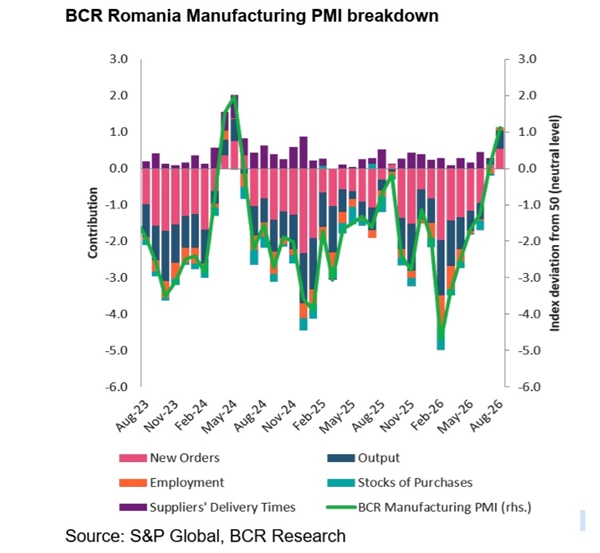
Romania’s Manufacturing Purchasing Managers’ Index (PMI, chart), compiled by BCR, rose to 51.1 in August from 50.1 in July, remaining in expansion territory for a second consecutive month. The increase was driven by stronger output and new orders, providing an early indication that the country’s prolonged manufacturing downturn may be close to bottoming out.
The return of the PMI above 50 may signal an end to the years-long industrial decline, but activity remains at historically weak levels. A genuine manufacturing recovery would require stronger and more sustained improvements in purchasing managers’ assessments. Improving manufacturing conditions in Germany provide a positive, although still cautious, signal for external demand, particularly given the close links between Romanian and German industrial companies.
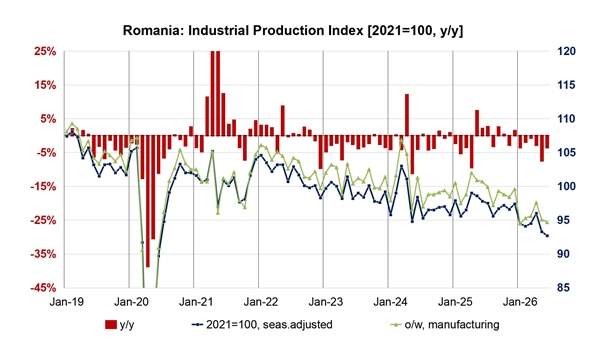
Manufacturing output in Romania fell to about 95%-96% of its 2021 annual average in the first half of 2026 (chart), from levels close to 100% previously, reaching levels not seen since the pandemic lockdowns. The sector has contracted for four consecutive years following the post-pandemic recovery, and a possible bottoming-out in the second half would not be sufficient to prevent a third consecutive annual decline in 2026.
“Weak hard data from the first half of the year suggest that Romanian manufacturing output is heading for a fourth consecutive annual contraction,” BCR said in its release accompanying the August PMI data.
BCR expects higher defence spending to provide some support to industrial activity across Europe, although the recovery is likely to remain uneven as geopolitical uncertainty continues to weigh on the regional outlook.
Developments in Germany support cautious optimism.
German manufacturing has shown stronger momentum, with the country’s PMI rising to 54.3 in August from 52.2 in July. German GDP increased 0.7% quarter on quarter in the second quarter, although it remained 0.3% below the level a year earlier.
The improvement broadly mirrors the Romanian PMI trend, although Romania’s industrial decline has been considerably steeper, with manufacturing output down 4.5% year on year in the second quarter (although a 0.7% q/q advance in the quarter sent a positive signal). The strong presence of German industrial groups in Romania makes developments in Germany particularly relevant for local manufacturing.
However, the increase in Germany’s PMI was led by intermediate goods, suggesting that part of the expansion may still reflect safety stockpiling amid tight supply conditions, according to Phil Smith, economics associate director at S&P Global Market Intelligence, cited by Reuters. Germany’s services PMI, meanwhile, fell to 48.5 in August from 49.8 in July.
BCR concluded that the improvement in German manufacturing represented £a positive, although cautious, signal for external demand conditions relevant to Romania."
Romanian manufacturing orders improve, but the picture remains mixed.
Romanian manufacturers linked the August increase in production to stronger order volumes and an overall improvement in demand. New orders continued to increase, supported by promotions and successful sales negotiations, although the rate of growth remained modest.
Export orders also returned to growth for the first time in four months, recording the strongest increase in the survey’s three-year history. Most companies, however, reported no change in export orders from July.
On the downside, business confidence about the next 12 months fell to a new record low in August, following another record low in July, reflecting continued concerns about Romania’s economic and geopolitical environment.
Unlock premium news, Start your free trial today.


