
Renewables met 100% of global electricity demand growth in 2025 that will speed America's decline


For the first time in history, renewables covered all new global electricity demand in 2025, and the oil shock of the Iran war will only accelerate the move away from the reliance on fossil fuels, according to a report by Ember.
The milestone is important. Not just in the battle to halt temperature rises, but increasingly renewable electricity generation is taking on a geopolitical power component that will lead to the decline of the US as global superpower.
The geography of where this renewable expansion is happening matters as much as the fact that it happened at all — and it matters directly for the global balance of power.
China contributed more than half of the entire global increase in solar generation in 2025, adding 336 TWh — a 40% rise y/y. The US recorded the second-largest increase globally at 85 TWh, which is less than a quarter of China's contribution. The US number is large as it is the world’s largest economy, but in proportional terms it punches below its weight.
In the first half of 2025, China added more than twice as much solar capacity as the rest of the world combined, accounting for two-thirds (67%) of global solar installations. India installed more new solar capacity than the US in 2025 for the first time.
China accounts for nearly 60% of global renewable capacity growth and has already achieved its 2030 wind and solar target years ahead of schedule, according to the International Energy Agency (IEA). By contrast, the IEA has revised its US renewable growth forecast for 2025-2030 down by almost 50%, reflecting the earlier phase-out of federal tax credits, new import restrictions, the suspension of offshore wind leasing, and restrictions on permitting onshore wind and solar on federal land.
The US generated around a quarter (26%) of its electricity from renewables in 2025 — against China's combined wind and solar share of 22% of a vastly larger grid, and the EU's 47.3%.
Chinese companies now lodge approximately three-quarters (75%) of global clean energy patent applications — up from just 5% in 2000. Cheap Chinese technology has enabled 25% of emerging markets to leapfrog the US in end-use electrification, and 63% have already surpassed it on solar generation share. The clean energy race, in other words, is not one the US is currently winning — and under the Trump administration's policy agenda, it is actively stepping back from the field. That is a mistake.
Fossil fuels added nothing
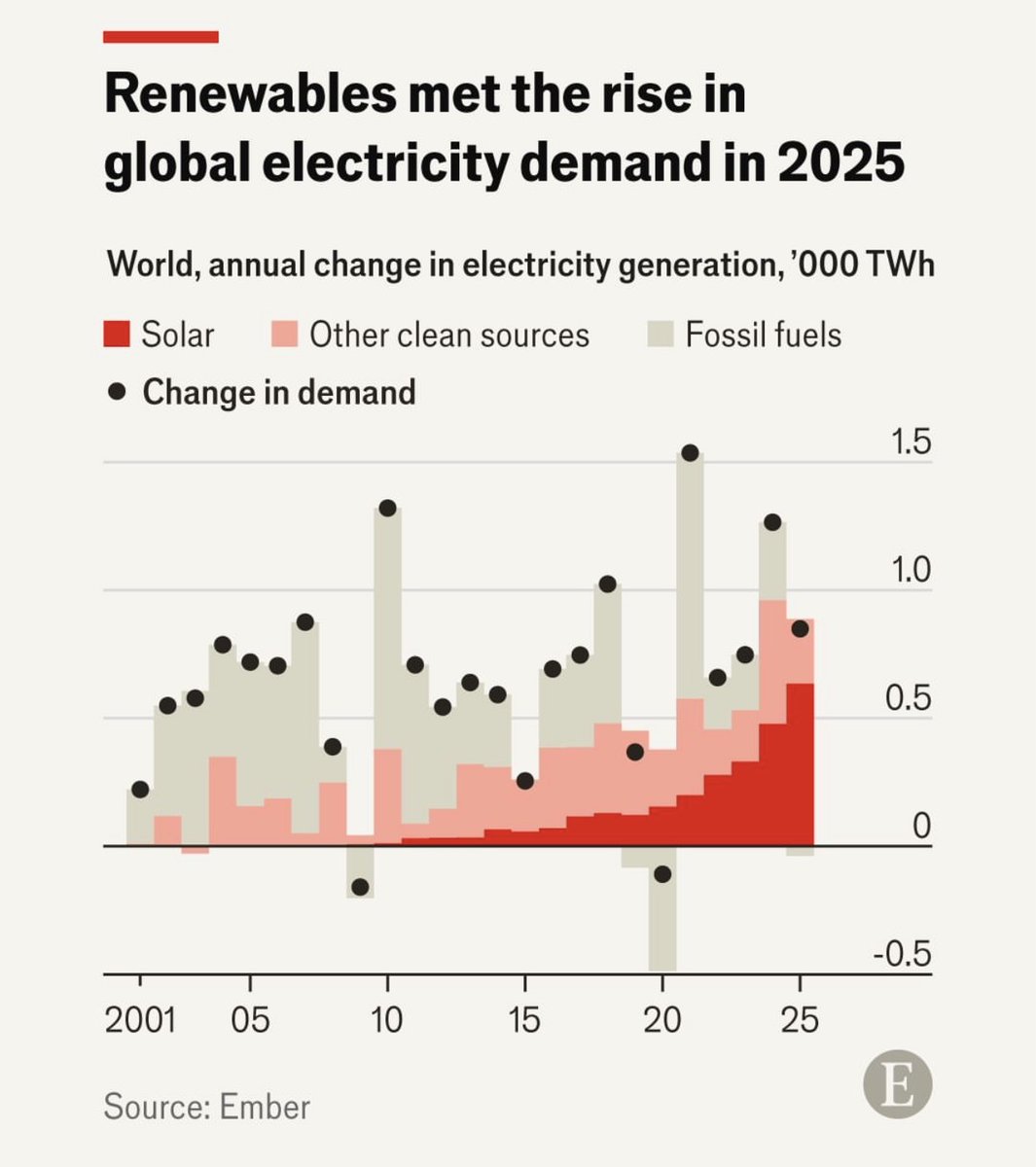
Fossil fuels added nothing net to the electricity growth equation. Clean power generation, including nuclear power, grew by 887 terawatt-hours in 2025, slightly exceeding global electricity demand growth of 849 terawatt-hours, according to Ember's Global Electricity Review.
Solar is the main driver of the uptick, meeting three-quarters of new demand, while solar and wind combined covered 99% of it. As a result, fossil fuel electricity generation fell by 0.2% — making 2025 only the fifth year this century in which fossil power generation did not grow.
The share of renewables in the global electricity mix crossed one-third for the first time, reaching 33.8%. For the first time in over 100 years, renewables surpassed coal as a source of global electricity generation.
Solar PV was the single largest contributor to growth in global energy supply in 2025, accounting for more than 25% of the increase — the first time on record that a modern renewable source has led global primary energy supply growth, according to the IEA's Global Energy Review 2026.
Since 2015, solar power generation has increased more than tenfold and roughly doubles every three years. In 2001, almost all electricity demand growth was met by fossil fuels. By 2025, solar alone was carrying the load.
"We have firmly entered the era of clean growth," said Nicolas Fulghum, lead analyst at Ember. "We're coming from a period over the last few decades where new electricity demand growth meant growth in fossil generation. We're now moving into a world where that's no longer the case."
Age of Electricity
Faith Briol, the head of the IEA has dubbed this century as the “Age of Electricity.” China has emerged as the global green energy champion, but it is not investing into renewables simply as a way to make money – although it does make a lot of money – but it’s also a geopolitical long-term strategy as becoming the world’s leading electrostate also frees it from the petrodollar system and undermines the US’ stranglehold on the global economy as America’s power is so dependent on the fact that the energy market is run on the dollar making the greenback a default reserve currency. The less oil you import, the fewer dollars you need.
Over the past three years, China’s rapid electrification of transport has begun to materially erode oil demand, with electric vehicles now displacing on the order of 0.4–0.5mn barrels per day (b/d) of gasoline annually, rising to roughly 0.5–0.55mn b/d in 2025–26 as the EV fleet expands.
Taken together with broader electrification trends, analysts estimate that China’s EV fleet is already offsetting more than 1mn b/d of oil demand from a total of around 12mn b/d , equivalent to around 10-15% of the country’s transport fuel consumption. Transport fuel use in China has already plateaued, and in some segments begun to fall, despite continued economic expansion.
US President Donald Trump’s biggest strategic blunder from attacking Iran and causing the worst oil crisis in history is probably to accelerate this process.
Battery revolution
The green energy transformation is being helped by the battery revolution, which smooths the erratic generation of solar and wind power, so that renewables can store energy for when it is needed most, not just produce it when conditions are right. While grid-level eight-hour batteries are still missing that would complete the revolution, battery technology is progressing very fast. And more recently the Chinese innovations in the production of a sodium-ion battery promises to close the gap by providing sufficient and cheap grid-level storage capacity on an industrial scale in the coming years.
Battery costs fell 45% last year while storage capacity grew 46%, allowing solar power to operate beyond peak daylight hours. Ember estimates that the battery capacity added in 2025 can shift 14% of solar generation from midday to other parts of the day — a structural change that begins to address one of the central problems: solar's inability to act as a baseload source of power during peak demand in the early evening after the sun has gone down.
Alexis Abramson, dean of the Columbia University Climate School, said the shift is real but incomplete. "We've really crossed this important threshold that clean energy now can meet rising demand economically and at the same time really help address national security concerns. The next challenge is really turning that into a steady decline of fossil fuel use as well."
The half it doesn't solve
The same year that renewables achieved this historic milestone, the Iran war closed the Strait of Hormuz and reminded the world with brutal effect that electricity generation and liquid fuels are two entirely different problems — and that renewables solve only one of them.
The Hormuz closure cut approximately 20% of global seaborne oil supply, pushed Brent crude above $120 a barrel, grounded tankers across the Persian Gulf, triggered force majeure declarations from QatarEnergy, and sent fertiliser prices surging more than 50%.
None of those consequences has anything to do with electricity generation. They were consequences of the world's dependence on liquid hydrocarbons for shipping, aviation, road freight, petrochemicals, fertiliser production and heating — sectors where electrification remains nascent, costly or technically irrelevant.
The IEA notes that global oil demand rose by 0.7% in 2025, in line with its projections, with electric vehicle growth constraining road fuel demand still marginal.
The overall liquid fuels system remains overwhelmingly fossil-dependent. The 20mn electric cars sold in 2025 — a record — displaces a meaningful volume of petrol consumption. But that does nothing for bunker fuel, jet fuel or the natural gas feedstock that makes the world's fertiliser.
The juxtaposition is not a reason to diminish what renewables achieved in 2025. It is a reason to be precise about what was achieved and how far there still is to go to complete the green transition revolution.
The electricity system is undergoing a genuine structural transformation, with renewables now growing faster than demand now and fossil fuel power generation clearly at the start of what will still be a very long and too slow decline. China's fossil electricity generation fell 0.9% in 2025; India's fell 3.3%. But these declines have still only just crested the brow of the fossil dependency hill.
Oil, gas and coal together still supply more than 80% of the world's primary energy. The Hormuz closure did not affect electricity grids — it affected everything else. And everything else, for now, still runs on fossil fuels.
Unlock premium news, Start your free trial today.

