
Putin proposes Ukraine peace summit with Trump and Xi that leaves Zelenskiy out


Russian President Vladimir Putin has proposed meeting Donald Trump and Xi Jinping next month to settle the war in Ukraine. Volodymyr Zelenskiy has not been invited, The Wall Street Journal reported on October 18.
Putin floated the idea during his October 9 phone call with Trump, the same call that produced the controversial diesel deal for the US to buy Russian fuel and bring prices down at the pump ahead of next month’s midterm elections, a former Russian intelligence officer briefed on the matter told the paper.
The Kremlin wants the three leaders to meet on the sidelines of the Asia-Pacific Economic Cooperation (APEC) summit in Shenzhen on November 18-19. Beijing has signalled it would not object if Trump agrees.
"There is no clear understanding yet regarding the meeting itself or its potential agenda, although all three parties acknowledge the hypothetical possibility of such a meeting taking place," Kremlin spokesman Dmitry Peskov told the paper. A senior US official said Trump had not agreed to the summit but could be receptive to it.
The proposal comes amid mounting US pressure on Kyiv over its refinery strikes. Trump has demanded that Zelenskiy halt Ukraine’s bombing of Russia’s refineries and unilaterally announced an “energy ceasefire” on October 11, although it quickly became apparent that neither the Kremlin or Bankova had agreed to it – or even knew of its existence. Zelenskiy held off bombing refineries for three days but then resumed again after Russia ignored the deal. This weekend, Ukraine launched a new massive drone strike against the oil port in St Petersburg in defiance of Trump’s wishes further undermining the already bad relations between Bankova and the White House.
Washington has responded by throttling intelligence sharing and access to the Starlink communications network, and slowed crucial Patriot interceptor deliveries; intelligence sharing has since resumed, Zelenskiy said, although much confusion remains over the state of the service. Trump has also put on hold the Graham Act's hellish sanctions on Russia, all while demanding that Ukraine stop its drone campaign against Russian refineries. With US diesel prices at record highs and the midterm elections on November 3, Trump wants the strikes stopped, and Putin is offering him a format in which Ukraine has no seat at the table.
Zelenskiy accused Trump of pushing Ukraine to capitulate to Russia in an interview with Bloomberg on October 18, escalating a week-long row with the US president.
Trump answered in a post on Truth Social the same day, defending his decision to hold back the sanctions bill and turning on the Ukrainian leader.
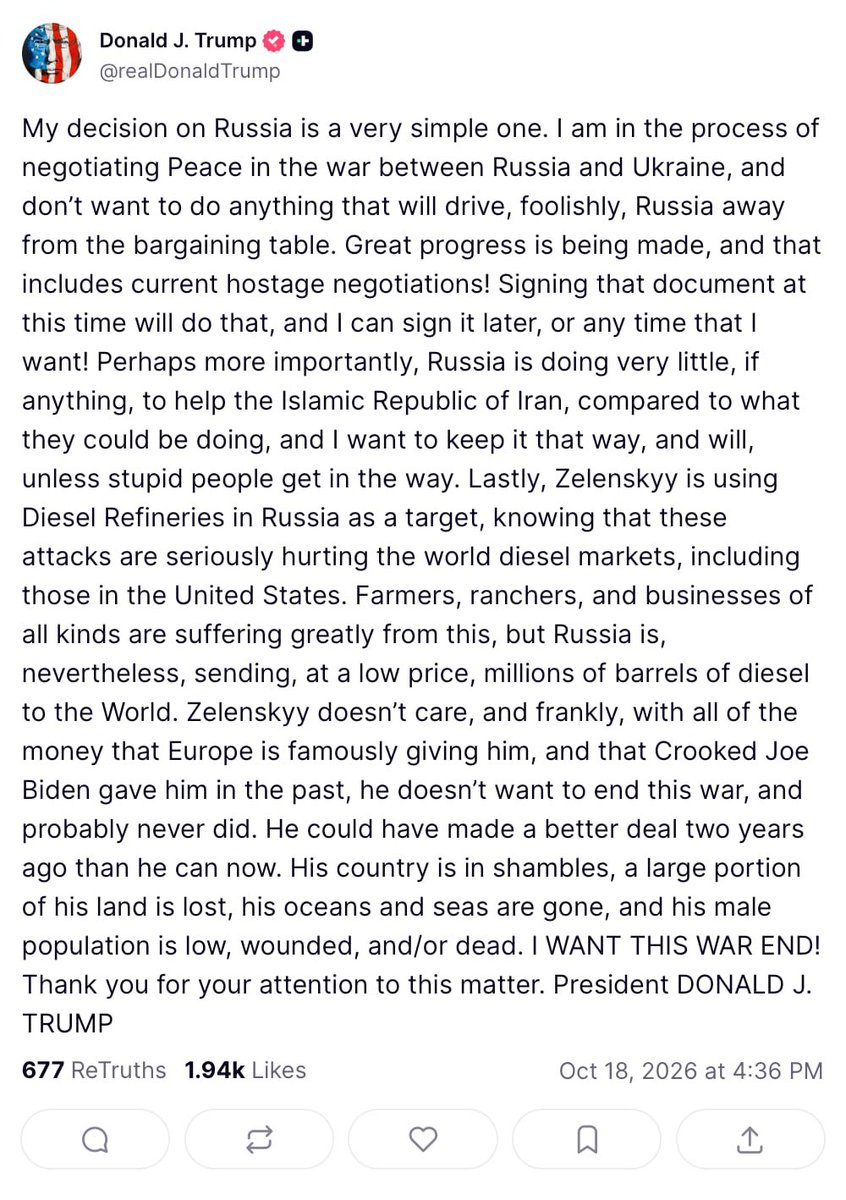
Trump's Truth Social post of October 18 on Russia, Ukraine's refinery strikes and Zelenskiy. Source: Donald J. Trump on Truth Social
"Zelenskyy is using Diesel Refineries in Russia as a target, knowing that these attacks are seriously hurting the world diesel markets, including those in the United States," Trump wrote. "Zelenskyy doesn't care, and frankly, with all of the money that Europe is famously giving him, and that Crooked Joe Biden gave him in the past, he doesn't want to end this war, and probably never did.”
In the last week the two presidents have traded increasingly vitriolic barbs. Trump called for Zelenskiy replacement as president after he very publicly criticised the diesel deal as a “betrayal” of Ukraine and followed up by calling Zelenskiy a “dictator” in a TV interview. Zelenskiy has since accused Trump of actively working towards Ukraine’s defeat in the war.
Trump added in this weekend’s post that Russia was "doing very little, if anything, to help the Islamic Republic of Iran" and that he wanted to keep it that way.
No missiles
Zelenskiy told Bloomberg that the US is now supplying just 12 Patriot interceptors a month, about a quarter of the rate under former president Joe Biden, and that Kyiv has to pay for them. Washington has approved only part of the missiles European allies have already paid for under Nato's Prioritised Ukraine Requirements List (PURL) scheme. "The American side approved the delivery of only some of them, but not the rest. And this is not a technical issue," he said. It has also been reported that Secretary of War Pete Hegseth has ordered Europe not to share what interceptors it has left with Ukraine, potentially cutting the Armed Forces of Ukraine (AFU) off completely from the only weapons that can stop Russia’s ballistic missile.
He has offered a trade, which the US has so far rejected. "My latest model was: We don't target Russian diesel, you give us missiles for Patriot systems to protect our facilities. But they just want us to stop attacking diesel," Zelenskiy said. The White House has already refused Kyiv any reward for halting the strikes, and Ukraine's interceptor missiles run dry as Russia's winter campaign intensifies. Coupled with a new class of Geran-5 jet powered drones, Ukraine is currently almost totally without effective air defences just as Russia scales up its winter bombing campaign.
The intelligence tap has been turned back on, for now. Zelenskiy said on NBC's Meet the Press on October 18 that the US had resumed intelligence sharing after blocking it for a period. The Washington Post reported on October 15 that US officials had warned Kyiv the flow would stop if Ukraine kept hitting Russian oil refineries, and Ukraine received no early warning of Russian ballistic missile launches on Kyiv on several occasions since October 12.
No satellite links, gas back on
Satellite links are the other pressure point. Ukraine has no access to the Pentagon's Starshield network, the military adjunct to the commercial Starlink communications network, and since October 14 Starlink terminals in Ukraine have shut down at speeds above 160 km/h, cutting out the interceptor drones Kyiv uses against Russia's jet-powered Shaheds, NV reported.
Ukrainian tests in EU countries ran the same terminals at more than 180 km/h. "The restrictions apply on Ukrainian territory, but they do not apply in EU countries. This means it is a planned operation," Zelenskiy said. US officials deny that Washington ordered any restriction.
US envoys Steve Witkoff and Jared Kushner are meanwhile pressing Ukraine and its European allies to accept the resumption of Russian gas transit through Ukrainian pipelines as part of a peace settlement, The New York Times reported. German officials pushed back hard at talks in Florida. Zelenskiy spoke to the two envoys on October 18 and said a face-to-face meeting with Trump's team could take place as early as this week.
Trump has made it clear from the start that he wants to do business with Russia. Zelenskiy reported earlier this year that there is a so-called Dmitriev package of deals worth an astonishing $12 trillion on the table. In addition to the gas project, the US envoys also suggested that some $100bn of Russian frozen assets be released and used to fund a US-Russia joint venture fund – a proposal rejected out of hand by Brussels.
Winter campaign
On the ground, Russia is trying to freeze Ukraine into submission as the heating season begins. Russian forces have massively scaled up strikes on what remains of Ukraine's energy and oil and gas facilities hitting them 76 times since Trump declared an "energy ceasefire" on October 11, Zelenskiy said on October 18. Russia has launched nearly 2,700 strike drones, 1,700 guided bombs and 66 missiles in the past week, most of them ballistic. Overnight strikes on substations in the Odesa, Khmelnytskyi, Vinnytsia and Zhytomyr regions left tens of thousands of families without power as of October 18.
Ballistic missiles hit Kyiv on the nights of October 18 and October 19, killing at least one person in the first attack, the Kyiv Independent reported. A hospital was damaged in the second attack, and missile debris struck a 25-storey residential block, journalist and former presidential spokeswoman Iuliia Mendel reports. Pro-Russian military bloggers claimed strikes over the weekend also hit the Zaporizhstal steel mill and the Zaporizhtransformator plant in Zaporizhzhia and a metals plant in Kryvyi Rih.
Russia has already reduced Ukraine’s generation capacity from 54GW pre-war to 12GW as of July, creating a 5-6GW deficit, but the recent campaign has taken out around a quarter of the remaining capacity and has begun to target key substations linking what remains of the nuclear power generation capacity that link these power stations to the grid.
A Russian plan intercepted by Ukraine, reported by The New York Times on October 15, aims to isolate Kyiv, Kharkiv and Odesa without electricity, heat and water this winter, using about 70 ballistic missiles, 720 long-range drones and 150 guided bombs. Kyiv's three combined heat and power plants have already lost more than half their pre-war capacity of about 1.3 GW.
Despite being now completely responsible for Ukraine’s funding and military support, the EU has also not been invited to the mooted summit and without a rapporteur is currently playing no role in proposed peace talks whatsoever.
Unlock premium news, Start your free trial today.

