
New START missile treaty expires


United Nations Secretary-General Antonio Guterres called the expiration of the New START missile treaty on February 4 a “grave moment” for international peace and security and urged Russia and the US to negotiate a new nuclear arms control framework.
New START agreement ran out at midnight on February 4, the last of the Cold War era security guarantees in effect, removing limits on the number of strategic nuclear warheads that the US and Russia can deploy, and the deployment of land- and submarine-based missiles and bombers to deliver them.
The Kremlin said that it assumes that the parties to the treaty are “no longer bound by the agreement’s obligations and are free to decide on their next steps,” the Russian Foreign Ministry stated.
"In the current circumstances, we assume that the parties to the New START are no longer bound by any obligations or symmetrical declarations in the context of the treaty, including its core provisions, and are in principle free to choose their next steps. In doing so, the Russian Federation intends to act responsibly and in a balanced manner, developing its policy in the field of strategic offensive arms on the basis of a thorough analysis of the US military policy and the overall situation in the strategic sphere," the statement said.
Analysts said the failure to renew the deal clears the way for a new nuclear arms race that will also promote nuclear proliferation to emerging economies that currently don’t have them.
A renewal deal was signed in 2021 during former US President Joe Biden’s first week in office with Russian President Vladimir Putin.
"For the first time in more than half a century, we face a world without any binding limits on the strategic nuclear arsenals of the Russian Federation and the US of America – the two States that possess the overwhelming majority of the global stockpile of nuclear weapons," Guterres said in a statement.
He said the unwinding of the arms control infrastructure "could not come at a worse time – the risk of a nuclear weapon being used is the highest in decades… The world now looks to the Russian Federation and the US to translate words into action," Guterres said. "I urge both states to return to the negotiating table without delay and to agree upon a successor framework that restores verifiable limits, reduces risks, and strengthens our common security."
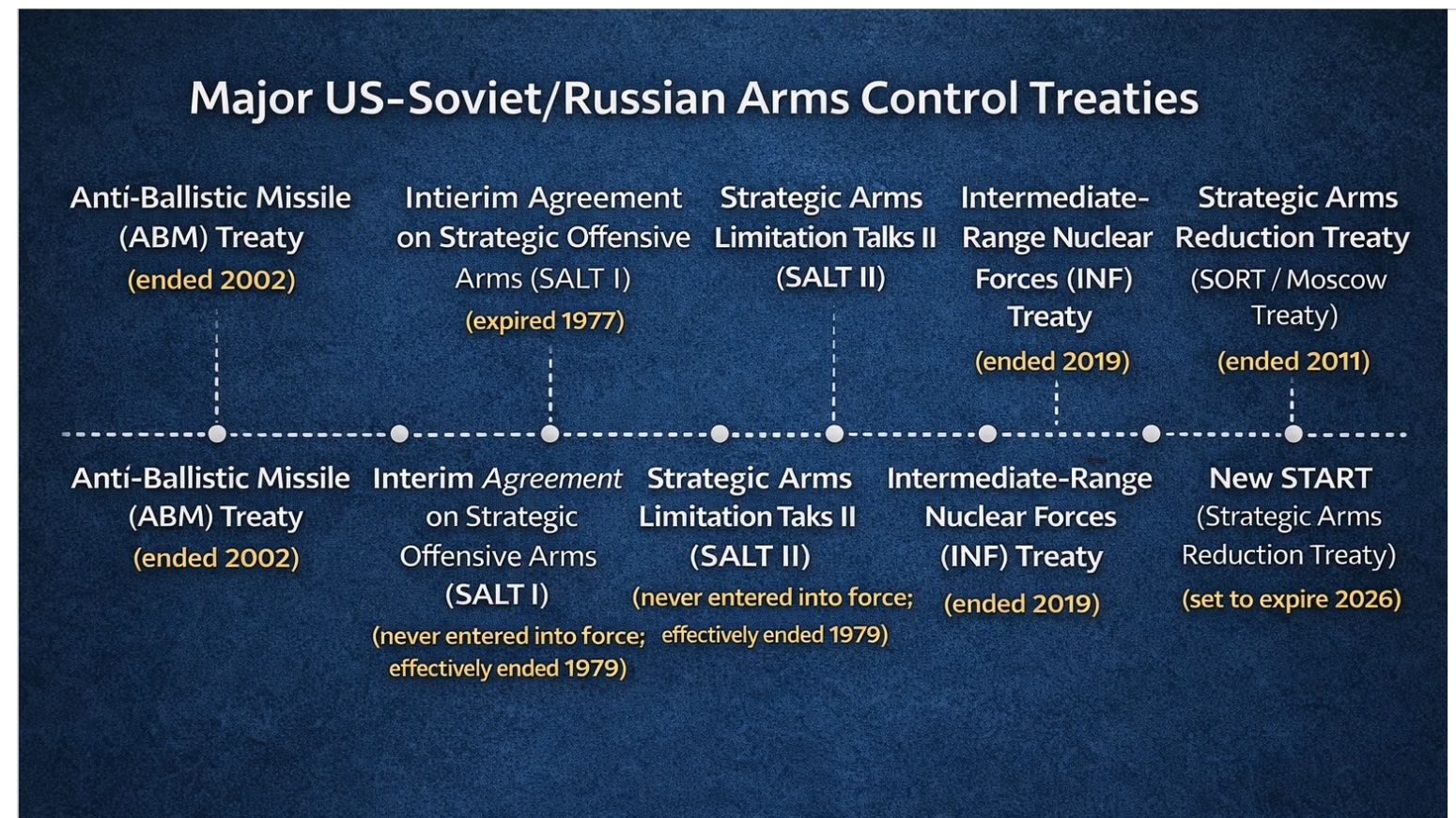
Since former US President George W Bush unilaterally withdrew from the ABM treaty (Anti-Ballistic Missile Treaty), that was the first deal to be signed between Richard Nixon and Soviet leader Leonid Brezhnev in 1972, the US and Russia have withdrawn or cancelled all of the missile agreements that underpinned security during the Cold War.
Putin has made it clear that he would like to put all Cold War-era missile agreements back in place and as soon as the New Start deal was signed, the Kremlin suggested starting talks on reviving the Intermediate-Range Nuclear Forces Treaty (INS Treaty) that was cancelled in 2019 during president Donald Trump’s first term in office.
Missiles stockpiles
Early in his presidency, Trump also said that he would like to see the number of nuclear missiles reduced, but the White House has refused to negotiate with Russia on a renewal of the START treaty unless China also participates in the deal.
The US and Russia maintain by far the largest stockpile of nuclear missiles with an estimated 5,580 and 5,244 respectively, but China has at least 500 and is adding to that number aggressively.
Summary Comparison (2024 est.)
|
|
|||
|
Country |
Total Warheads |
Deployed Strategic |
ICBMs & SLBMs |
|
Russia |
~5,580 |
~1,710 |
~400–450 |
|
US |
~5,244 |
~1,770 |
~400+ ICBMs + 14 SSBNs |
|
China |
~500–600 |
~410 |
~350+ launchers |
|
source: IntelliNews |
|||
Beyond the US, Russia and China, six other countries possess nuclear weapons, though their arsenals are considerably smaller.
France maintains an estimated 290 warheads, primarily deployed on submarine-launched ballistic missiles and air-delivered systems. The UK possesses around 225 nuclear warheads, with a continuous at-sea deterrent based on Trident-armed submarines. Pakistan and India have roughly 170 and 164 warheads respectively, and both continue to expand and modernise their arsenals with new delivery systems, including tactical and long-range missiles. Israel, which has never officially confirmed its nuclear status, is believed to hold approximately 80 to 90 warheads, potentially deliverable by aircraft, ballistic missiles and possibly submarines. North Korea, the newest and least transparent nuclear power, is estimated to have assembled 50 to 60 warheads, with active production of fissile material suggesting it could possess significantly more in the near future.
The original START treaty (START I) was first signed on July 31, 1991, by US President George H. W. Bush and Soviet President Mikhail Gorbachev. It was negotiated during the 1980s and was part of the broader arms control efforts of the Cold War era. In the post-Soviet-era it was then renewed in Prague in 2010 by then-US President Barack Obama and Russian President Dmitry Medvedev to much fanfare.
The treaty limits each country to no more than 1,550 deployed strategic nuclear warheads and 700 deployed missiles and bombers. It also allows for mutual on-site inspections and data exchanges to verify compliance — measures that arms control experts say are vital for maintaining transparency and reducing the risk of miscalculation. The agreement was extended for five years by Biden, who has also long been a proponent for restarting the arms controls.
Russia suspended, but did not cancel, its participation in the START treaty after sanctions were imposed on it in 2022, but the Kremlin has held the door open to restarting and reimposing all the Cold War security deals, should a ceasefire agreement be reached with Ukraine and its Western allies.
While the mutual inspections of nuclear facilities were suspended in August 2022, the Kremlin has been sticking to the provision that Russia keep its fleet of nuclear-enabled long-distance bombers visible to satellites by parking them out in the open on airfields, albeit very distant from the Ukrainian frontline. That went wrong when Ukraine smuggled a truck full of drones deep into Siberia and destroyed nearly a dozen irreplaceable bombers in Operation Spiderweb in June last year.
The Russian Ministry of Foreign Affairs blamed the White House for the failure to reach an agreement on renewing the deal. Putin had suggested a temporary extension for one year to give both sides more time to negotiate a new deal.
According to the ministry, Russia did not receive a formal response to its proposal to comply with the New START limitations. It said that, “no message is a message in itself.”
“Public comments from the American side also give no reason to conclude that Washington is ready to follow the course of action in the field of strategic offensive arms proposed by the Russian Federation. In fact, it means that our ideas have been deliberately left unanswered," the ministry said in a statement, TASS reports.
Russian diplomats added that this US approach to Russia's New START initiative is misguided and regrettable. "From a practical point of view, our country considers such developments as a fact that must be taken into account when determining further Russian policy in this area," the ministry said.
The ministry suggested that Russia was willing to enter into a new arms race as a result of the end of the Cold War security infrastructure. Russia remains ready to "take decisive military-technical measures to counter potential additional threats to the national security,” the MFA said, but held the door open for new talks.
"At the same time, our country remains open to seeking political and diplomatic ways to comprehensively stabilize the strategic situation on the basis of equal and mutually beneficial dialogue solutions, if the appropriate conditions for such cooperation are shaped ," the ministry concluded.
Beijing has no plans to join nuclear disarmament talks at this stage the Chinese Ministry of Foreign Affairs said in a statement.
"China’s nuclear forces are at a different level compared with those of the US. At this stage, China cannot participate in negotiations on nuclear disarmament," according to Chinese Foreign Ministry Spokesman Lin Jian. "China has consistently advocated that nuclear disarmament should advance in accordance with the principles of maintaining global strategic stability."
Unlock premium news, Start your free trial today.


