
Nato's new €70bn Ukraine pledge repackages aid already promised


Nato pledged to provide Ukraine with €70bn ($80bn) in military equipment, assistance and training this year during the Ankara Nato summit on July 8, with a commitment to match that sum in 2027 — but little of the money is new.
The pledge was set out in a joint declaration issued at the close of the alliance's summit, adopted by consensus by all 32 member states.
"For 2026, Allies pledge €70bn in military equipment, assistance and training for Ukraine and affirm their sovereign commitments to sustaining at least equivalent levels in 2027," the statement read.
The first tranche of the EU’s €90bn loan for Ukraine of €3.2bn was received earlier this month and $15bn in international financial assistance in June. That has boosted its international reserves to a comfortable $51.3bn, solidifying Kyiv’s finances for the rest of this year. Since the start of the war the EU has sent a total of €215bn in budget and military support to Ukraine.
"A significant part of these funds is aimed at replenishing reserves, which made it possible to resume their growth," the NBU reported.
But behind the headline number, little of the €70bn package is new. Most of it consists of commitments already made rather than fresh cash. Of the total, €30bn is part of the €90bn loan agreed in December that was already earmarked for Ukrainian defence spending. The remaining €40bn is to be met through bilateral support from other allies, and largely reflects pledges first made at Nato's 2024 summit in Washington, according to Reuters and other reports.
That means almost none of the announced €70bn is new money. Current EU and bilateral commitments fall short of the mark, leaving Ukraine’s funding in 2027 and beyond in doubt.
Recycling previously made pledges matters because the two-year total of roughly €140bn is not expected to be covered in full by existing programmes. The €50bn shortfall from estimated needs for the next two year Ukrainian budget was two thirds covered by December’s €90bn loan but it was always intended to raise the missing money from the other non-European members of the G7. Those countries have yet to commit to making more funding available for Ukraine.
The joint statement did add some clarity to exactly which country has committed to how much. The US has sent no money to Ukraine since US President Donald Trump took over and will not participate in this latest funding pledge either. That has left Europe, Canada and Japan to shoulder the lion’s share of the burden. The declaration's denomination of aid priced in euros rather than dollars was read in Ankara as a deliberate signal that Washington remains out of the game, despite Trump’s promise to grant Ukraine a license to make Patriot missiles.
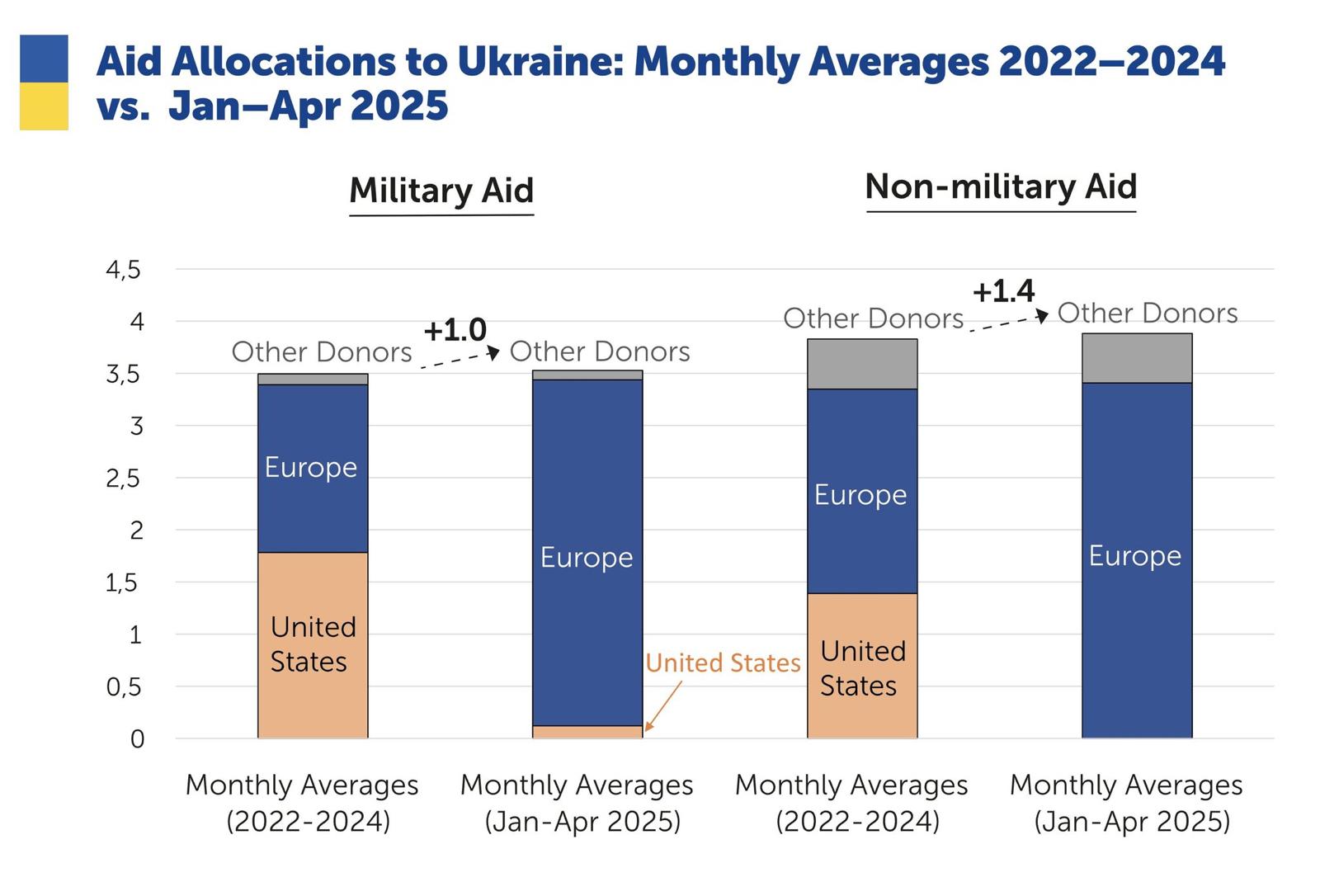
The statement said that European allies and Canada, "now finance the vast majority of security assistance to Ukraine through bilateral and multilateral means." Support must be "equitable, predictable, and sustainable in the long-term."
What new money there is, is increasingly channelled into hardware and, above all, air defence — the overriding theme of this year’s Nato summit. Ukrainian President Volodymyr Zelenskiy spent all his time in Turkey shuttling between nearly 20 bilateral meetings, trying to scrounge up more interceptor ammo to counter Russia’s relentless missile and drone attacks.
During the two-day event, Russian missile strikes on Kyiv killed at least three people and wounded 14, underscoring Zelenskiy's case for more interceptors. As IntelliNews reported, while Ukraine has mounted a spectacular and effective long-range drone campaign against Russia’s oil refineries that has caused a country-wide fuel crisis, in the drones vs missiles arms race, Russia has the overwhelming advantage. As Ukraine runs desperately low on interceptor missiles, Ukraine’s skies are once again open to Russian missile attacks. On the last day of the summit, Russia launched 29 missiles against Ukraine and all of them got through to hit their targets, according to local reports.
Appearing alongside Zelenskiy, in addition to announcing the Patriot licence Trump said the mega drones-for-weapons deal suggested by Zelenskiy last year will go ahead. The Ukrainian president said he has already secured fresh agreements with Estonia, the Netherlands and Denmark, with further drone deals expected with Germany, Norway, Finland and Canada. He also thanked South Korean President Lee Jae Myung for a $100mn support package and hailed Italy for "always [helping] in a principled way to protect life." Additional US weapons are expected to reach Ukraine indirectly, bought by European states under the Prioritised Ukraine Requirements List (PURL) scheme.
One of the main take outs from the Ankara summit is that increasingly Ukraine is being seen by the White House as a contributor to transatlantic security rather than merely a recipient of it. The 32 Nato leaders repeated they "stand united in our unwavering support for Ukraine in defending its freedom, sovereignty, and territorial integrity," in the statement. It retained wording from previous years describing Russia as a "long-term" threat to Euro-Atlantic security, more than four years after its full-scale invasion.
Europe boosts spending, but fiscal space tightening
In addition to funding for Ukraine, much of the discussion in the Turkish capital was also given over to the allies' own defence spending. At last year’s Nato summit in the Hague the European Nato members promised to increase their defence spending from under 2% to 5% of GDP by 2035, although most of them will struggle to hit that target.
European allies and Canada have increased their core defence investment by more than $139bn in 2025, with some members expected to hit the goal well ahead of schedule. Poland and the Baltic states are already spending just under 5% of GDP and all the other members have now crossed the Welsh summit threshold of 2% of GDP. The alliance also announced "more than $50bn in new procurements," pledging to expand collective manufacturing capacity, with planned investment spanning integrated air and missile defence, deep-precision strike, uncrewed systems and a shared transatlantic military cloud. Rutte said Europe would be able to manufacture 4mn shells in 2026, after it failed to meet a pledge to make one million shells for Ukraine in 2023.
The summit ran alongside allied disputes over defence spending and the fallout from the recent conflict between the US and Iran — tensions.
An increasingly dysfunctional European economy is finding it harder and harder to find enough funds for Ukraine. Dutch Prime Minister Rob Jetten said this week that the Netherlands had run out of money for Ukraine. As IntelliNews reported, as Russia continues to fund its war effort with cash earned from oil exports, and increasingly Europe is finding it support with debt, European governments are starting to run out of fiscal space as the cost of borrowing inextricably rises.
Finnish Defence Minister Antti Hakkanen also told the Kyiv Independent that Finland was reaching the limits of what it could provide from its military stockpiles after more than four years of supporting Ukraine.
"Of course, I think that there's two pillars: what can you give from stocks or from industry, and how much can you give financial aid," Hakkanen said on the sidelines of the summit. "We already also have challenges to give from stocks anymore."
At the same time, after Trump’s withdrawal of support last year, Europe has struggled to offset the end of US military funding and year-on-year weapons deliveries to Ukraine fell for the first time last year, since the war started.
The meeting’s key quote came not from Trump, but from US Secretary of State Marco Rubio, who suggested that Washington is counting on Ukraine negotiating with Russia from a position of strength, rather than relying on plans stemming from the Trump-Putin Alaska summit last August, which has defined the negotiations until now.
"We are currently engaged in a dialogue that takes into account Ukraine's capability to strike deep inside Russia, aren't we?" he said. "I think that is precisely the dynamic that has changed the picture of the war in recent months. Russia is finding it difficult to defend even its own airspace. But we hope this will create an opportunity for negotiations to end this war."
Based on signals given by Bankova and reports of ongoing backchannel talks between the US and Russia, analysts speculate a formal attempt to restart ceasefire talks may be launched in August.
|
Western funding for Ukraine |
|||
|
Facility |
Size |
Period |
What it is / pays for |
|
Ukraine Support Loan newest |
€90bn |
2026–27 |
New EU loan agreed April 2026. Split €60bn military / €30bn budget. Repaid only if Russia pays reparations. €7bn out so far. |
|
Ukraine Facility |
€50bn |
2024–27 |
EU recovery, reconstruction & reform fund, tied to conditions. €42bn mobilised; €24bn paid into the budget. |
|
G7 ERA loans |
$50bn |
2024–onward |
Extraordinary Revenue Acceleration — loans repaid from interest on frozen Russian assets, not the assets themselves. $35bn delivered; EU share €18.1bn now fully disbursed. |
|
NATO Ankara pledge |
€70bn/yr |
2026 (+2027) |
Military equipment, training & assistance. Mostly repackages existing bilateral aid + the EU loan. US not contributing; 31 allies carry it. |
|
Reparations loan stalled |
up to €210bn |
proposed |
The Commission plans to tap the frozen Russian assets themselves. Blocked by Belgium over legal risk; unresolved. |
|
IMF Extended Fund Facility |
$8bn |
2026–29 |
New IMF programme underpinning macro-financial stability, unlocked once the EU loan secured Ukraine's financing path. |
|
Reconstruction need gap |
€197bn |
post-war |
Estimated cost to rebuild Ukraine. The EU has budgeted only €89bn — leaving a €108bn hole, separate from war-fighting needs (bne IntelliNews). |
|
Sources: European Council/Commission, G7, IMF, NATO Ankara declaration. Figures rounded and current to mid-2026; disbursed amounts change month to month. The frozen-asset facilities (ERA, reparations loan) rely on €193bn of Russian assets immobilised at Euroclear in Belgium. |
|||
Unlock premium news, Start your free trial today.


