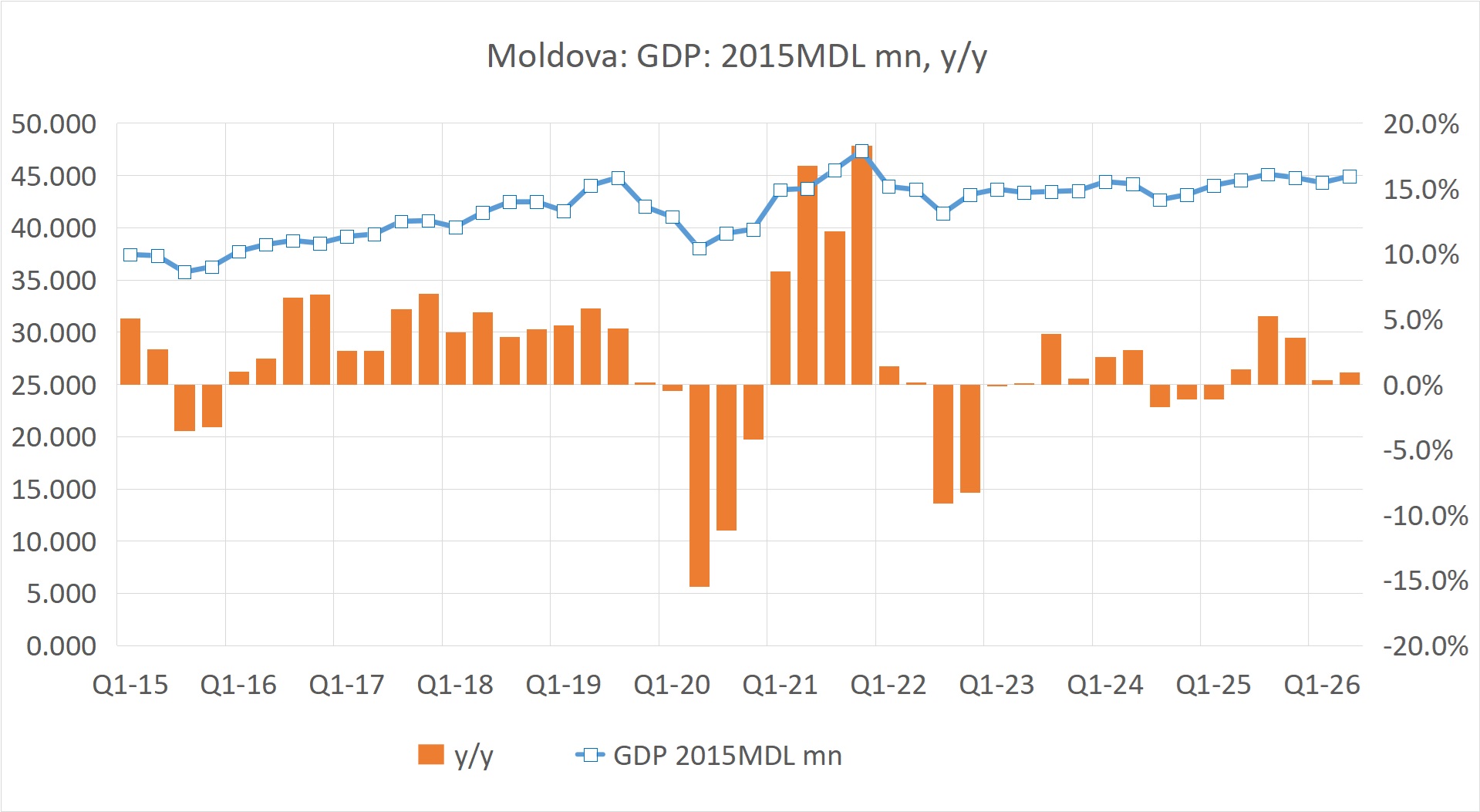
Moldova’s GDP growth accelerates to 0.9% y/y in Q2 but remains modest in H1


Moldova’s GDP growth (chart) accelerated to 0.9% y/y in the second quarter of 2026 from 0.4% in the first quarter, bringing growth for the first half of the year to 0.6%, according to data from the National Bureau of Statistics (BNS).
Moldova’s Ministry of Economic Development and Digitalisation has cut its 2026 GDP growth forecast by 0.4 percentage points to 1.8%, citing weak investment and a challenging external environment, according to the ministry's latest forecast update published in August. Growth forecasts for subsequent years were also lowered, to 2.8% in 2027, 3.2% in 2028 and 3.4% in 2029.
Also in August, Fitch cut its forecast for Moldova's economic growth in 2026 to 1.7% from 2.9%, citing the continuing impact of high inflation on domestic demand and risks to external demand, particularly in the EU. Growth is expected to recover gradually towards potential of about 3.8% in 2027-28, supported by higher public investment under the RGF, lower inflation and real wage growth.
In seasonally adjusted terms, GDP increased 1.4% q/q in Q2, reversing most of the 1.8% contraction accumulated over the previous two quarters. However, economic output remained broadly unchanged for a fourth consecutive quarter.
Moldova’s GDP reached MDL88.3bn (€4.4bn) in nominal terms in Q2, while GDP for the four quarters through June stood at MDL364bn (€18.3bn).
Manufacturing, utilities and agriculture recorded positive annual growth and contributed to GDP growth in both Q2 and H1. Their combined advance was largely offset by construction and services, where gross value added was broadly unchanged, leaving the overall increase in GDP driven entirely by stronger net taxes on products.
Manufacturing gross value added rose 6.7% y/y in Q2 and contributed 0.5 percentage points to annual GDP growth. Utilities increased 21% and contributed 0.3pp, while agriculture expanded 9.4%, also contributing 0.3pp.
Construction was the main drag, with gross value added falling 7.5% y/y and reducing GDP growth by 0.5pp in Q2. Information technology and communications also weakened, with value added down 7.9% and a 0.6pp negative contribution.
Sectoral trends were broadly similar in the first half as a whole.
On the demand side, household consumption increased 1.2% y/y in Q2 and 1.5% in H1. Gross fixed capital formation rose 3.2% y/y in Q2 but remained 1.4% lower over H1 following its contraction in the first quarter. External demand proved robust, with exports -- one third og GDP in Q2 and slightly more in H1 -- advancing by double-digit rates in both Q2 (+13.6% y/y) and H1 (+12.2% y/y).
Despite the high gross exports, the overall chronic net imports remained substantial, accounting for 23.5% of total domestic demand, comprising household consumption and investment, in both Q2 and H1.
Unlock premium news, Start your free trial today.