
Last strongmen standing


Albania's Edi Rama and Slovakia's Robert Fico are now the longest-serving leaders in Central and Southeast Europe, after Serbia's Aleksandar Vucic conceded defeat in the general election on October 25.
After two years of anti-government protests, Vucic resigned as Serbia's president in September to run for prime minister in the snap vote. Instead, the Student List that grew out of the protests won 52.7% of the vote against 39.2% for the list grouped around Vucic's Serbian Progressive Party (SNS), according to Election Commission data. Turnout was the highest since the break-up of Yugoslavia.
"It is clear that we have lost these elections," Vucic said, conceding defeat. He had spent just over 12 years at the top of Serbian politics, first as prime minister from 2014 and then as president from 2017, while the SNS has governed since 2012.
His fall comes six months after Viktor Orban was voted out in April after 16 consecutive years as Hungary's prime minister, nearly 20 years in total including his first term in 1998-2002. Peter Magyar, a former insider in Orban's Fidesz who was sworn in on May 9, has since retroactively limited prime ministers to eight years in office, while his government probes suspected corruption from the Orban era.
The two defeats remove some of the region's most entrenched elected leaders within a single year and leave a very different picture behind them. In the EU's eastern members and the Western Balkans, the long-serving leaders who remain have mostly built their tenure in instalments, losing power and winning it back. Further east, in the countries of Central Asia, the Caucasus and Belarus, rated authoritarian regimes by Freedom House, the list is dominated by presidents who have rewritten constitutions to stay on.
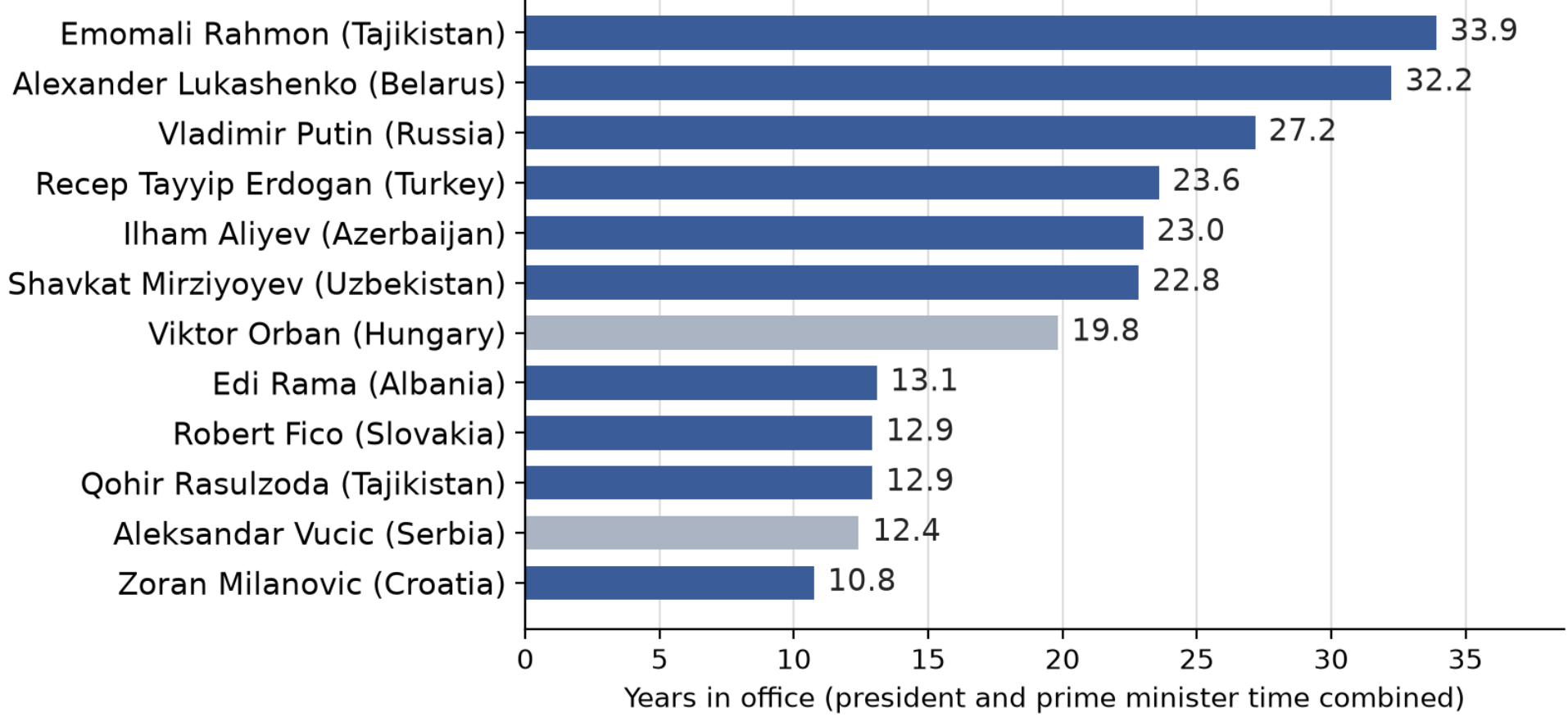
Years in office of the longest-serving presidents and prime ministers in the region, president and prime minister time combined, to October 26, 2026. Orban and Vucic, both out of office, in grey. Source: IntelliNews calculations.
Rama under pressure
Rama has been Albania's prime minister for just over 13 years, since September 2013, and won a fourth consecutive term in May 2025. A former artist and mayor of Tirana, he currently faces the most sustained street opposition of his tenure.
The "Flamingo Revolution" began on May 30 over a luxury tourism project near the protected Vjosa-Narta wetlands at Zvernec, linked to US President Donald Trump's son-in-law Jared Kushner's investment firm Affinity Partners, and passed 100 days in September with demands for Rama's resignation, a technical government and new elections. A separate wave of student protests over conditions in education began on October 13. Unlike the Flamingo Revolution, the protests have repeatedly erupted into violent clashes, with protesters throwing stones and Molotov cocktails and police using tear gas.
Rama has rejected calls to step down. His appeals for dialogue have been fiercely rejected; chairs set outside his office as an invitation to talks were repeatedly overturned or set ablaze by protesters. In a partial concession to protesters, he ordered ministers to seek resignations from officials across central and local government, and more than 90% of senior officials had handed in their resignations by October 23, local outlet CNA reported. Then on October 26 he proposed tougher protest laws, with fines for unauthorised demonstrations and legal action against people posting calls for violence online.
Whether he lasts depends on whether the protests can do in Tirana what they did in Belgrade. The Serbian movement took almost two years, from the November 2024 collapse of a railway station canopy in Novi Sad that killed 16 people to this month's vote, and in the end it removed Vucic at the ballot box, not on the street. Rama's Socialists hold a parliamentary majority and the next regular election is not due until 2029, so the protesters have no comparable opening unless the government breaks first.
The comeback leaders
Fico, at 12.9 years, is the clearest example of longevity in instalments. He has been Slovakia's prime minister three times: from 2006 to 2010, from 2012 to 2018, when he resigned amid mass protests over the murder of investigative journalist Jan Kuciak and his fiancee, and again since October 2023. He survived an assassination attempt in May 2024.
His third government has faced regular mass protests since it was formed, most recently a rally of thousands in Bratislava on October 17 at which demonstrators chanted "Russians go home" over the cabinet's Kremlin-friendly stance. In an Ipsos poll for Dennik N published on October 21, the opposition Progressive Slovakia sat narrowly ahead of Fico's Smer, with opposition parties on a combined 49% against 27% for the ruling coalition, ahead of the election due to take place next September.
Poland's Donald Tusk follows the same pattern: prime minister from 2007 to 2014, president of the European Council from 2014 to 2019 and back as prime minister since December 2023, for 9.7 years in the top job in all. His Civic Coalition led an IBRiS poll for Polsat News on October 20 with 27.8%, but the four governing parties together trailed Law and Justice and the two far-right Confederation parties, 40.4% to 43.2%, ahead of the 2027 election.
Slovenia's Janez Jansa has been prime minister four times, most recently since June 2026, adding up to about 7.7 years. On October 26 he said Slovenia would block progress on Serbia's EU accession talks until Belgrade hands over the archives of the former Yugoslav secret services.
Croatia has had the same two men at the top for a decade. Andrej Plenkovic has been prime minister since October 2016, just over 10 years, while his rival Zoran Milanovic, prime minister from 2011 to 2016, has been president since February 2020 and was re-elected in January 2025, giving him 10.8 years in the two top jobs.
In the EU's eastern members, voters threw Fico, Tusk and Jansa out at least once, and each returned after a spell in opposition. Their long totals add up spells of power separated by defeats.
Orban, Vucic and Rama, in his 13 unbroken years, each built a dominant party that critics accuse of capturing state institutions, public media and patronage networks, charges rejected by their governments.
The two who fell share several features. Neither was beaten by the traditional opposition. Orban lost to Magyar, a defector from his own camp with a new party, Tisza, and Vucic lost to a student movement that kept its distance from the established opposition parties. Both challengers ran on anger over corruption and the capture of state institutions. In both cases the end came through an election, not a street revolt.
Rama faces a movement that, like Serbia's, rejects both the government and the traditional opposition led by Sali Berisha, with protesters chanting "Rama in prison, Berisha in prison".
No exit in the East
East of the EU and Western Balkans, longevity is the rule. Tajikistan's Emomali Rahmon has led the country since 1992 and Belarus' Alexander Lukashenko since 1994, the two longest-serving leaders in the region at 33.9 and 32.2 years respectively. Russia's Vladimir Putin has held the presidency or the premiership since August 1999, adding up to a total of 27.2 years.
Turkey's Recep Tayyip Erdogan, 23.6 years as prime minister and president, Azerbaijan's Ilham Aliyev, 23.0 years, and Uzbekistan's Shavkat Mirziyoyev, 22.8 years as prime minister and then president, complete a group in which almost every leader has changed or reset constitutional limits on his time in office. Tajikistan's prime minister Qohir Rasulzoda, in office since 2013, and Uzbekistan's Abdulla Aripov, since 2016, serve presidents who hold the real power.
None of them faces an election the opposition is in a position to win, and nothing like this year's defeats in Budapest and Belgrade is in prospect there.
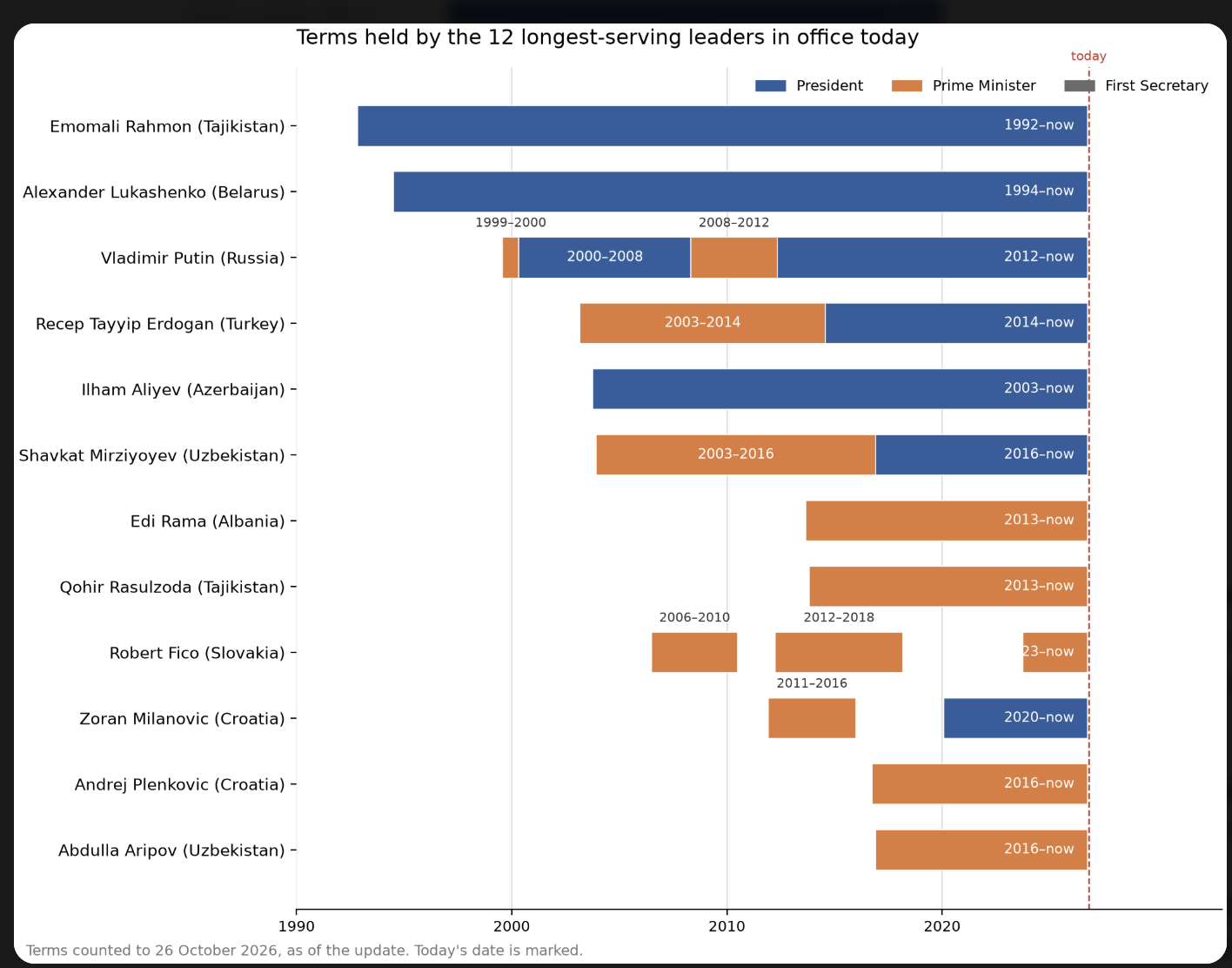
Terms held by the 12 longest-serving leaders in office today, as president or prime minister, counted to October 26, 2026. Source: IntelliNews calculations.
The top 10 longest-serving leaders in office
|
1. Emomali Rahmon (Tajikistan) - 33.9 years: Head of state since November 1992, first as chairman of the Supreme Council and as president since 1994. A 2016 referendum lifted presidential term limits for him. His son Rustam Emomali, speaker of the upper house of parliament, is widely seen as his successor. |
|
2. Alexander Lukashenko (Belarus) - 32.2 years: President since July 1994, the only leader independent Belarus has had since then. A 2004 referendum removed term limits. He crushed mass protests after the disputed 2020 election and claimed a seventh term in January 2025. |
|
3. Vladimir Putin (Russia) - 27.2 years: Prime minister in 1999-2000, president 2000-2008, prime minister again 2008-2012 and president since 2012. Constitutional amendments in 2020 reset his term count, allowing him to stay in office until 2036. Re-elected in March 2024. |
|
4. Recep Tayyip Erdogan (Turkey) - 23.6 years: Prime minister from 2003 to 2014 and president since 2014. A 2017 referendum created an executive presidency. Re-elected in May 2023; his main rival, Istanbul mayor Ekrem Imamoglu, was jailed in March 2025. |
|
5. Ilham Aliyev (Azerbaijan) - 23.0 years: President since October 2003, when he succeeded his father Heydar Aliyev. A 2009 referendum abolished term limits and a 2016 vote lengthened the presidential term to seven years. Re-elected in a snap vote in February 2024 after retaking Karabakh. |
|
6. Shavkat Mirziyoyev (Uzbekistan) - 22.8 years: Prime minister from 2003 to 2016 and president since the death of Islam Karimov in 2016. A 2023 constitutional referendum extended the presidential term to seven years and reset his term count; he was re-elected in July 2023. |
|
7. Edi Rama (Albania) - 13.1 years: Prime minister since September 2013 and leader of the Socialist Party. A former artist and mayor of Tirana, he won a fourth consecutive term in May 2025 and now faces months of street protests demanding his resignation. |
|
8. Robert Fico (Slovakia) - 12.9 years: Prime minister in 2006-2010, 2012-2018 and since October 2023, leader of Smer. Resigned in 2018 after protests over the murder of journalist Jan Kuciak, returned five years later and survived an assassination attempt in May 2024. |
|
9. Qohir Rasulzoda (Tajikistan) - 12.9 years: Prime minister since November 2013, previously governor of the northern Sughd region. Runs the government under President Rahmon, who holds executive power. |
|
10. Zoran Milanovic (Croatia) - 10.8 years: Prime minister from 2011 to 2016 for the Social Democrats and president since February 2020. Re-elected in January 2025, he has spent much of his presidency in open conflict with Prime Minister Andrej Plenkovic. |
Unlock premium news, Start your free trial today.


