
Japan doubles ETF sell-off as the rest of Asia goes all-in on index funds


The Bank of Japan will sell off its exchange-traded fund hoard at more than double the current pace from January 2027, just as Asian savers pour record sums into ETFs.
At its October 29-30 meeting the BoJ's board voted unanimously to lift annual ETF sales to about JPY860bn ($5.46bn) at book value, from about JPY330bn ($2.09bn), according to its statement on monetary policy. Converted at market prices, the new pace is about JPY2.46 trillion a year. Sales that began in January 2026 had gone smoothly while turnover on the Tokyo bourse kept rising, the bank said, so disposals will now equal about 0.1% of trading value instead of 0.05%.
The speed-up shortens the timetable dramatically. A BoJ reference paper puts the time needed to clear the portfolio at about 43 years, against about 112 at the old rate. The policy rate was left at 1.25% on an 8-1 vote.
For more than a decade the BoJ bought index funds as a tool of monetary policy. Across the rest of Asia the buyer that now sets the tone is a household with a brokerage app, and governments from Seoul to Jakarta are rewriting rules to steer more savings into listed funds. The shift is fast, uneven and, in places, already volatile.
South Korean individuals bought a net KRW80.02 trillion ($60bn) of ETFs between January 1 and October 23, more than double their KRW35.21 trillion for all of 2025, according to Korea Exchange figures carried by SBS Biz. Foreign investors, who put in only KRW1.66 trillion last year, have added KRW10.68 trillion.
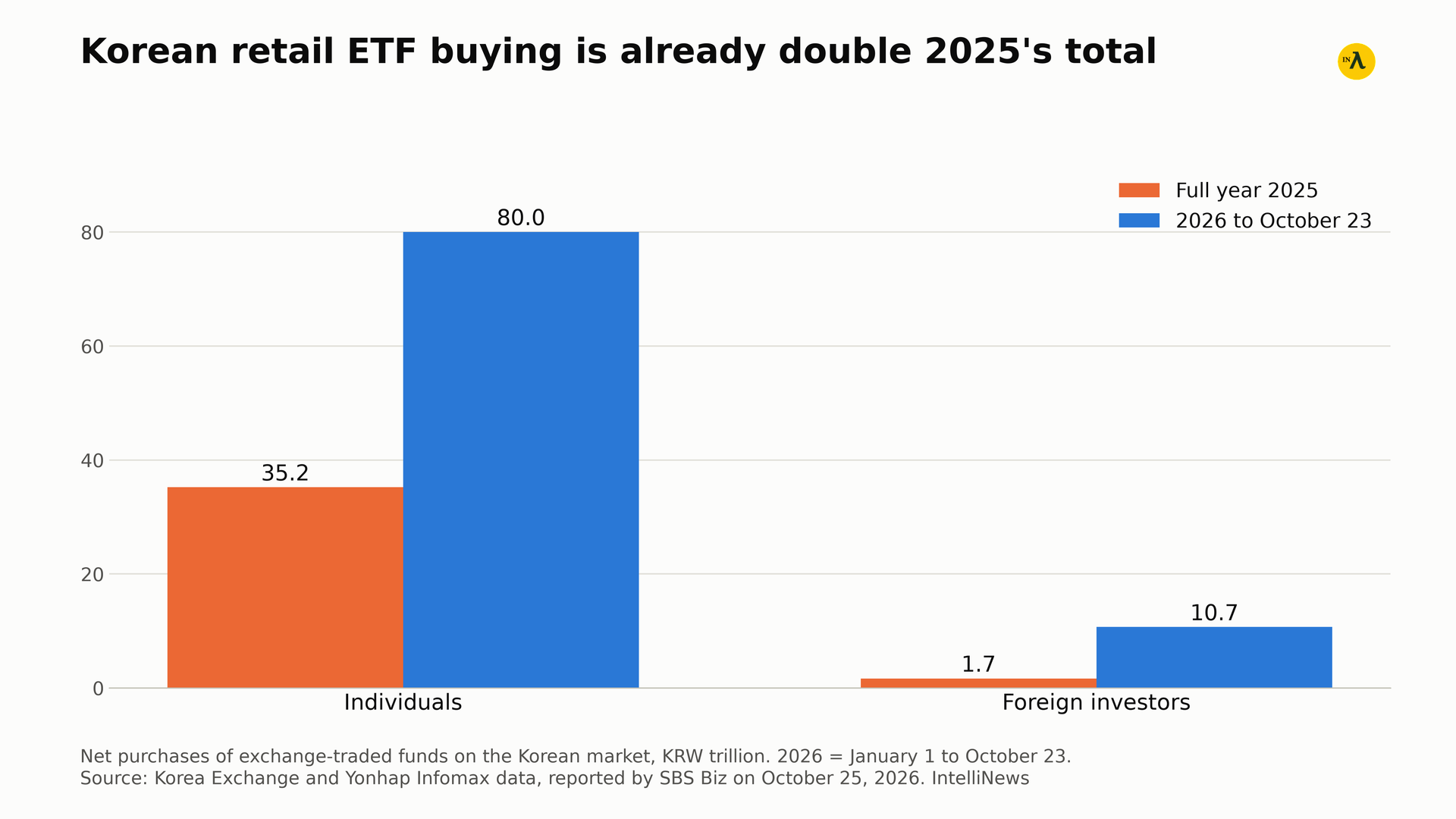
Net purchases of ETFs on the Korean market by investor type, KRW trillion. Source: Korea Exchange, Yonhap Infomax. IntelliNews
By June 25 the market's ETF net assets had reached KRW519.75 trillion, overtaking the KRW499.3 trillion value of the whole Kosdaq, the Korea Times reported, citing the exchange. Regulators fed the boom by clearing single-stock ETFs on Samsung Electronics and SK hynix from April 28, with gearing capped at two times, and then by opening the market to foreign buyers. Buyers of the leveraged products now have to sit two hours of compulsory training before they trade, double the previous requirement.
The ride has been rough. The Kospi set a record close of 9,114.55 on June 22 and had slid into the 6,000s by mid-July. ETF sales through the five biggest banks dropped from KRW15.32 trillion in May to KRW463.4bn in the first 20 days of August. Many traders took their appetite to Wall Street, buying a net $3bn of a triple-leveraged US chip ETF in July and August. Even the Bank of Korea joined in, taking a $250mn stake in the SPDR Gold Trust in 2Q26, its first gold purchase since 2013.
Taiwan's craze is concentrated in a single fund. The Yuanta Taiwan Top 50 ETF (0050) managed TWD2.50 trillion ($76.6bn) on October 29, up TWD1.48 trillion, or 146%, since the start of the year, Taiwan Stock Exchange data show. Its holders numbered 3.72mn on October 22, 1.68mn more than at the start of the year. Dividend funds come next in size: the Yuanta Taiwan Dividend Plus ETF (0056) has grown 62% this year to TWD843.7bn.
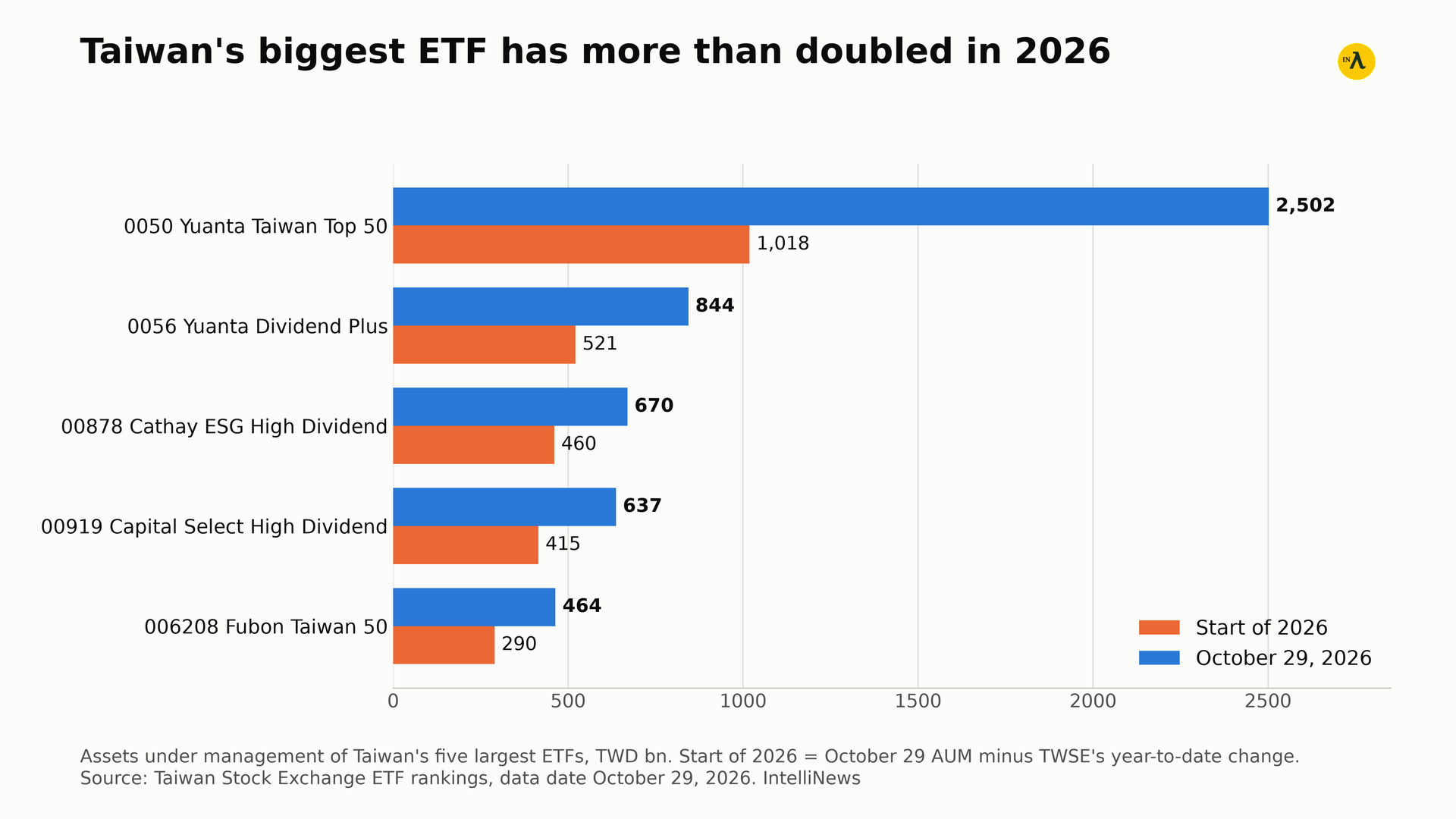
Assets of Taiwan's five largest ETFs, TWD bn. Source: Taiwan Stock Exchange. IntelliNews
Active management is the next leg. UPAMC's Taiwan Growth Active ETF has grown 441% this year to TWD272.4bn, and Schroders is preselling its first active ETF in Asia, an AI fund, through LINE Bank, which says nearly 60% of subscriptions to new ETFs arrive between 6pm and 8am.
China is moving the other way. Chinese ETF assets fell 17.4% to $699bn in 1Q26 after a record CNY805bn ($120.9bn) left broad-based equity funds, letting Japan reclaim first place in the region with $728bn, Morningstar data showed.
“The pullback was driven by heavy redemptions from China-domiciled broad-based equity ETFs,” said Jackie Choy, senior principal for global passive investment strategy ratings at Morningstar, in comments carried by Asia Asset Management in June.
Hong Kong offers a warning for newcomers, however. The city held just $733mn of the $172.9bn in global crypto exchange-traded products in late September, CoinShares data show, as Thailand opened its own bourse to bitcoin and ether ETFs on October 16.
In India the favoured ETF is gold. Net inflows into gold ETFs hit INR240.40bn ($2.53bn) in January, Association of Mutual Funds in India data show, before an INR7.25bn outflow in May, the only negative month of the year so far. Inflows recovered to INR44.51bn in September, and assets stood at INR1.73 trillion at the end of July.
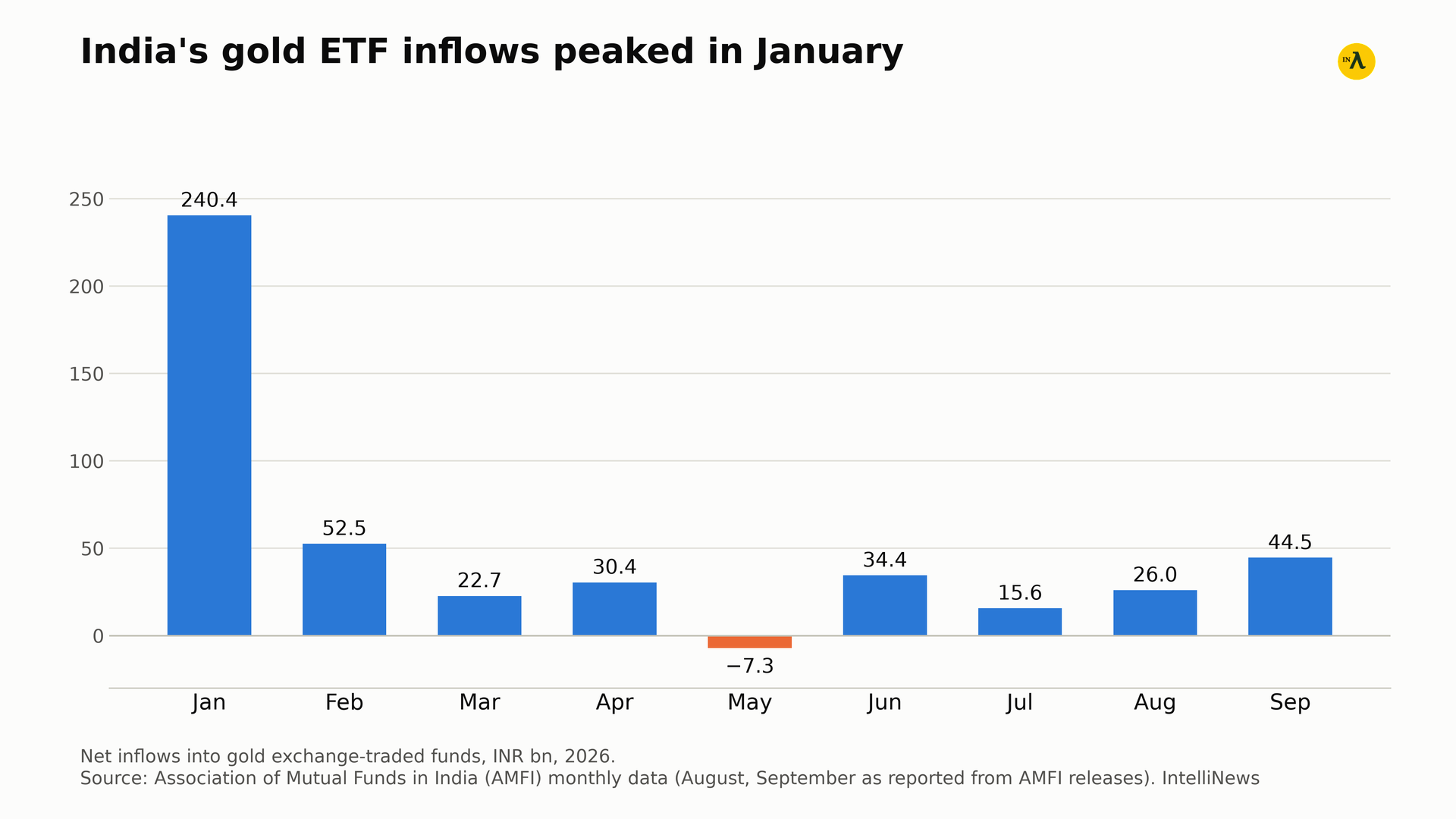
Net inflows into India's gold ETFs by month, INR bn, 2026. Source: AMFI. IntelliNews
Pension money could add to that demand. Rules issued in December 2025 let the $184bn National Pension System buy gold and silver ETFs for the first time.
Southeast Asia is still laying the pipes. Indonesia's stock exchange listed a sharia-compliant gold ETF on August 10, a product that Financial Services Authority chair Friderica Widyasari Dewi said had taken 10 to 15 years of research. Singapore's exchange counted 54 ETFs with more than SGD21bn ($16.4bn) in assets after an active mid-cap fund listed in September. In Vietnam, Phu Hung Fund Management chief executive Lu Hui Hung reckons passive ETFs could bring about $1.7bn once FTSE Russell's upgrade of the market takes effect.
This article was produced with the help of IntelliNews Lambda analytical tool
Unlock premium news, Start your free trial today.


