
Germany’s hydrogen pipeline network races ahead of electrolysis capacity


Germany will nearly triple its working hydrogen pipeline network to around 1,500 km by end-2027, for hydrogen it still doesn't produce. Germany's operational electrolysis capacity ot make hydrogen stood at only 181 MW at the start of 2026, against a 10 GW target for 2030.
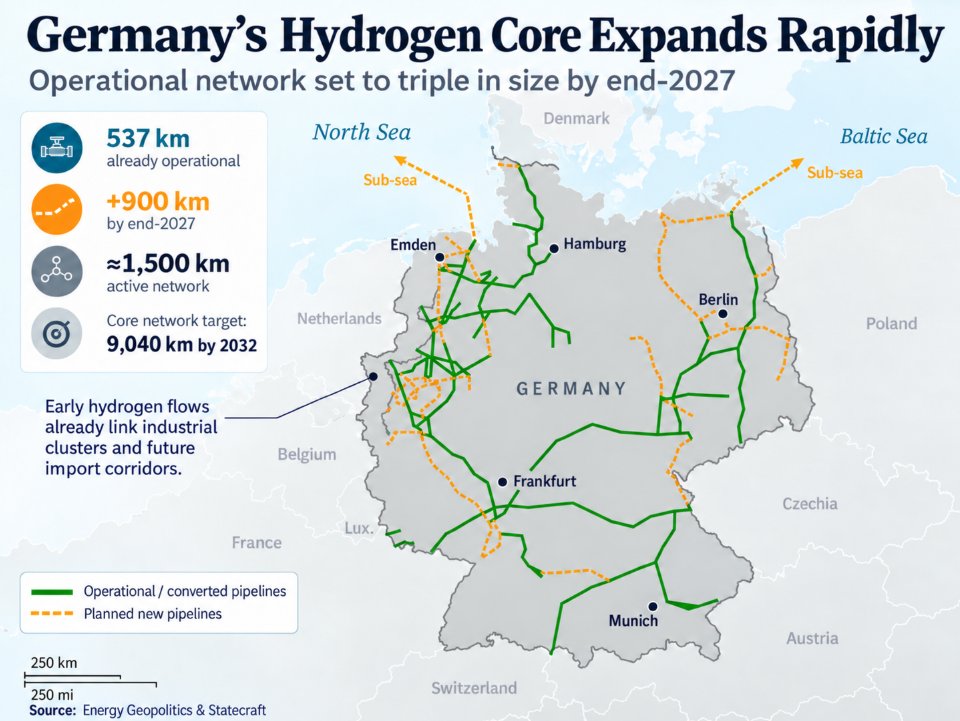
Germany's hydrogen core network: operational or converted pipelines (green) and planned new lines (orange). The map is schematic. Source: Energy Geopolitics & Statecraft, via Francesco Sassi (@Frank_Stones)
Gas transmission operators had 537 km of hydrogen pipelines in service on the second anniversary of the network's approval and will add another 900 km this year and next, their industry association FNB Gas said on October 22. Most of what is running is converted natural gas pipe: 507 km of the lines readied last year, the longest a 400 km stretch from Lubmin on the Baltic coast to Bobbau in Saxony-Anhalt that GASCADE filled with hydrogen in December 2025.
The country is putting the pipeline horse before the production cart. Germany had only 181 MW of electrolysis capacity in operation at the start of 2026, against a target of 10 GW by 2030. The country is building expensive network assets before a viable hydrogen market exists, and the state has promised to pick up most of the bill if the customers never arrive, according to energy analyst Francesco Sassi, author of the Energy Geopolitics & Statecraft newsletter.
"The network operators have delivered: the first pipelines are in the ground and industry is reserving transport capacity. But every further pipeline needs customers, and every new customer needs enough hydrogen," FNB Gas managing director Barbara Fischer said. "Only if supply and demand keep growing will the core network as a whole be a success."
A network ahead of its customers
The Bundesnetzagentur approved the 9,040 km core network, the Wasserstoff-Kernnetz, in October 2024 at an estimated cost of €18.9bn, with completion due in 2032. About 60% of it is converted gas pipeline and the rest new build, linking industrial clusters in the Ruhr and the east German chemical triangle to storage sites, ports and import corridors.
The second draft of the first joint gas and hydrogen network development plan (NEP 2025) foresees a 9,241 km hydrogen transmission system by 2037 and total investment of €24bn, FNB Gas said. Presenting the first draft in March, Fischer said network expansion would cost about 30% more than earlier scenarios assumed, mainly because of higher material and construction costs, the utilities trade paper ZfK reported.
Shippers have been able to book binding entry and exit capacity on the network since March 19, and paid reservations reached just under 6 GW by the latest deadline, double the level in May. Those bookings have not yet turned into firm offtake contracts, according to Sassi.
Electrolysers stall
The 181 MW figure comes from an analysis of electrolysis projects by the Institute of Energy Economics at the University of Cologne (EWI) published in January. A further 1.3 GW had reached a final investment decision or was under construction, so up to 1.5 GW could be running by end-2027. Even if every project announced for completion by 2030 were built, capacity would reach 8.7 GW, and almost 3 GW of schemes had already been struck off EWI's database as cancelled or dormant.
EWI blamed high production costs, buyers' low willingness to pay and regulatory uncertainty. Delays were visible early: Shell's 100 MW Refhyne 2 electrolyser at its Rheinland refinery reached a final investment decision only in July 2024, two years later than first planned.
The taxpayer's guarantee
Operators recover their costs through a uniform ramp-up tariff, which the Bundesnetzagentur set at €25/kWh/h/a in July 2025, so that the first users do not pay for an empty network. The gap between fee income and costs in the early years is paid out of an amortisation account funded by a KfW credit line of up to €24bn, to be repaid from surplus fees as traffic grows, by 2055 at the latest.
If the account is still in deficit in 2055, the federal government covers 76% of the shortfall and the network operators the remaining 24%. With hydrogen-fired power plants that were meant to be big customers delayed, the state may end up carrying that 76% share, according to Sassi.
FNB Gas wants still more protection. Fischer called for financing terms for the core network that "adequately reflect" the operators' ramp-up risks, along with an extension of Germany's climate protection contracts for industry and state backing for import corridors.
Brussels lowers its sights
The European Commission opened a consultation on a renewed hydrogen strategy on October 26, running to November 23. Its call for evidence says renewable and low-carbon hydrogen is developing more slowly than expected because of "high costs, limited demand, investment uncertainty and infrastructure constraints", and that planned projects fall short of the estimated 3-4mn tonnes of renewable hydrogen needed by 2030 to meet the EU's consumption targets.
That is a long way below the REPowerEU ambition of 10mn tonnes of domestic production plus 10mn tonnes of imports by 2030, which the European Court of Auditors said in July 2024 needed a "reality check". A draft Commission impact assessment on the post-2030 renewables framework floated replacing binding national renewable hydrogen quotas with an indicative EU-wide consumption target of 8mn tonnes a year by 2040, Argus reported on September 10.
Imports to fill the gap
Berlin already expects to buy most of its hydrogen abroad. Its import strategy, adopted in July 2024, puts national demand for hydrogen and its derivatives at 95-130 TWh in 2030, of which around 50-70% (45-90 TWh) would have to be imported.
However, that international supply doesn't exist yet either. The world's two largest makers of hydrogen are the US and China. China accounted for almost 30% of global output of nearly 100mn tonnes in 2024—roughly 30mn tonnes. The US Department of Energy puts US production at approximately 10mn tonnes annually. However, they are likely to consume their entire production for domestic needs leavnig almost nothing for export.
Transporting hydrogen over such long distances is a seperate headache as hydrogen liquifies at -253C - 20C above absolute zero, the second lowest liquidification point of all elements after helium. That is a very expensive process and evapouration while in transit is a major problem.
Algeria, Tunisia, Italy, Austria and Germany signed the Algiers Declaration on the SoutH2 Corridor in October, a pipeline project meant to carry up to 4mn tonnes a year of green hydrogen north from Algeria, largely through converted gas lines, and a German trade mission toured Algeria and Tunisia in September looking for projects. Germany's H2Global auctions have bought derivatives from further afield: the first round gave Fertiglobe a contract to ship green ammonia from Egypt at €1,000 per tonne, and India's AM Green won the Asia lot of the second round with a ten-year deal worth at least €585mn, Argus reported on September 30.
Relying on imports for half or more of demand by 2030 exposes Europe to new geopolitical, transport and conversion risks along the North African and Iberian corridors, according to Sassi. FNB Gas chairman Matthias Jenn sees the opposite outcome, saying a successful ramp-up would make Germany "less dependent on individual countries from which we import energy".
Unlock premium news, Start your free trial today.


